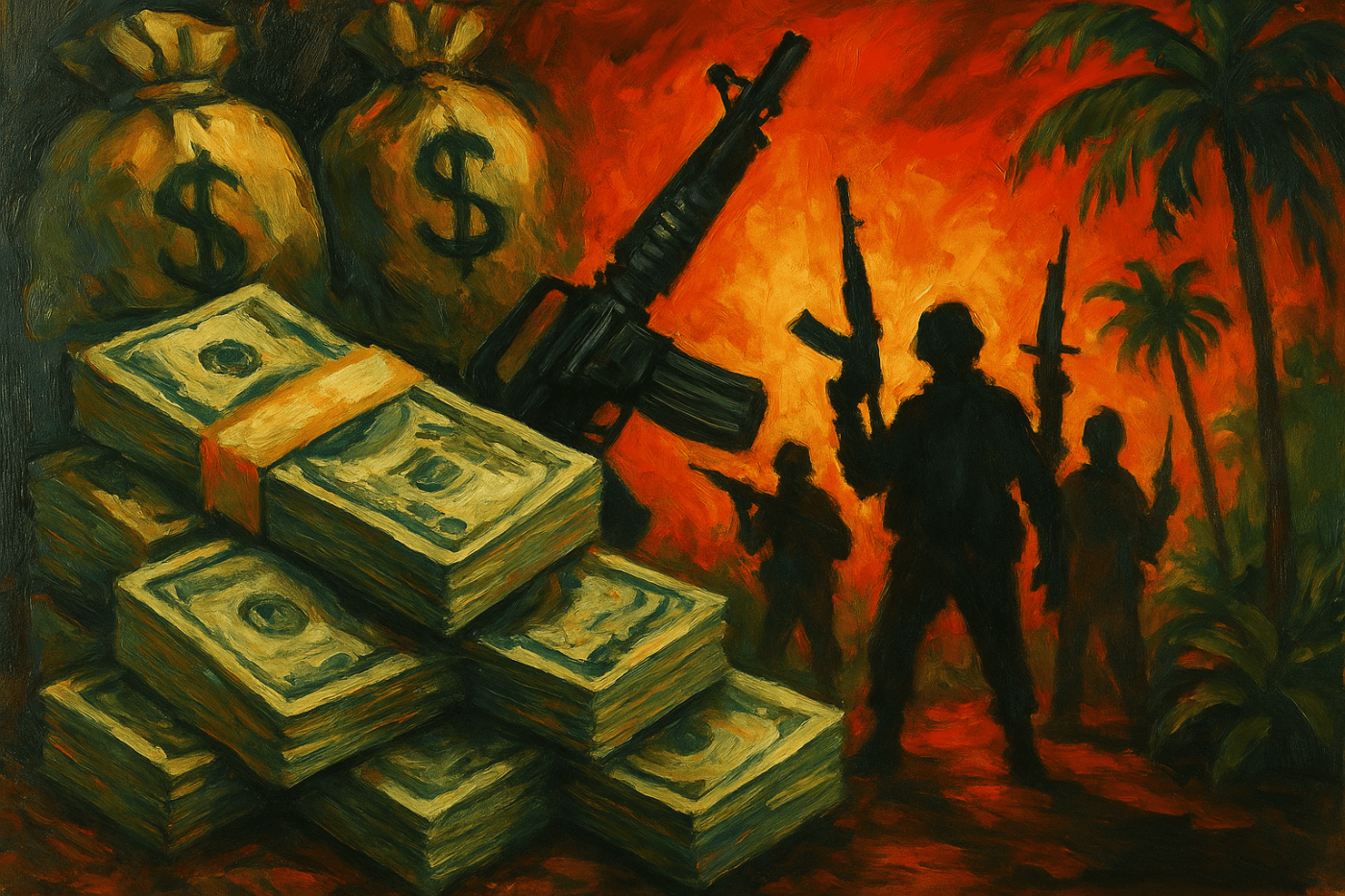
Empire Armed the Cartels: Narco-Capitalism, Money Laundering, and the Machinery of Repression
The drug war isn’t a failure. It’s the business model. From CIA planes to HSBC accounts, empire moves dope, launders the cash, and locks up the poor—while the real criminals wear suits and run the banks.
By Prince Kapone | Weaponized Information | May 10, 2025
Part I: Excavation – NewsNation, Cartel Theater, and the Empire’s Invisible Trigger Finger
The NewsNation article in question, authored by Robert Sherman, isn’t journalism—it’s imperial anesthesia. NewsNation presents itself as a centrist antidote to partisan media, but in practice it’s another delivery system for sanitized empire propaganda. Sherman doesn’t investigate power—he stenographs it. His coverage repackages law enforcement press releases as analysis, reinforcing state narratives while feigning neutrality.
Take the central quote: Mexico’s Secretary of Public Safety, Rosa Icela Rodríguez, stating that three out of four guns seized from cartels originate in the United States. This should have exploded across every network. Instead, Sherman buries it under layers of bureaucratic bromides—“interdiction,” “regional coordination,” “joint enforcement.” The explosive core is defused through tone and omission. Nowhere is there mention of Operation Fast and Furious, the U.S. program that knowingly armed Mexican cartels with assault rifles under ATF surveillance. Nowhere does Sherman address the U.S. gun lobby’s ongoing sabotage of export restrictions or enforcement measures.
The article pivots rapidly away from Rodríguez’s damning indictment, offering no historical context, no forensic trail, no data. Sherman doesn’t ask how these weapons move, who profits from the flow, or how U.S. arms policy enables it. Instead, we’re given vague calls for “cooperation” and “oversight”—technocratic euphemisms designed to diffuse accountability. What we’re left with is an empty performance: the empire’s fingerprints are wiped from the murder weapon.
This is how imperial media manages damage control. NewsNation neutralizes the explosive implications of its own reporting by deleting context and avoiding causality. It removes U.S. arms manufacturers from the story entirely. No mention of Smith & Wesson stock prices. No mention of congressional legislation kneecapped by weapons lobbyists. No mention of how these weapons travel through legal loopholes, straw purchasers, and deregulated channels.
Sherman’s role is clear: not to inform, but to anesthetize. His narrative reinforces the border-industrial complex’s central myths—Mexico is unstable, cartels are irrational, and the U.S. is a benevolent actor trying to restore order. The fact that U.S. foreign and domestic policy fuels the very violence it condemns never enters the frame.
And then there’s the omission of scale. Not just in body counts, but in arms trafficking logistics. No investigation into where the weapons originate, which manufacturers they come from, how they evade regulation, or how many times U.S.-sourced rifles have turned up at massacre sites. The story is flattened into abstraction, stripped of blood, stripped of blame.
This is not a failure of journalism—it’s its function under empire. Sherman plays the role of narrative engineer, guiding readers away from structural understanding and toward emotional fatigue. He doesn’t cover the crime scene—he scrubs it.
But we know the truth. We know that U.S. gun policy is a colonial export system. That cartels are armed through legal commerce. That deregulation isn’t a loophole—it’s a weapon. And that when the U.S. media points to “crisis” south of the border, it’s usually projecting the violence already built into its own economy.
Mexico is not imploding. It is being detonated—by U.S. foreign policy, by arms manufacturers, and by a propaganda machine that knows exactly how to hide the bodies. Every bullet has a serial number. Every gun has a ledger. And every “balanced” headline that ignores this is part of the cover-up.
Part II: From CIA Cocaine to Citibank Cash – The Empire Behind the Trigger
If the NewsNation article anesthetized the crime scene, Fox News went further—burying the body and blaming the neighbors. Their report dutifully repeats Rodríguez’s explosive claim that 75% of cartel weapons come from the United States—but only to pivot away from it, flooding the narrative with fear-mongering about “border security,” Cuba, and China. No follow-up, no forensic trail, just misdirection and moral panic.
But here’s the thing: the cartels are not a rogue element. They are embedded logistics in the global supply chain of empire. Fed by U.S. arms, financed by U.S. banks, and shielded by U.S. intelligence priorities, they are a paramilitary extension of capitalist crisis management. The so-called “drug war” is not about prohibition. It’s about domination—of labor, land, and life.
Start with the historical record. From the Vietnam War’s Air America flights trafficking heroin to U.S. bases, to the Contras in Nicaragua bankrolled by cocaine and blessed by Reagan’s White House, to Barry Seal’s operations out of Mena, Arkansas—every major U.S. conflict since 1945 has carried a narcotic subtext. Drugs paid for wars. Drugs destabilized dissent. Drugs neutralized Black radicalism and Latin American sovereignty.
And then came Los Angeles. The CIA’s role in flooding Black communities with crack cocaine during the Contra War was exposed by journalist Gary Webb—a man who paid with his life for printing the truth. His 1996 Dark Alliance series didn’t just uncover a scandal. It revealed an operational blueprint: move dope through sanctioned networks, target colonized communities, generate cash off-the-books, and crush revolutionary potential before it blooms.
But the cocaine didn’t just get sold—it got laundered. Wachovia Bank was caught in 2010 having cleaned over $378 billion for Mexican drug cartels through wire transfers, traveler’s checks, and cash shipments. That’s not a typo—billion. Nobody went to prison. The bank paid a fine. In 2012, HSBC admitted to laundering $881 million for drug traffickers and terrorist organizations. The penalty? Another fine. No indictments. No headlines.
In 2019, 20 tons of cocaine—worth $1.3 billion—were found aboard the MSC Gayane in Philadelphia. The ship was operated by Mediterranean Shipping Company, but had been financed in part through a JPMorgan Chase-managed investment fund. JPMorgan distanced itself immediately. No charges were filed. The banks always walk clean—even when the cargo bay is full of imperial powder.
This is not negligence. It is imperial accounting. The drug trade is allowed to exist—not despite the war on drugs, but because of it. Its profits backstop liquidity shortfalls. Its violence justifies domestic militarization. Its chaos helps displace populations, suppress labor, and weaken anti-imperialist movements across Latin America.
The cartels are not external enemies. They are paramilitary partners. Narco-capitalism is a political economy. A system in which violence becomes a form of currency, and repression a form of investment. It’s why DEA agents turn a blind eye at the ports, why cartel leaders often carry satellite phones bought with Pentagon funds, and why prisons across the U.S. are filled with Black and Brown youth criminalized for petty drug charges while not a single banking executive has been jailed for laundering billions.
Every stage of this economy is imperial by design:
- Weapons move south, creating chaos and casualties.
- Drugs move north, flooding communities already under siege.
- Profits flow through HSBC, Wachovia, and Wells Fargo—then back into the empire’s bloodstream.
This is not a malfunction. This is the model.
The result? The hood becomes a warzone. Latin America becomes a staging ground for “counter-narcotics” operations that double as counter-insurgency. Meanwhile, Wall Street banks become central nodes in what should rightfully be called narco-finance capital.
And Fox News? They rant about Cuba. About Chinese “espionage.” About fentanyl from China. But they never explain how those drugs enter the country, how weapons leave it, or how the cash circulates back into the vaults of the very institutions underwriting empire.
Because the truth is this: every kilo of cartel cocaine has a flight path. Every gun has a serial number. Every offshore account has a banker. And every piece of this puzzle—trafficking, laundering, policing, media—fits perfectly when you see the whole picture. That picture is narco-imperialism. And its headquarters are in Washington and Wall Street.
Part III: Empire Isn’t Losing Control—It’s Running the Show
Let’s be clear: the United States is not “failing” to stop the drug trade. It is not “losing” control of the cartels. It is managing a transnational system of death and profit with imperial precision. The “war on drugs” is not a war on narcotics—it’s a war on people. A war on migrants, on the colonized poor, on revolutionary movements in Latin America, and on the working class at home.
This is not a conspiracy theory. It’s historical continuity. During the Vietnam War, Air America, the CIA’s proprietary airline, trafficked heroin. During the 1980s, the Iran-Contra operation used cocaine sales to arm death squads in Nicaragua. During the 2000s, Plan Colombia militarized coca-producing regions, not to fight drugs, but to crush peasant resistance and clear land for multinational agribusiness.
Whenever the U.S. needs off-the-books revenue, discipline in the ghettos, or destabilization abroad, narcotics become a tool of statecraft. Drugs are not the enemy. They are the instrument. And the U.S. ruling class doesn’t oppose cartel violence—it regulates it. It doesn’t fear drug profits—it launders them. The only thing it fights is resistance.
In Mexico, the line between cartel and state has all but collapsed. From the municipal level to the federal police, cartel networks function as paramilitary auxiliaries of the state—enforcing order, collecting tribute, and terrorizing dissent. During the presidency of Felipe Calderón (2006–2012), the so-called “war on drugs” unleashed a militarized campaign that fractured cartels, escalated civilian massacres, and embedded armed groups deeper into local governance structures. Rather than dismantle narco-power, Calderón’s offensive restructured it—transforming Mexico into a patchwork of cartel-governed zones, police-linked death squads, and intelligence assets masquerading as traffickers. This wasn’t a failure. It was an outsourcing strategy—an imperial model of low-intensity governance through non-state actors, perfected abroad and mirrored at home.
What we are witnessing is the full maturation of what must be named: narco-technofascism. A political-economic regime where monopoly finance capital fuses with militarized logistics, and narcotics serve as both lubricant and leash. Death becomes a business expense. Surveillance becomes a service. And prisons become warehouses for surplus labor rendered unemployable by austerity and automation.
In this system:
- The cartel enforcer is not an enemy of the state—he is its subcontractor.
- The banker who launders blood money is not prosecuted—he is promoted.
- The DEA agent isn’t stopping the flow—he’s managing supply chains.
- The media anchor doesn’t expose crime—she scripts the cover story.
This is not policy failure. This is imperial logistics.
And the language used to describe it—“instability,” “crisis,” “failed states”—is part of the operation. These are not unintended consequences. They are engineered conditions. The empire requires instability in the periphery to maintain control at the core. Every collapsed municipality, every cartel warzone, every migrant caravan is an output of the same machine that prints Pentagon budgets and bails out Wall Street.
That’s why the United States never truly prosecutes the institutions responsible. Because they are the institutions. Smith & Wesson manufactures the guns. JPMorgan Chase finances the fleets. HSBC launders the proceeds. And the CIA, DEA, and State Department coordinate it all—under the legal fiction of fighting the very violence they enable.
This is not a shadow operation—it is the operating system. A system that rewards death with dividends and criminalizes survival. A system in which the overdose death of a working-class teen becomes a data point in a crisis report, while a bank CEO who facilitated billions in narco-profits is treated to a bonus and a seat at Davos.
The “border crisis” is a political hologram. The real crisis is the unregulated movement of capital, guns, and commodified death across borders—while human beings fleeing violence, poverty, and imperial destabilization are hunted, caged, or drowned. The real border is between capital and life.
There will be no justice from within this system. No solution from the parties that created the crisis. Not from bipartisan task forces, not from Senate hearings, not from NGO summits. The solution lies elsewhere—in rupture. In revolutionary defiance. In dismantling the architecture of narco-capitalism, brick by brick, bank by bank.
Because as long as this system stands, the flow will continue. Guns will go south. Drugs will come north. Blood will spill. And the empire will profit. It is not losing control. It is control.
Part IV: From Dope to Defiance – Building Power Against the Empire’s Drug War
We know who pulls the trigger. We know who profits from the blood. We know the names of the banks, the agencies, the weapons manufacturers, and the media conglomerates that engineer narco-chaos from boardrooms and surveillance bunkers. The question now isn’t whether we can expose them—the record is clear. The task is to organize, to strike, to build revolutionary power where the empire expects only despair.
First, we must unite the social forces most brutalized by this system: the colonized poor, the undocumented, the lumpenproletariat, the carceral class, the youth branded as threats before they ever held a paycheck, the mothers navigating poisoned neighborhoods and buried children. These are not broken people. They are the raw material of rebellion. The drug war doesn’t target them because they are weak—it targets them because they are dangerous to imperial order.
Second, we must support and amplify the resistance already underway. From Chiapas to Chicago, from Bogotá to the Bronx, movements are building power:
- La Voz del Pueblo in Mexico and Honduras—organizing peasants against cartel-state collusion and defending communal land from narco-capitalist seizure.
- Abolitionist collectives and mutual aid networks across the U.S.—building harm reduction sites, political education programs, and direct action campaigns against the prison-police-drug nexus.
- Grassroots movements in Colombia, El Salvador, and Haiti—fighting IMF-imposed austerity and narco-economies through people’s assemblies, land recuperation, and street militancy.
Third, we must shut down the financial arteries of the drug war. If JPMorgan Chase, HSBC, and Wells Fargo are laundering blood money, they are legitimate targets of disruption, boycott, and revolutionary exposure. We must:
- Disrupt their branches and board meetings.
- Call out their complicity in public campaigns.
- Organize bank workers to blow the whistle from within.
- Launch digital sabotage and cyber-disobedience against financial institutions profiting from narco-terror.
Fourth, we must build dual power in the zones empire has abandoned or militarized. This means:
- Establishing people-run harm reduction centers, not NGO-funded projects that depoliticize the crisis.
- Creating revolutionary media to counter the DEA-scripted narratives of mass criminality.
- Reclaiming land for autonomous use—gardens, clinics, safe houses, and political schools.
- Training organizers to politicize the hood, not pathologize it.
The goal is not to “fix” the communities destroyed by narco-imperialism—it’s to arm them politically and structurally to fight back, take power, and rebuild on their own terms.
Finally, we must tell our people the truthyou are not the enemy. Whether you’re hustling on corners in Baltimore, burying a cousin in Juárez, locked in a cell in Atlanta, or watching fentanyl erase your neighborhood block by block—you are not broken. You are part of a global class war. And you have a side to pick.
Every cartel bullet has a manufacturer. Every overdose has a banker. Every prison bed has a contract. But every act of resistance also has a legacy. From the Young Lords distributing clean needles in the South Bronx to the EZLN building anti-narco autonomy in the mountains of Chiapas, we walk in the footsteps of revolutionaries who understood: drugs are not just a scourge—they are a weapon wielded by empire.
Let the next step in that legacy begin now. In the projects, the pueblos, the tent cities, the prisons, and the refugee camps—let it be known: empire armed the cartels, but the people will disarm the empire.
 Weaponized Information
Leave a comment