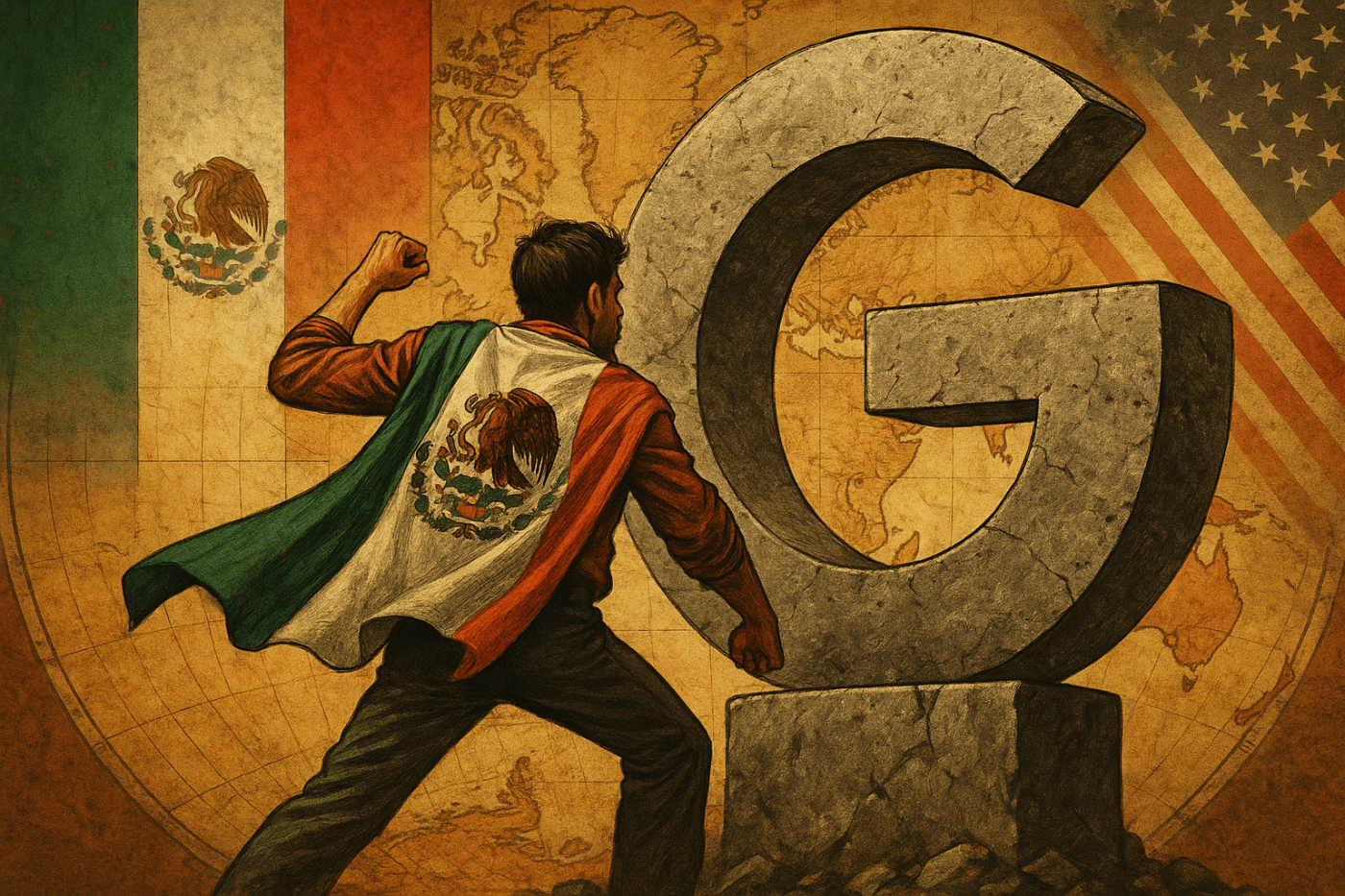
In the algorithmic age of empire, cartography isn’t dead—it’s privatized. And Mexico’s lawsuit against Google may just be the first real counterstrike.
By Prince Kapone | Weaponized Information | May 9, 2025
Cartographic Colonizers: Google Maps and the Digital Theft of Memory
The AFP byline attached to this brief dispatch offers little in the way of journalistic identity, and that’s no accident. AFP—Agence France-Presse—is one of the oldest and most entrenched news agencies of the Euro-American media bloc. Based in Paris, funded in part by the French government, and operating as a key node in the imperialist media apparatus, AFP serves not the people, but the state interests of NATO-aligned powers. Their institutional objectivity is a polished fiction—they exist to translate imperial diktats into neutral-sounding news copy. In this case, they’re not reporting a story—they’re laundering a digital land grab into a quirky tech headline.
Then we’ve got Google, of course—Alphabet Inc.’s flagship imperial cartographer. Then there’s Donald Trump, whose executive decree to rename the Gulf of Mexico as the “Gulf of America” forms the basis of this entire farce. And quietly, behind the curtain, sits the U.S. State Department, long obsessed with normalizing U.S. supremacy through soft power and semantic conquest. Alphabet functions here not just as a tech giant, but as an algorithmic governance contractor for U.S. empire, and this is a textbook case of digital colonialism in action.
But the most revealing part is how the article frames the issue. There’s no investigation into how a U.S. executive order came to override geographical naming conventions recognized by international law. There’s no questioning of Google’s role in erasing a name steeped in indigenous, Afro-Caribbean, and Latin American histories. There’s certainly no outrage that a private corporation, at the whim of a settler-fascist politician, redrew a border overnight using nothing but code. Instead, what do we get? A smirk. The framing is featherlight—Sheinbaum’s resistance is painted as a punchline (“Mexican America”), and the lawsuit is tucked neatly behind the phrase “without saying where and when it was submitted,” as if legal recourse from the Global South is somehow less legitimate when not endorsed by Washington.
What we are witnessing is cognitive warfare via cartography. This is how empire rewrites history—not with bombs, but with map labels. The Gulf of Mexico isn’t just water—it’s a political memory. It’s the site of stolen land, forced labor, sugar plantations, and imperial naval maneuvers. It’s where French, Spanish, British, and U.S. warships once floated to impose their will on Latin America. To rename it is to erase that legacy, to scrub history of its colonial crimes and repaint it in stars and stripes. AFP doesn’t ask why Google was allowed to make such a change. It doesn’t ask what it means for a tech company to perform diplomatic acts of cartographic aggression. It just shrugs, jokes, and moves on.
But we don’t and never will. We call it what it is: not a glitch, not a joke, but a deliberate act of imperialist recalibration. Trump wants to rename seas. Google wants to digitize those claims into geopolitical gospel. The press wants you to laugh, forget, and scroll. But we remember. Because every pixel renamed is a piece of stolen memory. And memory, comrade, is the first terrain of struggle.
Extracting the Facts, Reclaiming the Context
Let’s separate the noise from the signal. What are the raw facts? Google, following an executive order from Trump, changed the label of the “Gulf of Mexico” to “Gulf of America” for U.S.-based users of its mapping platform. Mexico, under the leadership of President Claudia Sheinbaum, responded with a lawsuit challenging the legitimacy of the name change. The Mexican government rightly argued that the U.S. decree can only apply to its own continental shelf, not to the entire Gulf—which, geographically, geopolitically, and historically, spans multiple sovereign nations.
Also factual: this executive order was signed during Trump’s first week back in office. The U.S. Congress then codified it into federal law, effectively using legislative power to enforce a semantic rebranding of a major international body of water. Meanwhile, Sheinbaum’s rhetorical counter—suggesting the U.S. be renamed “Mexican America”—was dismissed as satire, though it points to the very real legacy of stolen land and conquest following the 1848 U.S. annexation of Mexican territory.
Now let’s place this into the larger frame. The renaming of the Gulf isn’t just a symbolic provocation—it’s the digital echo of centuries of imperial conquest. The Gulf of Mexico was central to the colonial economy of the Americas, serving as a passageway for the transatlantic slave trade, the extraction of indigenous resources, and the deployment of naval power by every European empire with a stake in the hemisphere. It is the watery edge of a continent built on the bones of colonized people.
To rename it “Gulf of America” is to erase that history, to impose a digital Manifest Destiny on one of the most politically and culturally charged bodies of water in the world. This is digital colonialism: not just the theft of data, but the imperial rewriting of cartographic memory via code. Just as the colonizers once redrew borders with gunpowder and treaties, the technocrats now do so with software updates and server-side toggles. Google Maps is not a neutral tool—it is a geopolitical weapon shaped by algorithmic governance, calibrated to reproduce U.S. ideological supremacy in everything from driving routes to national borders.
Missing from the article entirely is any serious investigation into the implications of this maneuver. What does it mean for a private corporation, with no democratic mandate and no territorial claim, to rename an international waterway? What precedent does this set for future digital encroachments? How do these changes affect education, geopolitics, and sovereignty—especially in the Global South, where U.S.-based platforms still dominate digital infrastructure? None of this is explored. Because the story isn’t written to inform—it’s written to disarm. To trivialize a structural act of epistemic violence as just another “quirky headline.”
But we see it differently. The facts, placed in their proper context, expose a deeper contradiction: between the territorial claims of empire and the decolonial resistance of the oppressed. What Google and Trump attempted with this name change is not an isolated glitch. It is part of a broader strategy of imperialist recalibration—where control over information replaces control over land, and algorithmic mapmaking becomes a new frontier of conquest.
From Cartography to Class Struggle: Reframing the Battle Over the Gulf
This isn’t about a map—it’s about a map of power. What the empire calls “renaming,” we call erasure</strong. The attempted digital expropriation of the Gulf of Mexico is not some accidental mislabeling or internal tech update. It’s a calculated maneuver within a larger imperialist playbook: to claim not only territory, but narrative. To overwrite historical memory. To reforge colonial hegemony in the circuitry of the cloud.
Let’s call this what it is: algorithmic Manifest Destiny. Trump’s regime, with Google as its preferred cartographer, is drawing digital borders to reinforce its political project—an imperial resurrection draped in flags and coded in software. And like every imperial project, it’s built on a contradiction: it needs the Global South’s resources, labor, and strategic geography—but it also needs to deny the humanity, history, and sovereignty of the people who live there. The result is cognitive warfare masked as cartographic reform.
This renaming also performs a subtler function: it enlists the map itself as a tool of settler-colonial pacification. When youth in the U.S. learn geography from platforms like Google Maps, what are they being taught? That “America” owns the sea? That borders are whatever Washington says they are? That the Gulf is a domestic zone of consumption, not a contested space of struggle? This is how imperialism reproduces itself: not just through guns and trade deals, but through the architecture of knowledge. The map becomes a classroom, a courtroom, and a battlefield all at once.
But resistance to this rebranding isn’t just about semantic pushback—it’s about defending anti-imperialist sovereignty on the ideological front. Sheinbaum’s satirical counter—calling the U.S. “Mexican America”—isn’t just humorous. It’s a reassertion of memory, of loss, of the historical trauma of 1848. It is a rhetorical reclaiming of territory through historical truth. And it works because it makes visible the very thing the empire hopes to hide: that this entire continent is soaked in blood and betrayal, and that every border it claims is a lie with a treaty taped to it.
In this sense, the Mexican lawsuit is more than a legal maneuver—it’s a front in the struggle for epistemic decolonization. To fight back against the empire’s map is to fight for the right to remember. To name. To resist. It is to remind the world that imperialism doesn’t just occupy land—it occupies language. It trains algorithms to lie, and calls it “user experience.” And every time we challenge that lie, we chip away at the digital scaffolding of empire.
So we reframe this not as a footnote of tech news, but as a flare on the geopolitical horizon. Google’s map is not neutral. It is a statement of war. And Mexico’s response is not symbolic—it’s strategic. The Gulf of Mexico remains what it has always been: a space of resistance, a site of struggle, and a mirror of empire’s unraveling illusions.
Cartographic Sabotage and Digital Solidarity: Mobilizing Against Empire’s Maps
We are not map-readers. We are map-breakers. And this moment—absurd as it may seem on the surface—is an opening for revolutionary praxis. Because when imperialism draws new borders with satellites and servers, our job is to redraw them in struggle. Mexico’s lawsuit signals that this is not just a cartographic dispute—it is a challenge to technofascist narrative control, a crack in the empire’s digital hegemony.
We declare full ideological unity with all forces resisting this renaming: not just the Mexican state, but the artists, hackers, educators, journalists, and grassroots collectives who are already fighting back. From Chiapas to Oaxaca, from indigenous cartographers to decolonial media workers, the struggle against algorithmic empire is already unfolding. Our task is to deepen it.
Now is the time to weaponize digital solidarity. Here’s how:
- Flood the Feeds: Launch coordinated campaigns to rename U.S. landmarks with indigenous and colonized names on open-source map platforms. Turn satire into sabotage. Call Washington “Occupied Tsenacommacah.”
- Map the Resistance: Develop people’s maps that expose the geography of exploitation—military bases, data centers, lithium mines, maquilas. Publish them. Print them. Teach them.
- Hack the Narrative: Support code collectives and digital security hubs that defend map sovereignty and protect indigenous data from extraction and surveillance.
- Forge South–South Cartographies: Build counter-mapping collaborations between Global South nations, challenging colonial geography with maps of cultural resistance, trade solidarity, and ecological care.
- Escalate the Lawsuit: Pressure international courts, UN forums, and regional blocs like CELAC to treat the Google renaming as a violation of sovereignty and information warfare.
Every map is a story about who belongs and who doesn’t. About who owns the land, and who gets erased from it. That’s why empires obsess over borders—they fear the memory of what came before them. The Gulf of Mexico is not just water. It is the belly of the beast. A site of conquest, rebellion, migration, and extraction. And now, it’s a site of digital warfare.
Let’s meet them there—with memory as our weapon, solidarity as our compass, and history on our side. Empire draws maps. We draw fire.
 Weaponized Information
Leave a comment