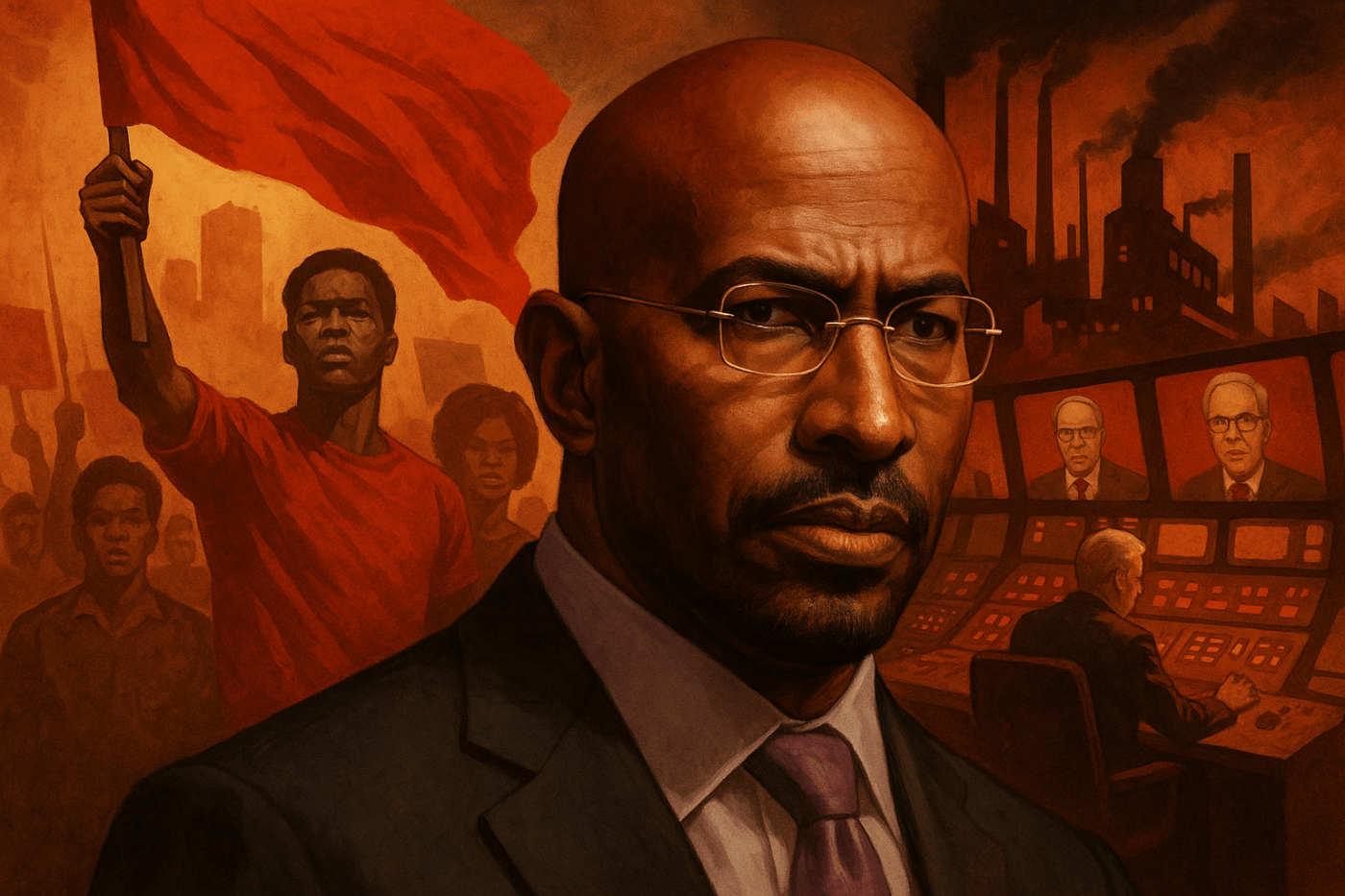
How a Revolutionary Narrative Became a Tool of Imperialist Counterinsurgency
By Weaponized Information Editorial CollectiveMay 6, 2025
Introduction
Van Jones is not an aberration. He is a prototype—a figure who embodies the liberal counterinsurgency strategy of technofascism in the imperial core. To speak of Jones merely as an individual “sellout” misses the deeper structural function he performs. He is a product and instrument of the nonprofit-industrial complex, a managerial agent of settler-colonial pacification tasked with absorbing the radical energies of the colonized and proletarian masses, laundering them through algorithmic governance and celebrity activism, and redeploying them as reformist dead-ends that serve imperialist recalibration.
This exposé is not a personal exposé, nor a moralistic denunciation. It is a weaponized analysis: an investigation into the political, ideological, and material role that Van Jones plays as a key node within the technofascist apparatus of the United States during its period of imperialist decay and hyper-imperialism. His trajectory—from a self-identified communist and Black revolutionary nationalist to a “bipartisan consensus-builder” on CNN and a broker between corporate capital and Black celebrity—mirrors the broader process by which counterinsurgency adapts under crisis: not only repressing radicalism with overt violence, but absorbing it through cultural, financial, and ideological cooptation.
We write from the standpoint of historical and dialectical materialism. Our methodology centers the colonial contradiction as primary: the irreconcilable conflict between a settler-colonial imperialist state and its internal and external colonies. Van Jones cannot be analyzed outside this contradiction. His function is inseparable from the broader strategy of settler-colonial pacification and counterinsurgency waged against Black insurgency in the U.S. internal colony. His work represents not a deviation from empire’s logic, but a fulfillment of it: the creation of a Black comprador managerial class to manage, neutralize, and redirect insurgent political formations back into the circuits of capital, policy reform, and symbolic inclusion.
Our thesis is clear: Van Jones is an agent of technofascist cooptation. He represents a class fraction whose historical function is to mediate between the white ruling class and the colonized Black population, translating the language of liberation into the grammar of social entrepreneurship, bipartisan compromise, and market solutions. He does not “betray the movement” so much as embody a movement that was institutionally absorbed into the nonprofit-industrial complex—a machinery of soft counterinsurgency designed to preempt revolutionary rupture.
This exposé proceeds in five sections, each interrogating a stage of Van Jones’ political and ideological evolution within the broader structures of imperialist recalibration and technofascist governance:
- 1. “Radical Roots or Radical Branding?” — explores his early affiliations with STORM and the Bay Area’s post-1990s radical left, situating them within the collapse of organized revolutionary movements and the rise of NGO-managed activism.
- 2. “Green Jobs, Greenwashing, and Eco-Capitalism” — examines his transition into eco-capitalist reformism under the Obama administration, linking the Green Collar Economy to technocratic strategies of capitalist environmental pacification.
- 3. “The Nonprofit-Industrial Complex: Managing Oppression” — analyzes Dream Corps, #cut50, and #YesWeCode as institutional mechanisms of counterinsurgency, designed to depoliticize abolitionist and anti-capitalist demands into bipartisan policy fixes.
- 4. “Roc Nation, Celebrity Activism, and the Culture Industry” — critiques his integration into celebrity philanthropy and corporate media, framing it as a cultural apparatus of cognitive warfare against revolutionary consciousness.
- 5. “The Black Misleadership Class and the Technofascist Capture of Radical Energy” — situates Jones within the broader pattern of liberal cooptation of Black radicalism, mapping his function as a comprador mediator under conditions of imperialist decay and intensifying counterinsurgency.
This exposé is not neutral. It is not objective. It is a weapon of ideological warfare aimed at dismantling illusions, exposing the comprador classes, and equipping organizers and militants with a clear-eyed analysis of how counterinsurgency now operates through celebrity, nonprofit infrastructures, and algorithmic culture. The stakes are nothing less than the future of socialist liberation under empire: whether it remains trapped in a loop of managed reform—or breaks toward revolutionary rupture.
Let this be read not as a eulogy for a radical lost, but as a manual for those refusing to be captured.
1. Radical Roots or Radical Branding?
It is tempting to begin with the story Van Jones likes to tell: the radicalized law student, arrested in the wake of the Rodney King verdict, transformed by the brutality of the police state into a fighter for justice. But to reproduce this narrative at face value is to fall into the very ideological trap we are here to dismantle. What if the story of Van Jones’ “radical roots” is less a seed of rebellion and more an early stage of incorporation? What if the so-called radicalism was already shaped, from its inception, by the structures that would later claim him?
Jones’ political beginnings took place in the 1990s, a decade marked by the unipolar moment of the post-Cold War world. The collapse of socialist states globally, the retreat of revolutionary movements domestically, and the ascendancy of neoliberal governance created an ideological terrain where the rhetoric of liberation persisted, but the organized capacity for revolutionary rupture had been severely weakened. It was a period when the U.S. state, having decimated Black and Third World revolutionary organizations through counterinsurgency, shifted strategies: investing in the nonprofit-industrial complex, expanding diversity bureaucracies, and establishing new circuits to contain, professionalize, and depoliticize dissent.
It is here that Van Jones’ “radicalism” must be situated. His leadership of STORM—Standing Together to Organize a Revolutionary Movement—has often been cited as evidence of his early militant commitments. STORM described itself as a Marxist collective, invoking the language of multiracial socialism and anti-imperialism. But even in STORM’s own reflections, published after its dissolution, we see the contours of an organization that never quite escaped the gravitational pull of progressive nonprofitism. Its campaigns, while confrontational in tone, often operated within the frameworks of policy advocacy, coalition-building with liberal NGOs, and local reforms rather than direct confrontation with state power.
The founding of the Ella Baker Center for Human Rights in 1996 deepened this trajectory. While the Center carried the name of one of the Black radical tradition’s fiercest strategists, its institutional form reflected the ongoing shift from mass-based movements to foundation-funded advocacy. Programs like “Books Not Bars” challenged youth incarceration, but they did so through legal reform, lobbying, and policy work—important interventions, but ultimately constrained by the rules of lawfare, confined to the parameters of policy adjustment rather than systemic dismantling. The terrain itself was already prefigured by settler-colonial pacification, designed to offer managed reforms in lieu of revolutionary rupture.
This is not to dismiss the sincerity or dedication of Jones and his collaborators at that time. Rather, it is to trace the material and ideological conditions under which their politics developed. The movements of the 1990s were not operating in the open revolutionary spaces of the 1960s and 70s, but within the narrowing architecture of NGO-led activism. The figure of the “radical” itself was being professionalized, transformed into a consultant, a policy advisor, a media commentator. Leadership was becoming individualized, branded, and increasingly disconnected from any project of dual and contending power that could challenge the legitimacy of the settler-colonial state.
In this context, Jones’ political development reflects a dialectical tension embedded in the historical moment: revolutionary language tethered to reformist institutions; radical aesthetics constrained by liberal policy outcomes; militant postures absorbed into the managerial logics of nonprofit governance. His trajectory from Marxist collective to media-friendly advocate was not a dramatic rupture—it was a logical continuation, an adaptation to the constraints and incentives of the ideological field shaped by technofascism.
Indeed, it is in this period that we begin to see the outlines of the political role Jones would later formalize: a broker of dissent, a translator of radical demands into palatable policy solutions, a bridge between insurgent communities and the corridors of power. Already in the 1990s, the conditions were in place for the emergence of a class of intermediaries tasked with managing the contradictions of empire from within the communities most targeted by its violence. Jones’ early career prepared him for this role—not by betrayal, but by function.
This is why we reject the simplistic narrative of Van Jones as a fallen radical. The question is not when he “sold out,” but what structural function his so-called radicalism already served within the broader apparatus of U.S. settler-colonial governance. His early activism, while employing the idiom of liberation, remained inside the circuits of managed dissent—inside the parameters acceptable to foundations, to city governments, to policy coalitions whose ultimate function was to stabilize, not overthrow, empire.
To understand Van Jones, we must understand the political economy of the 1990s: the deliberate construction of a landscape where dissent could be channeled into “solutions” that left the system intact. We must understand the historical process by which the language of revolution was repurposed as branding for managed reform. And we must see how the figure of the “radical leader” was reconstructed not as a threat to empire, but as an asset to its adjustment and survival.
The roots were never free from the soil of empire. The roots were already planted in the greenhouse of managed rebellion. And the fruit? It was cultivated for a role we now recognize: the radical who makes revolution safe for capital.
2. Green Jobs, Greenwashing, and Eco-Capitalism
If the 1990s laid the institutional groundwork for Van Jones’ role as a broker of managed dissent, the 2000s offered the opportunity for formal entry into the state apparatus. And it came dressed in green. The language was revolutionary-sounding enough to win support from liberals and progressives—green jobs, green economy, green collar work—but beneath the eco-friendly slogans lay a familiar strategy: the channeling of systemic crises into market solutions. This was not the radical transformation of an economy rooted in extraction, racialized dispossession, and imperialist war; it was the repackaging of capitalism in a new color.
In 2008, Jones published The Green Collar Economy, a book celebrated across the liberal establishment. It framed environmental justice as a business opportunity, arguing that solving the climate crisis and alleviating poverty could be accomplished through green capitalism: training programs, corporate incentives, public-private partnerships. Missing from the analysis was any recognition of the underlying logic of capitalist accumulation—the structural imperative to exploit, externalize, and expand. There was no interrogation of neocolonial extraction fueling global supply chains; no challenge to financial piracy looting the Global South. Instead, Jones offered a blueprint for imperialist recalibration: smoothing the contradictions of capitalism by greening the circuits of profit.
The political function of this framework became clear when Jones was appointed in 2009 as “Special Advisor for Green Jobs” under the Obama administration. Here was the next logical step: moving from nonprofit intermediary to state technocrat, managing the interface between environmental reform and corporate interests. The Green Jobs Act, which Jones had championed in 2007, authorized $500 million in funding—channeled largely through corporate contractors, training centers, and institutions already embedded in the neoliberal state. There was no radical redistribution of wealth or land. No challenge to fossil fuel imperialism or militarized resource extraction. The green jobs agenda was not a rupture with capitalism, but a reformist adaptation of it.
Jones’ resignation from the White House later that year—amid right-wing attacks over his past radical statements—was framed by many as a cautionary tale of progressive exclusion. But the reality is more complicated. His departure did not mark an exit from elite politics; it marked a return to the nonprofit-industrial complex, corporate consulting, and media branding. Within months, Jones was building new initiatives—Rebuild the Dream, Dream Corps—designed to merge progressive causes with corporate partnerships. He did not abandon influence; he diversified its portfolio.
This is the core contradiction of the green jobs framework: it attempts to solve crises produced by capitalist accumulation without confronting the system that generates them. The climate crisis is not a market failure; it is a structural expression of capitalism’s ecological rift, a global extension of the same imperialist logics that built empire on stolen land, enslaved labor, and ecological destruction. A green job inside this system is still a job inside a system premised on exploitation—often built on neocolonial extraction of lithium, cobalt, and other minerals, pulled from communities in the Global South facing militarized dispossession.
Jones’ embrace of “eco-capitalism” thus represents not a compromise between reform and revolution, but a foreclosure of revolutionary horizons. By framing environmental justice as an opportunity for market solutions, it disarms the fundamental critique that capitalism itself—green or otherwise—is incompatible with ecological and social survival. In place of abolition, it offers adjustment. In place of rupture, recalibration.
This is the ideological function Van Jones was cultivated to perform: translating the language of systemic crisis into a vocabulary of technocratic reform, converting the raw material of social struggle into inputs for policy papers, grant proposals, and bipartisan commissions. It is a role that leaves intact the underlying structures of settler-colonial pacification and technofascist governance, while offering symbolic victories that preempt insurgency.
Here, the pattern becomes visible. The early radical language of the 1990s became the eco-capitalist marketing of the 2000s. The “radical” became the reformer; the reformer became the technocrat; the technocrat became the celebrity spokesperson. And at each stage, the function remained consistent: to mediate, to translate, to neutralize.
This is not a story of individual corruption. It is the structural process by which empire absorbs its critics, converts them into intermediaries, and redeploys them as managers of managed dissent. Van Jones did not simply “sell out” his radicalism. His radicalism was already structured to be sold.
3. Nonprofit Counterinsurgency: Dream Corps, #LoveArmy, and the Machinery of Managed Dissent
By the 2010s, the trajectory of Van Jones’ political role was unmistakable. What began as radical posturing in the 1990s, transformed into eco-capitalist technocracy in the 2000s, had by now consolidated into full alignment with the machinery of the nonprofit-industrial complex. No longer simply an advocate or a policy advisor, Jones had become an institutional entrepreneur—a builder of organizations whose primary function was to capture dissent, translate it into deliverables, and funnel it back into the circuits of elite governance.
Dream Corps, founded by Jones in 2014, epitomizes this transformation. Marketed as a “social justice accelerator,” Dream Corps operates as a platform connecting progressive causes with Silicon Valley funders, philanthropic foundations, and corporate sponsors. Its initiatives—#YesWeCode, #cut50, Green For All—each embody a similar model: an ambitious mission statement, a set of policy goals, a partnership network heavily populated by tech corporations and liberal funders, and a media-friendly narrative framing reform as innovation.
But beneath the glossy branding lies a familiar political function. Programs like #cut50, ostensibly committed to reducing mass incarceration, prioritize incremental sentencing reforms and bipartisan legislative lobbying. They avoid direct confrontation with the prison-industrial complex’s structural role in settler-colonial pacification. They do not challenge the legitimacy of the carceral state; they seek to streamline it. Likewise, #YesWeCode, positioned as a tech workforce diversity initiative, operates within the very architecture of digital colonialism and platform feudalism—preparing marginalized communities to enter industries structurally premised on extractive data economies and algorithmic governance.
The ideological function of Dream Corps is clear: to present managed reform as transformation, to channel systemic critiques into policy tweaks, and to provide corporate actors with progressive credentials while leaving their power untouched. Jones, as founder and figurehead, became a broker in this arrangement—leveraging his radical backstory to authenticate partnerships with entities whose operations sustain the very systems his organizations claim to reform.
The emergence of #LoveArmy after the 2016 U.S. election extended this role into the ideological terrain of reconciliation. Framed as a post-Trump “healing” movement, #LoveArmy advanced a narrative of bipartisan unity, civic dialogue, and national healing—subtly recoding systemic violence as “division” and structural oppression as “misunderstanding.” It turned the antagonisms of U.S. settler-colonial empire into interpersonal discord to be solved through empathy workshops and viral hashtags. In doing so, it provided a moral language that disarmed rebellion while normalizing the political status quo.
This is the heart of nonprofit counterinsurgency: not simply the dilution of radical demands, but their transformation into tools of legitimacy for a system in imperialist decay. By packaging dissent into campaigns palatable to corporate sponsors and policymakers, organizations like Dream Corps function as ideological buffers—absorbing insurgent energies, repurposing them as managed initiatives, and preempting the emergence of dual and contending power structures capable of contesting state sovereignty.
In 2017, Jones formalized this merger of activism and celebrity by signing a management deal with Jay-Z’s Roc Nation. This was not a rupture with his prior trajectory; it was its logical continuation. The radical lawyer had become the nonprofit executive; the executive became the CNN commentator; the commentator became the celebrity partner. At every stage, the same structural function remained: to translate critique into commodity, to convert rebellion into branding, to ensure that resistance could be monetized, televised, and ultimately neutralized.
To mistake these developments as personal failings or opportunism is to miss the deeper structure. Jones’ ascent into the nexus of celebrity activism and corporate partnership is not an aberration; it is a template. It reflects the evolving strategies of technofascist counterinsurgency, which no longer relies solely on brute repression but increasingly mobilizes soft power, narrative control, and institutional cooptation to maintain hegemony. The activist-celebrity hybrid is a vital node in this apparatus—delivering legitimacy to a ruling order that can no longer claim it through traditional ideological means.
By the mid-2010s, the Van Jones story had come full circle. The radicalism of his youth, already circumscribed by the ideological terrain of the nonprofit-industrial complex, had been transformed into a brand, a product, a political commodity circulating in the media marketplace. The revolutionary language remained in fragments, but its substance had been emptied, packaged, and resold to a liberal audience hungry for catharsis but unwilling to confront the structural demands of revolutionary rupture.
And so we return to the central question: what does Van Jones represent? Not as an individual, but as a function, a position, a role within the ideological apparatus of U.S. settler-colonial empire. His career is not a deviation from radicalism—it is a symptom of a political economy designed to capture, contain, and redeploy rebellion as reform. His legacy is not one of betrayal, but of incorporation. He is not the exception; he is the rule.
To understand Van Jones is to understand the machinery that produced him—and to prepare ourselves for the next generation of brokers, intermediaries, and celebrity activists who will be offered to us as symbols of hope, while ensuring the system remains intact.
4. Media, Messaging, and the Manufacture of Consensus
Van Jones’ transition from nonprofit executive to CNN commentator marked the culmination of a political transformation decades in the making. But to describe it merely as a “career shift” is to miss its deeper ideological function. This was not simply a move from activism to journalism; it was the absorption of a figure once positioned at the margins of power into the very machinery of the imperialist media apparatus—a system tasked with converting structural crises into narratives of consensus, managing dissent through spectacle, and repackaging rebellion as moderation.
On CNN, Jones was marketed as a “voice of reason,” a bridge between left and right, a man capable of “seeing both sides.” It was a carefully curated persona, drawing legitimacy from his past affiliations while advancing a politics of bipartisan reconciliation. His commentaries—whether lamenting police brutality, praising criminal justice reform, or applauding gestures of corporate “inclusion”—offered catharsis without confrontation, critique without rupture, solidarity without struggle. Each segment performed the same ideological work: converting systemic antagonisms into administrative dilemmas, framing empire’s crises as “messy truths” rather than structural contradictions.
Jones’ 2017 book, Beyond the Messy Truth, codified this narrative. In its pages, Jones argued for a “love army” that could unite disaffected liberals and disillusioned conservatives, transcending partisanship through empathy and shared values. Absent from the text was any recognition of the material roots of polarization: the ongoing crisis of U.S. imperialism, the structural violence of settler-colonialism, the economic immiseration imposed by neoliberal austerity. By framing political antagonisms as failures of communication rather than expressions of class and colonial contradiction, Jones’ analysis echoed the ideological function of cognitive warfare: obscuring the causes of rebellion while preemptively delegitimizing insurgency.
This is the role of the “reasonable radical” inside the imperialist media ecosystem. It is not to challenge hegemony, but to translate dissent into the language of reform, to signal critique while reinforcing legitimacy. Jones’ presence on CNN did not expand the boundaries of acceptable discourse; it fortified them. He became a symbol of “responsible dissent”—a dissenter who stays within the frame, who condemns property destruction while mourning inequality, who validates the system’s capacity for self-correction while disavowing the necessity of revolutionary rupture.
In the aftermath of the 2020 George Floyd uprising, this role became starkly visible. As millions flooded the streets demanding abolition, redistribution, and an end to police terror, the media apparatus scrambled to contain the ideological rupture. Jones was deployed not as an abolitionist, but as an interpreter—explaining Black pain to white audiences, offering reassurance that reform was possible, that hope remained inside the system. His televised tears following Derek Chauvin’s conviction became emblematic: a moment of catharsis that signaled closure, a performance of relief that framed accountability as achieved, justice as delivered, struggle as complete.
But the material conditions remained unchanged. The police budget expanded. Evictions surged. Surveillance technologies proliferated. Settler-colonial pacification deepened. And the imperialist media apparatus returned to normal, having processed rebellion into a digestible narrative arc—tragedy, mobilization, reform, resolution. In this process, Jones’ role was not aberrant; it was essential. His commentaries provided the moral scaffolding for technofascism to advance under the banner of inclusion, for digital surveillance to expand in the name of equity, for neoliberal governance to sustain itself while declaring a “racial reckoning.”
The figure of Van Jones on CNN is thus not merely a media personality; it is an ideological function. It represents the structural absorption of “radical” legitimacy into the circuits of imperialist consensus. It performs the soft counterinsurgency that accompanies the hard repression. It ensures that rebellion is narrated as reform, that liberation is reduced to representation, that critique is subordinated to consultation.
In this capacity, Jones does not challenge the machinery of empire; he services it. His tears, his pleas, his calls for love—all become components of a spectacle that manages dissent while leaving the structures of domination intact. His presence offers audiences the sensation of moral seriousness, while ensuring that the underlying antagonisms remain depoliticized, individualized, pacified.
To understand this function is to understand the political economy of narrative under U.S. settler-colonialism. In a moment of imperialist decay, when legitimacy falters and rebellion surges, the system must produce new intermediaries capable of translating crisis into continuity. Jones, like other members of the Black misleadership class, occupies this role: a symbol of access that substitutes for power, a broker of inclusion that displaces abolition, a voice of reason that drowns out the call for rupture.
It is not enough to name the betrayal; we must map the system that requires such figures. It is not enough to critique the individual; we must dismantle the structures that render their function necessary. And it is not enough to weep on camera; we must organize beyond the frame, outside the circuits of spectacle, toward a power that cannot be televised, a rupture that cannot be narrated into reform.
5. Co-optation in Context: Van Jones and the Black Misleadership Class
Van Jones is not an aberration. He is a crystallization. A symptom, not a deviation. To understand his trajectory is to confront the deeper machinery that produces his role: a system that, in every generation, cultivates a cadre of intermediaries tasked with translating rebellion into reform, critique into consultation, insurgency into institutional access. In this process, figures like Jones emerge not despite empire’s violence, but because of it.
The late Glen Ford, founding editor of Black Agenda Report, coined the term Black misleadership class to describe this phenomenon: a class fraction of Black elites whose legitimacy rests on their claim to represent Black communities, while their material function is to discipline, contain, and neutralize Black radical potential. Their power derives not from autonomous Black political development, but from their proximity to white ruling class institutions—corporate boards, media networks, Democratic Party coalitions, philanthropic foundations. They are, in Ford’s words, “a class that has prospered through its service to white corporate power.”
Van Jones exemplifies this class. His career maps the coordinates of incorporation: from radical circles to nonprofit leadership; from nonprofit leadership to state technocracy; from state technocracy to media spectacle; from media spectacle to celebrity partnership. At each stage, the language of liberation is retained in fragments, but its substance is progressively stripped, commodified, redeployed as legitimacy for institutions designed to foreclose revolutionary rupture.
This trajectory is not unique to Jones. It is the pattern of liberal capture writ large. From Booker T. Washington’s industrial uplift programs to the post-civil rights integration of Black political elites into the Democratic Party machine, from the NGO-ization of Black radical spaces to the philanthropic laundering of Black Lives Matter, the process repeats: the insurgent potential of Black freedom struggle is absorbed, depoliticized, and recycled as reformist symbolism within the circuits of U.S. settler-colonial governance.
This is the structural context in which Van Jones operates. His function is not to lead a liberation movement, but to mediate between insurgent demands and institutional power; to ensure that rebellion never crosses the threshold into dual and contending power; to offer just enough critique to maintain his legitimacy among the oppressed, while offering just enough moderation to remain acceptable to the ruling class.
Here, the role of the Black misleadership class is inseparable from the broader architecture of counterinsurgency. In the 1960s and 70s, this role was played by federal informants, liberal pastors, civil rights brokers who moved to absorb Black Power demands into tokenistic diversity programs. Today, it is played by media commentators, foundation-funded activists, nonprofit executives whose salaries are paid by the very corporations their communities protest. The function remains the same: to manage the colonial contradiction without abolishing it; to pacify the oppressed without empowering them to rule.
This process is not the result of individual failings. It is a structural necessity for an empire in crisis. In a moment of imperialist decay, when legitimacy erodes and rebellion surges, the system must produce intermediaries who can translate insurgency into inclusion, violence into misunderstanding, revolution into reform. Van Jones’ role as a CNN commentator, as a Roc Nation-affiliated activist, as a policy advocate inside corporate diversity boards, is not a betrayal of his radical past. It is the structural fulfillment of a political economy designed to co-opt, incorporate, and redeploy dissent as a stabilizing force.
To understand Van Jones is to understand the system that produced him. To critique Van Jones is to critique the imperialist media apparatus, the nonprofit-industrial complex, the corporate-philanthropic capture of social movements. To reject the function Van Jones represents is to reject the politics of access, proximity, and incremental reform offered as substitutes for power.
What, then, is the alternative? Not a search for “better” intermediaries. Not a hope for incorruptible brokers inside corrupted structures. The alternative is the construction of autonomous, mass-based, dual and contending power institutions capable of contesting the legitimacy of the settler-colonial state. The alternative is a politics not of consultation, but of confrontation; not of inclusion, but of abolition; not of reconciliation with empire, but of revolutionary rupture.
Van Jones’ story is not yet finished. But its trajectory has been set by the structures he inhabits. Our task is not to rehabilitate him. It is to build beyond him, against the system that requires him, toward a power that cannot be captured, branded, or televised.
 Weaponized Information
Leave a comment