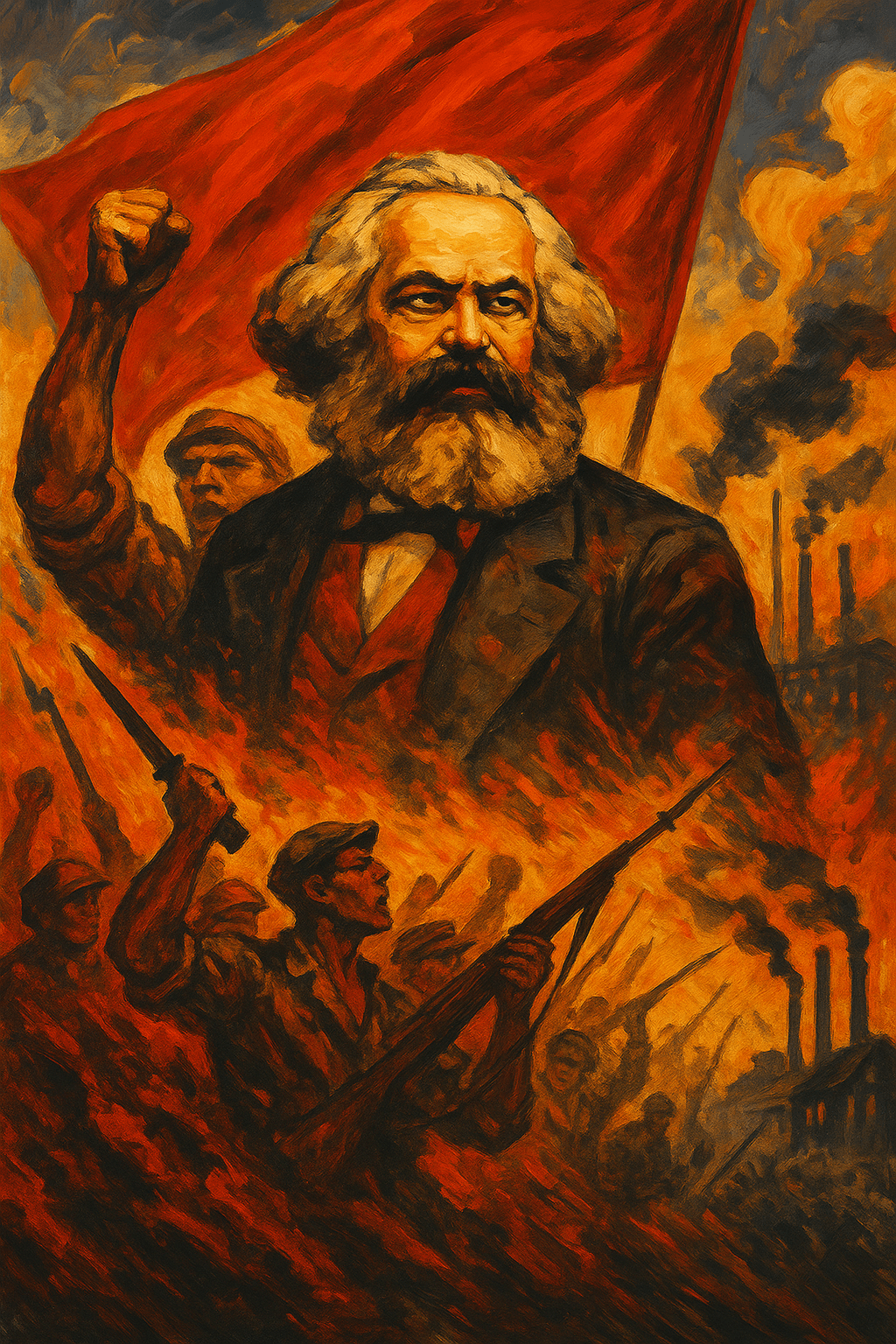
On May 5, we don’t commemorate Marx to worship the past. We commemorate him to wage the future.
By Prince Kapone | Weaponized InformationMay 5, 2025
“Philosophers have only interpreted the world, in various ways; the point, however, is to change it.” — Karl Marx, Theses on Feuerbach
Part I: From Trier to the World: A Revolutionary Born in Exile
Karl Marx was born on May 5, 1818, in Trier, a small town in what was then the Prussian Rhineland—a place choked by monarchy, censorship, and police surveillance. He was born into a Jewish family that had been forced to convert to Lutheranism to avoid exclusion from the professions. This wasn’t a private theological decision—it was the boot of theocracy pressing down on every nonconforming household. Marx was marked by repression from birth: religious, ethnic, and political. His father’s coerced conversion was not just a matter of faith—it was the price of survival in a German state built on aristocratic domination and national chauvinism.
But if oppression shaped his early life, rebellion shaped his soul. As a student in Bonn and Berlin, Marx was no quiet scholar. He flirted with Romantic poetry, fell under the spell of Hegel, joined the Young Hegelians—and soon surpassed them. His pen was sharp from the start, but he sharpened it further as a journalist, taking on Prussian censorship, clerical hypocrisy, and aristocratic land theft. The state responded predictably: exile. Banned from Germany, banned from France, driven from Belgium, Marx became what the reactionaries feared most—a revolutionary without borders, a fugitive whose writings traveled faster than armies.
He wasn’t a German thinker in the narrow sense. He was already an internationalist in formation. Expelled from his homeland, published in London, inspired by the Paris Commune, cheering the uprisings in Ireland, Poland, India, and China—Marx’s life was a living map of global revolt. His office wasn’t a university classroom but the reading room of the British Museum, where he poured over reports of colonial plunder, capitalist expansion, and the tremors of revolt from the margins of empire.
When Marx and Engels wrote The Communist Manifesto in 1848, it wasn’t a manifesto for Germans alone. It was a war cry for a world already set ablaze by rebellions, a call to arms for every worker, every peasant, every enslaved and dispossessed person confronting the brutal machinery of capital and empire. “Workers of all lands, unite!” wasn’t a metaphor. It was an imperative, forged in the knowledge that exploitation knows no national boundary—and neither should liberation.
By the time Marx settled in London—hounded, impoverished, yet indefatigable—he had already become what the German state most feared: an exile who refused assimilation, a thinker who refused the parochialism of European chauvinism, a revolutionary who saw the struggle of the British proletariat intertwined with the fight of the Irish tenant farmer, the Indian peasant, the Chinese worker. As Kevin B. Anderson shows, Marx’s writings and political engagements in this period reveal a growing recognition that the revolution would not simply erupt in the factories of Manchester or the coal mines of the Ruhr, but might break out in the colonial peripheries where imperial violence was most naked, and resistance most uncompromising.
He wasn’t an ivory-tower philosopher. He was a fighter. A man expelled by kings and censors alike because he dared to arm the exploited not just with slogans, but with critique—with the ruthless, uncompromising dissection of the system that ruled over them. And he knew, as we must know now: the state doesn’t exile harmless thinkers. It fears those who can teach the oppressed to see the system for what it is—and rise against it.
Marx’s life was a revolutionary itinerary: from Trier’s narrow streets to the barricades of 1848, from the exile salons of Paris to the strike meetings of London, from the pages of radical newspapers to the internationalist solidarity campaigns for Poland, Ireland, and the enslaved of the Americas. His story was never about Germany alone. It was the unfolding of a global rebellion. And in that unfolding, Marx found the key insight that would define his legacy: that no nation is free until all nations are free; that no class is liberated until every oppressed people has shattered the chains of empire.
Part II: The Critique That Named the System
Marx didn’t invent socialism. He sharpened it into a weapon. He didn’t just oppose capitalism; he dissected it, stripped it bare, revealed its skeleton for the world to see. In Capital, Marx uncovered the secret of the system: that every gleaming factory, every pile of wealth, every palace of the bourgeoisie was built on stolen time, stolen sweat, stolen life. “Surplus value”—that was the name he gave the theft, the unpaid labor hidden behind every wage packet. The capitalist doesn’t get rich by working harder. The capitalist gets rich by paying the worker less than the value the worker creates—and pocketing the difference. It was robbery, systematized and legalized, clothed in contracts and respectability.
But Marx’s critique didn’t stop at the shop floor. He traced the bloody footprints of capital around the world. He showed that the wealth of Europe was fertilized by the bones of Africa and the Americas. “The veiled slavery of wage labor in Europe needed the unmasked slavery of the New World as its pedestal,” Marx wrote. Capitalism wasn’t born in peaceful markets. It was born in colonial conquest, in plantations, in mines worked by enslaved and colonized peoples. The “rosy dawn” of capitalist production, Marx thundered, was lit by the fires of genocide, dispossession, and forced labor.
This wasn’t academic critique. It was revolutionary indictment. And it had targets: British landlords bleeding Ireland dry; European merchants plundering India; French capital wringing profit from Algeria. Marx saw imperialism not as an external accident but as the global scaffolding of capital’s empire. Every colonial outpost was a node in the extraction machine, every colonized body a site of surplus drained to feed European accumulation.
Marx didn’t romanticize pre-capitalist societies. But in his later writings, as Kevin B. Anderson shows, he refused to see them as “backward” detours on a single road to capitalism. He studied the Russian mir, the Indian village commune, the communal property systems of Algeria—not as relics doomed to extinction, but as possible springboards for revolutionary transition. Marx was learning from the margins, recognizing that the world’s peripheries were not passive waiting rooms for capitalist modernity, but active zones of resistance, contradiction, and alternative paths to liberation.
His critique revealed capitalism as a system of global integration through violence: a world market built by breaking worlds apart, a network of profit spun from colonial looting and proletarian exploitation. Capital’s hunger was planetary. Its crises were planetary. And so, Marx insisted, the revolution must be planetary too.
Marx armed the workers with critique—and critique, for him, was never a sterile exercise. It was the “ruthless criticism of everything existing”—ruthless because it refused to bow to tradition, to superstition, to imperial apology, to bourgeois comfort. Ruthless because it aimed not merely to interpret the world, but to overturn it.
And the ruling class knew it. That’s why they censored him, exiled him, vilified him. They feared his critique because it didn’t just expose them—it showed the workers how to fight them. It gave the exploited a language for their chains, and a map for breaking them.
Part III: The Revolution Beyond Europe: Marx Against Empire
To read Marx as a European thinker alone is to miss his most radical turn. As empire spread its claws across the world, Marx’s gaze turned outward—from Manchester to Bengal, from the Irish countryside to the Algerian commons. The same system that robbed the English worker’s wage, he realized, was starving the Indian peasant, dispossessing the Algerian farmer, and driving the Irish tenant from his land. Capital wasn’t a local monster. It was a global hydra. And if the hydra’s heads stretched across continents, so too must the revolution’s fires.
Marx’s solidarity wasn’t charity—it was necessity. “A nation cannot be free if it oppresses other nations,” he wrote. For Marx, the English working class would never liberate itself until it broke solidarity with the English empire. Ireland was his test case. Early on, he believed Irish emancipation would follow English revolution. But by the 1860s, Marx flipped the script: the chain must be broken in Ireland first. The English working class was too tied to colonial privilege, too infected by imperial chauvinism. It needed the Irish rising to shatter its illusions, to force the class question out from under the imperial shadow.
He championed the Fenian movement—not as liberal nationalism but as a revolutionary force born from the landless poor, the dispossessed, the exiled. Marx understood that colonial rebellion wasn’t an embarrassing distraction from class struggle. It was its front line. Ireland’s fight wasn’t peripheral—it was a dagger pointed at the heart of the empire. And Marx urged the workers of England: stand with Ireland, or remain chained yourselves.
His solidarity extended further. In Algeria, he condemned France’s scorched-earth campaigns against the Kabyle and Arab peasants. In India, his early writings praised British railways as “progressive,” but by the 1870s, he saw the deeper cost: famine, dispossession, extraction. His late notebooks, as Kevin B. Anderson shows, are filled with studies of communal property systems in non-European societies—not as relics, but as potential roots for revolutionary alternatives. Marx began to imagine a multilinear path to emancipation: one that didn’t demand every society pass through capitalist hell to reach socialist possibility.
He wasn’t romanticizing the “noble savage.” He was recognizing that communal land, collective labor, and shared resources were not primitive detours but living challenges to capital’s privatization drive. In this shift, Marx broke with the mechanical “stages” theory of many European radicals. Revolution, he saw, might erupt not in London’s factories, but in the anti-colonial barracks, the occupied commons, the insurgent villages of the colonized world.
His internationalism wasn’t abstract universalism. It was rooted solidarity. When John Brown was executed for his armed raid against slavery, Marx raised funds for Brown’s widow. When enslaved Black Americans rose up in the Civil War, Marx wrote to Lincoln praising the Emancipation Proclamation as “rescuing a race” from bondage and “inflicting a mortal wound” on global slavery. When the Paris Commune fell under artillery fire, Marx hailed it as the first dictatorship of the proletariat, even as liberal Europe denounced it as savagery.
Marx’s name has been dragged through European universities, sanitized into safe syllabi. But his voice still carries from the peripheries: from every rebel who knows that empire must be fought, not managed. From every colonized people who knows that their liberation is not a favor to Europe’s working class, but a condition for any revolution worth the name.
In Marx’s embrace of the colonial question, we glimpse the unfinished project of internationalist liberation: that no socialism worthy of the name can ignore the racial and colonial foundations of capitalism. That no proletarian victory is possible while imperialism remains intact. That the road to emancipation runs not through reformist compromise with empire, but through solidarity with those who rise against it—rifle, barricade, commune, fist raised high.
Part IV: Marxism Is Not a Dogma: The Unfinished Science of Liberation
For Marx, theory was never scripture. It was a weapon. A method. A living critique that must be wielded by the oppressed in their specific, concrete struggles. He didn’t leave us commandments carved in stone. He left us a compass: historical materialism, dialectical analysis, ruthless criticism of all that exists. And like any compass, it points direction—but demands we walk the terrain ourselves.
The ruling class fears Marx not because of 19th-century Germany, but because his method still decodes the empire today. His critique still cuts through the illusions they sell us: that poverty is natural, that inequality is inevitable, that colonial domination is “development,” that exploitation can be reformed away. Marx’s method unravels the mystifications of capital and shows its beating heart: accumulation by dispossession, profit extracted from stolen labor, a world market glued together by imperial violence.
Today, his method explains why Silicon Valley fuses with the Pentagon and Monopoly Finance Capital to create surveillance capitalism and digital counterinsurgency- or what we at Weaponized Information have diagnosed as technofascism. Why the IMF chains nations in debt peonage while Wall Street siphons their resources. Why the working classes of the imperial core are pacified with cheap commodities while their “cost of living” is subsidized by the hyper-exploitation of labor in the Global South. Why every “progressive” government that refuses to break with imperialist structures finds itself co-opted, sabotaged, or overthrown.
Marx’s theory was never a blueprint for bureaucrats. It was a call to arms for revolutionaries. And it wasn’t static. It evolved—learning from new struggles, new contradictions, new uprisings. In his later years, Marx’s notes show a thinker grappling with complexity: questioning linear stages of history, studying non-European communal systems, opening his analysis to multiple paths toward liberation. He didn’t shrink the world into Europe’s image. He expanded the map of revolution to include every insurgent people rising against empire’s chains.
To reduce Marxism to dogma is to betray its essence. Marx’s legacy is not a closed system of answers. It’s an invitation to struggle, to study, to test theory against the world, to wield critique as a tool of emancipation. The real Marxism lives wherever the oppressed transform theory into praxis, wherever critique arms resistance, wherever people fight not only for bread—but for dignity, for freedom, for the abolition of a system that profits from their subjugation.
Marx’s vision was not a European export. It was a revolutionary horizon born from the struggles of the dispossessed, the exiled, the enslaved, the colonized. And that vision remains unfinished—not because he failed, but because the task remains before us: to overthrow the present state of things, to abolish capital’s reign, to make the world free for those who labor and create it.
Part V: The Revolutionary Inheritance: Carrying Marx Into the Multipolar Age
Marx does not belong to the 19th century. He belongs to the unfinished future. His name isn’t etched in stone monuments—it’s written in the barricades of today, in the occupied factories, in the liberated zones, in every clenched fist that refuses imperial order.
To carry Marx’s legacy is not to canonize it. It is to radicalize it. To wield it as critique, as strategy, as fire. Marx lives wherever critique arms practice. Wherever revolution fuses bread and freedom. Wherever the people refuse to separate economic liberation from political and cultural sovereignty.
Today, we see Marx’s heirs in the Bolivarian communes of Venezuela, where the poor organize production, defense, and education against imperial sabotage. In Cuba’s stubborn defiance of six decades of U.S. blockade, proving that socialism survives not by purity but by resilience. In Palestine’s steadfastness under Zionist settler-colonial siege, where resistance is not a slogan but a daily practice. In India’s Red Zones, where Maoist guerrillas keep alive the dream of land, dignity, and people’s power against comprador rule.
We see him in every strike that says no to austerity. In every land occupation that reclaims stolen soil. In every uprising that targets not just police but the colonial state behind the badge. Marx is there—not as a dogma, but as a compass. Not as a European export, but as a revolutionary inheritance forged in struggle from Haiti to Hanoi, from Soweto to Chiapas.
To honor Marx is not to worship him. It is to complete the work he began: to overthrow the system that feeds on exploitation, dispossession, and imperial plunder. To abolish the global architecture of wage slavery and debt bondage. To build a world where labor rules over capital, where the producers own what they produce, where no nation is oppressed and no people are chained.
“Communism,” Marx wrote, “is the real movement which abolishes the present state of things.” That movement is not a theory alone. It is insurgent hands reclaiming the world. It is every peasant who plants a collective field. Every worker who seizes a factory. Every revolutionary who dares to dream beyond the border, the checkpoint, the wage, the state.
And if we fight in his name, let it not be to entomb him in slogans. Let it be to vindicate him in victory. The empire still reigns. The chains are still fastened. The task remains. But as long as one worker lifts their head, as long as one colonized people rise against capital’s boot, Marx lives.
 Weaponized Information
Leave a comment