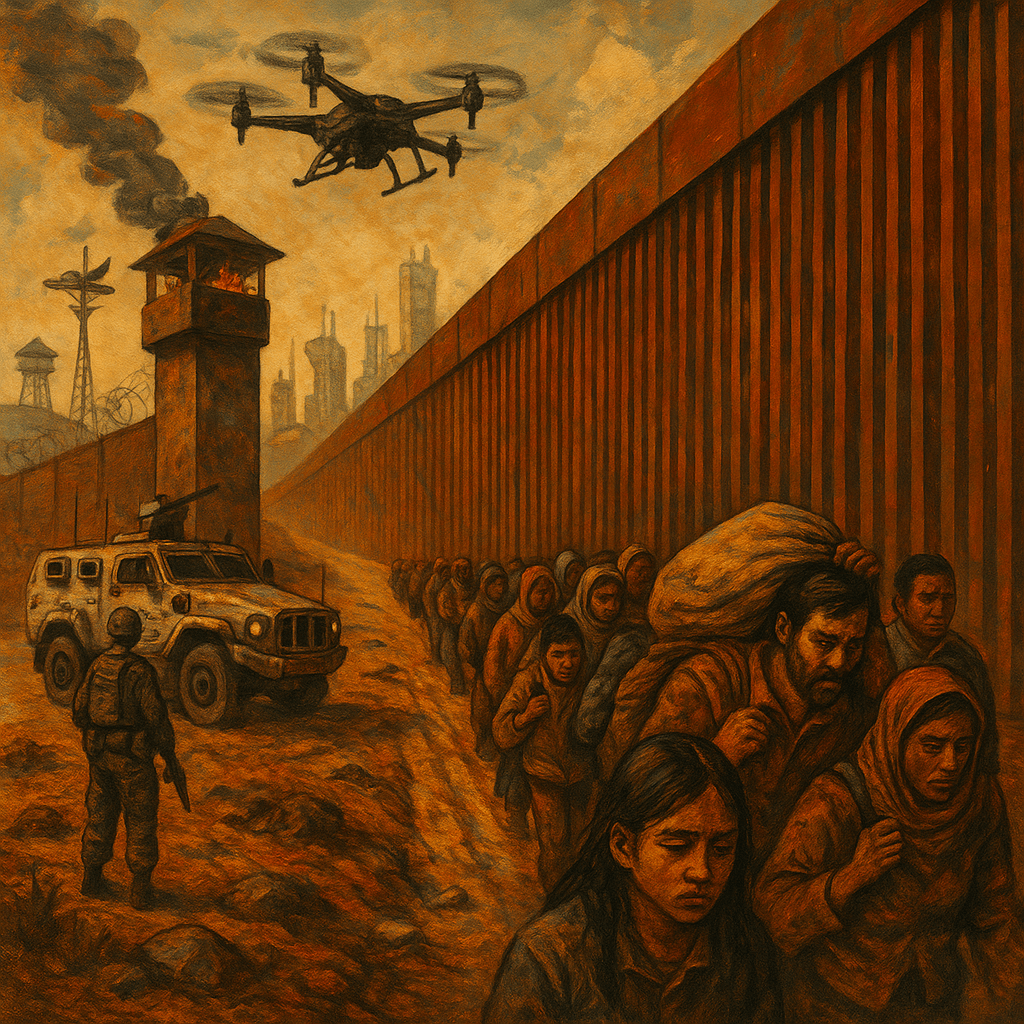
Exposing the U.S. border buffer zone as a technofascist frontline of counterinsurgency, corporate profit, and imperial crisis management.
By Prince Kapone | Weaponized Information
May 4, 2025
Part I: The Media’s War Story—How Propaganda Sanitizes Militarized Repression
The headline says it plain: “82 Charged with Trespassing on Military Property.” A story from KRQE News 13, a station owned by Nexstar Media Group—the biggest local TV conglomerate in the U.S., a corporate behemoth owning over 200 stations, backed by the Wall Street giant Apollo Global Management. But make no mistake: this ain’t just “local news.” This is monopoly-finance capital doing what it’s always done—controlling the airwaves to control the story, controlling the story to control the people. Louis Althusser told us long ago: these media outlets are ideological state apparatuses. Their job isn’t to inform us; it’s to discipline us. What you’re reading here is cognitive counterinsurgency, what Michael Parenti once called “soft repression”—the art of training our minds to bow before the state without realizing we’ve been conquered.
Look at the words they use: “charged.” “trespassing.” “military property.” Every phrase does legal work, laundering state violence through the language of law. This is fascist juridical theater—a courtroom play meant to turn an act of survival into a criminal offense. “82 people” get turned into a faceless number, a bureaucratic data point. Their names, their histories, their reasons for crossing? Nowhere. They’ve been stripped of humanity and turned into what Marx would call commodified abstractions—no longer living, breathing workers fleeing imperialist ruin, but criminal bodies invading imperial property. Their displacement doesn’t matter here; only their violation of the state’s line in the dirt.
The article repeats the U.S. Attorney’s press release without a question, without a challenge: “The U.S. Attorney for the District of New Mexico says a total of 82 people have been charged… for unauthorized entry into the military’s new buffer zone.” And just like that, the “buffer zone” becomes a given, a fact of life, something neutral, something technical. Nowhere do they tell you what the Roosevelt Reserve really is: stolen Indigenous land. Nowhere do they tell you this land has passed, once again, from settler bureaucrats at the Department of the Interior to settler generals at the Pentagon. It’s the same colonial story, just with fancier uniforms. Jodi Byrd taught us to call this the transit of empire—the slow, steady normalization of Indigenous dispossession under empire’s endless expansion.
And then comes the punchline: “The Department of Justice will work hand in glove with the Department of Defense and the U.S. Border Patrol to gain 100 percent operational control.” The article quotes it like it’s just another bureaucratic update. But that phrase—“hand in glove”—says everything. This isn’t “coordination.” This is technofascism in action: the military, the police, the courts, all fusing into a single machine of repression, all under the command of monopoly capital. “Operational control” ain’t about defending a line—it’s a counterinsurgency strategy, aimed at controlling the movement of bodies, the flow of labor, the circuits of life itself. It’s Phoenix Program logic brought home, a war doctrine turned inward, making every migrant a suspect, every crossing a battlefield.
And what do they show us alongside these words? A picture: a U.S. Army Stryker armored vehicle parked next to the border wall, a soldier aiming through a scope. But where are the migrants? Gone. Erased. The camera doesn’t see them. And in not seeing them, it teaches us not to see them either. What you’re looking at is what Guy Debord called the spectacle: the aestheticization of state violence. They don’t show the families chased through the desert, the bodies buried in the sand, the children locked in cages. They show the armored vehicle, the soldier, the gun. And in doing so, they make the violence look clean, inevitable, sterile.
They even throw in a technical note: “even citizens could face sanctions.” See how sneaky that is? Technically true. But materially false. We know—because ACLU data tells us—that over 90% of Title 50 prosecutions target Latin American migrants. They tell you anyone could be targeted to make it seem fair, neutral. But the boot always lands on the same necks. That’s the function of legality under settler colonial capitalism: to mask racial terror behind the form of universal law.
But nowhere in this article will you find a whisper about who owns KRQE, about how Nexstar is financed by Apollo Global Management—the same Wall Street capital that bankrolls private prisons, surveillance contractors, and border wall builders. That silence is the loudest sound in the piece. Because this ain’t just “media bias.” This is monopoly capital using its media empire to justify its military empire. Nexstar profits from selling the narrative; Apollo profits from financing the carceral apparatus; the state profits from tightening the noose. It’s the same extraction logic: whether it’s oil, water, or land, whether it’s stories, bodies, or territories—they extract, they monetize, they control.
The article forgets a lot, but it’s not by accident. It forgets the 1994 Border Patrol Strategic Plan, which first declared the border a national security threat and turned migrants into de facto enemy combatants. It forgets COINTELPRO’s partnership with the press to criminalize Black, Brown, and Indigenous radicals. It forgets Fort Huachuca’s history as the nerve center of genocidal wars against Apache peoples—and today, as a training ground for NSA cyber-surveillance. These aren’t footnotes; they’re the spine of the story. Leaving them out is how propaganda works: by making history invisible, it makes injustice seem natural.
This article doesn’t just report repression; it performs fascist normalization. It takes an act of colonial military occupation and makes it sound like bureaucratic routine. It takes a counterinsurgency campaign and makes it look like a zoning ordinance. And that, comrades, is the function of imperial media under technofascism: not just to tell lies, but to make the truth unspeakable. Our task isn’t just to call out the lie—it’s to destroy the platform that makes the lie possible. We don’t just need better stories. We need to seize Nexstar’s airwaves, to expropriate the tools of propaganda, to turn the narrative machine into a weapon of revolutionary education. Because until we do, the story will always belong to the empire.
Part II: Mapping the Technofascist Machine—Land Theft, Title 50, and the Infrastructure of Control
Let’s pull the mask off this story and lay out what the article actually tells us—and more importantly, what it doesn’t. The facts are these: the U.S. government has declared a 170-mile stretch of the U.S.-Mexico border a “National Defense Area.” This buffer zone, 60 feet wide, stretches across the Roosevelt Reserve, a piece of federal land recently transferred from the Department of the Interior to the Pentagon. The land is now under the jurisdiction of Joint Task Force–Southern Border, operating out of Fort Huachuca, Arizona. Since at least April 24th, 82 people have been arrested and charged under Title 50, a Cold War statute originally written for foreign espionage and military property protection, now deployed domestically against migrants. “Trespassers will be federally prosecuted,” the U.S. Attorney promises. And the Justice Department, Defense Department, and Border Patrol are working “hand in glove” to achieve “100 percent operational control.”
Those are the official facts. But facts don’t speak for themselves; they have to be put in historical motion. And once we set them in motion, we see something deeper: this isn’t just a legal measure, it’s part of a 70-year process of transforming the U.S. into a militarized surveillance state—a state that has steadily merged its imperial war machine abroad with its domestic policing machine at home. This is what we call technofascism: a fusion of military force, digital surveillance, carceral management, and monopoly capital, all welded together to control populations in crisis.
The use of Title 50—a statute once confined to Cold War counter-espionage—is no bureaucratic accident. It’s a signal. Since the 1981 Military Cooperation with Civilian Law Enforcement Act, the boundaries between military and police have been deliberately blurred. Post-9/11, that process accelerated: Homeland Security’s budget ballooned from $19.5 billion in 2003 to over $103 billion by 2023. Every dollar fed new drones, new surveillance towers, new databases, new contracts for Palantir, Anduril, and Raytheon. What was once called “border security” is now a sprawling domestic counterinsurgency infrastructure, capable of monitoring, tracking, and suppressing any population it deems surplus or suspect.
The land in question—the Roosevelt Reserve—isn’t just a random federal strip. It’s Indigenous land, stolen by the U.S. settler-colonial state and repurposed again and again for imperial uses. First expropriated to establish settler sovereignty, it was militarized to suppress Native resistance, then bureaucratized as a federal reserve, and now militarized anew under Pentagon control. This is the continuity of colonial contradiction: the U.S. cannot defend its borders without deepening the theft of land from the very nations it displaced. Every military checkpoint erected here is an extension of that original expropriation, an ongoing enclosure in the tradition of what Marx called primitive accumulation.
And the base overseeing this operation—Fort Huachuca—isn’t just another Army post. It was built as a command center for the genocidal campaigns against the Apache. Today it serves as a nerve center for NSA cyber-surveillance and drone warfare training. The same post that once hunted Indigenous warriors now trains the empire’s digital assassins. That’s no coincidence. That’s settler-colonial militarism evolving to meet the demands of the 21st century: from rifles and sabers to biometrics and algorithms.
When the U.S. Attorney brags about achieving “operational control,” we should recognize this language. It’s not about stopping individual migrants; it’s about exerting total dominance over a territory and the bodies within it. This is logistical counterinsurgency: the idea that borders are not just lines to defend, but spaces to be managed, flows to be mapped, populations to be sorted and disciplined. It’s the same logic that governed the Phoenix Program in Vietnam, now internalized within U.S. territory, aimed not at Viet Cong villages but at displaced workers from Latin America.
And who profits from this militarized enclosure? Follow the money. The buffer zone’s drones are supplied by Anduril Industries, whose founder Palmer Luckey sold the company’s Lattice surveillance system to Customs and Border Protection for $250 million. Data from arrests feeds directly into Palantir’s analytics platform, worth $49 million in ICE contracts last year alone. These aren’t side hustles—they’re profit streams for monopoly-finance capital, making the repression of migrants not just a political project, but an economic one. Every arrested migrant becomes a data point in a growing surveillance portfolio, a justification for the next contract, the next expansion, the next drone.
This is how the U.S. state converts public land into military territory, then converts that militarized space into a cash machine for monopoly capital. The same empire that fenced off the frontier is fencing off new “internal frontiers”—enclosing space not just to keep people out, but to turn the very policing of movement into a marketable commodity. Deborah Cowen calls this the deadly life of logistics: the way capitalist systems monetize the management of bodies, borders, and threats.
In this story, the migrants are never described as workers. They’re never contextualized as refugees from imperial plunder. They’re never seen as surplus labor displaced by free trade, coups, and climate catastrophe. Instead, they’re reduced to “trespassers”—a depersonalized, racialized “other” violating the sacred property of empire. And in that move, they’re criminalized not for what they’ve done, but for what they represent: the global poor, the colonized, the dispossessed knocking on empire’s gates.
What this buffer zone represents, then, is not a new chapter, but an old one written with new tools. It’s the continuation of settler colonial militarism, racial capitalism, and imperial logistics, fused under the sign of technofascism. A zone where monopoly capital, the Pentagon, and the carceral state merge to transform stolen land into an accumulation frontier: a space for extracting profit from repression, a laboratory for perfecting the management of surplus populations, a scaffold for future counterinsurgency.
Part III: Reframing the Border—An Accumulation Frontier for Capital, a Carceral Frontier for Labor
The imperialist media tells us this is “border security.” We call it what it is: technofascism. And technofascism, comrades, is not a slogan—it’s a system. A system forged at the intersection of monopoly-finance capital, military policing, digital surveillance, and racialized repression. Every drone in the buffer zone, every biometric scan at the checkpoint, every data point logged into Palantir’s ICE database is a cog in this machine. And this machine wasn’t built by accident—it was engineered to discipline labor, militarize territory, and enforce the racial hierarchies that capitalist accumulation demands.
This buffer zone is not just a border—it’s what Deborah Cowen calls an accumulation frontier: a site where capital extracts profit not through production, but through the logistics of repression itself. And who cashes in? Anduril Industries, raking in $250 million for its Lattice surveillance grid. Palantir, pocketing $49 million to process ICE raids. CoreCivic and GEO Group, profiting from every detention bed filled. Nexstar Media Group, selling the ideological cover. The ruling class doesn’t just militarize the border—they monetize it, turning repression into a business model, turning migrants into revenue streams, turning state violence into a return on investment.
But this isn’t just a story about money. It’s a story about power. The creation of the buffer zone is a textbook case of what Fanon called the colonial contradiction: the settler colony must expand its carceral frontier to maintain control over the very populations it displaces. By militarizing the Roosevelt Reserve, the U.S. state deepens its hold over stolen Indigenous land while criminalizing the displaced bodies of Latin American workers whose homelands have been ravaged by free trade, coups, and extraction. The same imperial machine that robs their countries now robs their freedom at the border.
In the eyes of the state, these migrants are not seen as workers—they are categorized as “non-state hostile actors.” That’s military doctrine, comrades. It means the border isn’t a line; it’s a battlespace. And once a territory becomes a battlespace, every person crossing it is a target. Every migrant is pre-coded as a threat, a trespasser, a problem to be neutralized. This is the logic of logistical counterinsurgency: mapping, managing, and eliminating flows of people to protect imperial circulation.
The buffer zone is thus a living monument to what Ruth Wilson Gilmore calls organized abandonment: the deliberate disposability of surplus populations in the service of racial capitalism. Migrants don’t just cross a militarized border—they cross an internal colony, a carceral landscape where their movement is criminalized, their bodies are commodified, and their existence is treated as a risk to be managed by algorithms and drones.
And make no mistake: this repression doesn’t stop at migrants. The same surveillance towers scanning the desert will soon scan urban streets. The same predictive policing software tracking border crossings will be redeployed in Black, Brown, and poor neighborhoods. The same military hardware deployed here will be aimed at domestic dissent tomorrow. The buffer zone is a laboratory for imperial counterinsurgency—a dry run for the mass pacification of the entire working class.
We’ve seen this before. From the Texas Rangers terrorizing Mexican communities, to Operation Wetback deporting a million workers in 1954, to the urban uprisings of the 1960s crushed by militarized police—every chapter of U.S. history teaches the same lesson: the state builds its repressive apparatus on the backs of the colonized, then expands it to discipline the whole working class. What starts as racial terror at the margins metastasizes into class warfare at the core.
That’s why this isn’t just a “border issue.” This is a class war from above. The buffer zone isn’t securing a border; it’s securing capital’s control over labor. It’s securing monopoly-finance capital’s ability to recalibrate the domestic workforce—to terrorize migrants into silence, to terrify citizens into submission, to drive wages down by making every worker feel disposable, precarious, surveilled.
This is technofascist labor recalibration: the use of mass deportations, surveillance, and militarized repression to reset labor relations under conditions of capitalist crisis. As the global South rises, as China and BRICS+ challenge U.S. dominance, the empire cannot rely on outsourcing forever. It must bring production home—but it will only do so if it can recreate Third World conditions inside its own borders. And to achieve that, it needs to smash solidarity, shatter unions, and reimpose colonial modes of labor discipline on Black, Brown, migrant, and poor settler workers alike.
Every drone flight over the buffer zone is a message to every worker: there is no outside the system of surveillance. Every armored vehicle is a reminder: resistance will be met with overwhelming force. But every act of repression reveals the state’s weakness, too: it cannot secure consent, so it must govern through fear. And fear, comrades, is brittle. It cracks under mass defiance.
That’s why our task is not to beg for reforms or oversight. It’s not to make technofascism more “humane.” It’s to dismantle the entire apparatus: to smash the surveillance towers, to sabotage the drones, to burn the databases, to abolish the border patrol, to return the land to its rightful caretakers, to break the accumulation frontier that feeds monopoly capital’s hunger.
The imperialist media wants us to see a technical measure. We see a war against the people. We see a military occupation of stolen land. We see a logistical infrastructure for racial capitalism. We see a system of repression that, if not destroyed, will consume every one of us. The question is not whether we oppose it. The question is how far we are willing to go to bring it down.
Part IV: From Solidarity to Sabotage—Building Revolutionary Counter-Logistics
We’ve excavated the propaganda. We’ve traced the historical line. We’ve reframed the narrative. Now comes the real task: mobilizing revolutionary solidarity. Because exposing the technofascist machine is just the beginning. What matters is how we fight it, dismantle it, and build something better on its ashes.
Let’s be clear: this buffer zone isn’t an isolated aberration—it’s part of a global system of imperial logistics. And across that system, people are resisting. From the Tohono O’odham Nation resisting the desecration of their lands by border militarization, to Indigenous water protectors at Organ Pipe Cactus National Monument chaining themselves to construction equipment in 2022, to No More Deaths volunteers risking arrest to leave water and food in the desert—struggles are already unfolding on the frontlines of technofascist expansion.
These aren’t charity projects. They’re acts of revolutionary mutual aid, defying the empire’s legal structures, disrupting its logistical flow, and affirming that life is more valuable than the empire’s “operational control.” And every act of solidarity cracks the smooth facade of technofascism. Every bottle of water left in the desert, every drone blinded by a laser pointer, every tower sabotaged is a rupture in the accumulation frontier.
We need to expand these cracks. Because the fight at the border is inseparable from the fight in the city, the fight in the workplace, the fight in the prison yard. The same drones flying over the buffer zone will soon monitor urban streets. The same biometric databases tagging migrants will tag Black youth as “threats” in predictive policing grids. The same military-industrial firms profiting from the buffer zone—Anduril, Palantir, Raytheon—are also arming police departments, running prison surveillance, and marketing their systems to governments worldwide.
That’s why solidarity can’t stop at the humanitarian. It must escalate into revolutionary counter-logistics: sabotaging the systems that make repression profitable. We need new networks of militant solidarity: hacker collectives disrupting biometric databases; workers inside defense contractors leaking blueprints; supply chain workers refusing to move military equipment; community brigades disabling surveillance infrastructure.
Historical models guide us. Think of the Chicano movement’s call for border abolition. The sanctuary movement of the 1980s, sheltering refugees from U.S.-backed death squads. The Black Panthers’ solidarity with Mexican farmworkers. The Zapatistas’ construction of autonomous zones beyond the reach of state repression. These are not relics—they are blueprints for insurgent solidarity across race, nation, and class.
We must learn from these struggles and go further. Because this moment demands not just solidarity, but coordinated resistance capable of disrupting the logistical lifelines of imperial control. The Stryker armored vehicles patrolling the buffer zone won’t be stopped by moral appeals. But they are vulnerable to mass collective action: blocked rail lines, disabled fuel depots, disrupted supply chains. The drones surveilling the border aren’t omnipotent. But they can be hacked, jammed, blinded, grounded.
That’s why we propose three immediate, concrete demands:
- Divest from all contracts with DHS, CBP, and the Pentagon’s domestic militarization programs. Cut the financial lifeblood of technofascism at its source.
- Return the Roosevelt Reserve to Indigenous jurisdiction under the stewardship of the original nations dispossessed by U.S. colonial expansion.
- Disband the U.S. Border Patrol and dismantle the buffer zone’s surveillance infrastructure, replacing repression with systems of cross-border mutual aid and popular sovereignty.
And beyond demands, we must act. Every community must map the technofascist machine in their terrain: where are the surveillance towers? The defense contractors? The data centers? The recruitment offices? Every node of the system is a potential target for disruption. Every logistical artery is a potential choke point. Every algorithm is a weakness waiting to be exploited.
Let’s stop asking how to make the border more “humane.” Let’s organize to abolish the border. Let’s stop asking how to reform the surveillance state. Let’s organize to dismantle it. Let’s stop mourning the stolen land. Let’s organize to take it back.
Because the buffer zone is a wall. But walls don’t last forever. And no drone, no biometric checkpoint, no armored vehicle can stop a people in motion. When the masses move together, the wall becomes a brittle relic. When the oppressed unite, no machine can contain them.
The border is not a line on a map. It’s a prison gate, a wage floor, a death sentence. And to tear it down is not an act of charity—it’s an act of revolutionary necessity.
 Weaponized Information
Leave a comment