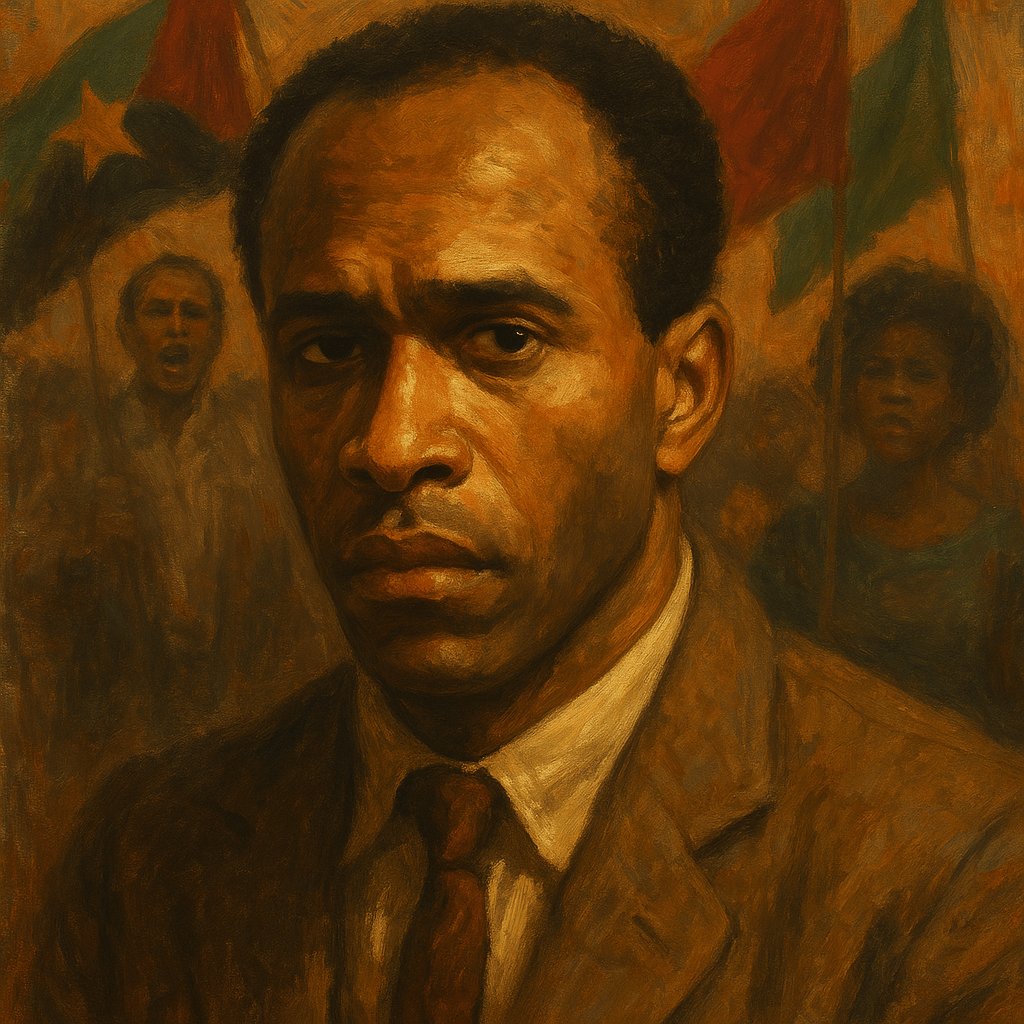
Part I: From Martinique to Blida – A Rebel Mind in the Making
Frantz Fanon was not born into revolution. He was born into colonial contradiction. In 1925, under the shadow of French imperialism, Fanon came screaming into the world in Fort-de-France, Martinique—a so-called “overseas department” that was in reality a Black colony governed by white settlers and administered by the logic of Paris. The island was draped in the trappings of French civilization, but underneath lay the same anti-Black racism and colonial domination that shaped the wider imperial world[1].
Fanon came of age in a settler society where Black people were taught to admire the language, culture, and history of their enslavers. “The West Indian… identified himself with the white man, adopted a white man’s attitude, ‘was a white man,’” he later wrote in bitter reflection[2]. But something in Fanon never fully assimilated. At 18, as fascism swept across Europe, he joined the Free French forces to fight against Nazi occupation—only to encounter the hypocrisy of white supremacy firsthand. He saw how colonial troops were thrown into the most dangerous battles, treated as expendable bodies for a Europe that denied their humanity[3].
After the war, Fanon returned to France, where he began his medical training in psychiatry and immersed himself in philosophy, literature, and existential thought. But the classroom could not contain his mind. In 1952, he published Black Skin, White Masks, an explosive psychological analysis of how racism distorts identity, alienates the colonized, and fractures the Black psyche. It was not written from abstraction—it was written from rage, from experience, and from struggle. “The black man has no ontological resistance in the eyes of the white man,” Fanon declared[4].
He did not stop with diagnosis. Fanon believed theory had to be a weapon—a tool in the arsenal of the oppressed. “We revolt simply because, for many reasons, we can no longer breathe,” he wrote in the opening pages of The Wretched of the Earth[5]. This was not metaphor. It was a call to arms.
In 1953, Fanon took a post as a psychiatrist at the Blida-Joinville Hospital in French-occupied Algeria. There, he treated both Algerians tortured by the colonial system and French soldiers traumatized by their role in enforcing it. Psychiatry, for Fanon, could not be neutral. “The colonial world is a world divided in two,” he later wrote. “The colonist and the colonized… are not merely different, but irreconcilably opposed”[6]. In Algeria, theory and praxis fused. Fanon soon joined the National Liberation Front (FLN) and became one of the revolution’s leading intellectual architects.
When French authorities began cracking down on resistance, Fanon resigned from his post and fled to Tunisia, where he became editor of the FLN’s newspaper El Moudjahid and a diplomat for the revolution. He traveled across the Global South, building networks of solidarity with African, Asian, and Latin American liberation movements. For Fanon, the Algerian Revolution was not an isolated struggle—it was the spearpoint of a worldwide fight against colonialism and neocolonialism. “Algeria is the vanguard of the African Revolution,” he declared in Accra[7].
This first stage of Fanon’s life—from Martinique to France to Algeria—formed the basis of his revolutionary worldview. He was a bridge between continents, between psychiatry and insurrection, between the trauma of colonization and the dignity of rebellion. He would spend the rest of his short life building that bridge into a weapon, one wielded by the oppressed in every corner of the colonized world.
Part II: The Healer Who Took Up Arms
Fanon’s weapon was not a pen—it was a scalpel. But he knew, by the time he was stationed in Algeria, that healing the psyche was impossible under the brutal weight of colonization. He treated tortured Algerian peasants and French soldiers breaking down from the trauma of administering that torture. “The colonist makes history,” he wrote, “his history… he is the absolute beginning”[8]. But Fanon chose to begin again. In 1956, he joined the FLN and resigned from the hospital. Colonial psychiatry could not cure a world on fire.
He became a revolutionary strategist and FLN propagandist, helping shape its ideological vision. He traveled across Africa to build bridges between anti-colonial movements, speaking at the All-African Peoples’ Conference in Accra and writing for El Moudjahid. Fanon didn’t just theorize the interconnectedness of struggles—he practiced it.
In The Wretched of the Earth, Fanon argued that violence was not simply a tactic—it was the dialectical response to the ontological negation of the colonized. “The colonized man finds his freedom in and through violence”[9]. Fanon did not romanticize bloodshed; he grounded it in psychological liberation. Resistance, for Fanon, was therapy.
But he also warned that the bourgeois nationalists who inherited independence might betray the people. He saw the danger of “flag independence” without social transformation. “The national bourgeoisie will be quite content with the role of the Western bourgeoisie’s business agent”[10]. If the people didn’t seize the reins of postcolonial power, neocolonialism would reign.
Fanon’s writings remain foundational because he understood colonization not merely as territorial theft, but as a system that entered the bloodstream and rewired the nervous system of the colonized. His call for liberation was total. Material, psychological, cultural, spiritual. And that is why his voice, though silenced by cancer at 36, still echoes through the revolutionary trenches today.
Part III: The Legacy of Fanon in a World Still Burning
Fanon died in 1961 at just 36 years old. But his legacy has never stopped breathing. His final act was to dictate The Wretched of the Earth from a hospital bed while dying of leukemia—his voice fading but uncompromising. “Each generation must, out of relative obscurity, discover its mission, fulfill it, or betray it,” he warned[11]. Fanon’s mission was to unmask the lies of liberal empire and teach the colonized how to fight for their full humanity.
His influence exploded across the Global South. In the 1960s and 70s, the Black Panther Party in the United States read him religiously. Huey Newton called Fanon a “beautiful brother” whose ideas shaped the Party’s theory of the lumpenproletariat and urban rebellion[12]. In South Africa, Steve Biko and the Black Consciousness Movement were profoundly influenced by Fanon’s insistence that “the most powerful weapon in the hands of the oppressor is the mind of the oppressed.”
In Latin America, Fanon’s critique of colonialism helped shape radical movements from the Sandinistas in Nicaragua to Brazil’s landless peasants. In Palestine, revolutionaries cited Fanon’s analysis of violence and resistance under settler regimes[13]. His work provided not just theory but legitimacy: a way for the oppressed to understand that resistance was not only righteous—it was necessary.
But Fanon also issued a prophetic warning. In The Pitfalls of National Consciousness, he foresaw how the post-independence national bourgeoisie would abandon the people in pursuit of profit and prestige. “The national bourgeoisie discovers its historical mission: that of intermediary,” he wrote, “of being the transmission line between the nation and capitalism”[14]. We see this betrayal play out across postcolonial Africa, where comprador elites sell out natural resources, privatize health and education, and repress dissent in the name of “democracy.”
In today’s era of hyper-imperialism, where drone wars replace boots on the ground, where NGOs replace revolutionary parties, and where data colonialism is wrapped in Silicon Valley sheen, Fanon remains more relevant than ever. His theory of psychological decolonization offers a roadmap for breaking free from not only material subjugation, but epistemic captivity.
Fanon did not offer a final blueprint. He offered a method: read reality, understand contradiction, act boldly. For revolutionaries today, his lesson is clear: the soul of the people cannot be liberated through negotiation with empire. It must be liberated by smashing the very systems that dehumanize us. And that liberation must be whole—economic, cultural, psychic, political.
Frantz Fanon is not an artifact. He is a weapon still waiting to be picked up.
Part IV: Fanon and the Struggle Ahead
Fanon’s work does not belong in the museum of leftist nostalgia. It belongs in the tactical training of every revolutionary cadre confronting neocolonialism, racism, fascism, and technocratic imperialism today. In a world ruled by algorithms, drones, and debt, the same principles he laid out in the heat of the Algerian revolution remain applicable. His dialectical lens, forged under fire, teaches us how to name the contradictions of the present: neocolonial states dependent on capital markets, NGOs acting as ideological cover for imperialism, and technofascist surveillance networks enforcing social control under the guise of progress.[15]
Today, Fanon’s theory of psychological liberation through struggle must be taken seriously. In communities where colonial trauma has metastasized into self-hate, addiction, and nihilism, Fanon offers a roadmap back to dignity—not through therapy alone, but through organized confrontation with the systems of domination. In ghettoes, reservations, favelas, refugee camps, and prisons, his theory breathes.
He warned us about the national bourgeoisie—those who wear the skin of the oppressed but manage the empire’s assets. He called out the substitution of nationalism for revolution, and the tragedy of movements that stopped at flag-raising. He insisted that no true liberation was possible without radical transformation of the social, economic, and cultural order. “What matters today,” he wrote, “is not the idiotic question of whether or not one should go back to the past, but the fact that the past can no longer serve as a screen behind which we can block the future”[16].
The future Fanon envisioned was not utopia. It was not Europe painted Black or a kinder, gentler colonialism. It was a new humanism rooted in solidarity, production, and revolutionary consciousness. It was the decolonization of being itself.
As we face the crises of the 21st century—climate collapse, settler violence, neocolonial extraction, digital enslavement—Fanon reminds us that no savior is coming. We must become our own liberators. That task requires courage, analysis, and commitment. It requires that we do more than quote Fanon. It requires that we complete his mission.
History has not yet closed the book on the wretched of the earth. And so long as that chapter remains open, Fanon’s weaponized theory remains loaded—waiting in the hands of the next generation.
Annotated Bibliography
- [1] Zeilig, Leo. Frantz Fanon. I.B. Tauris, 2016. Provides foundational biographical details on Fanon’s early life and colonial upbringing.
- [2] Fanon, Frantz. “West Indians and Africans.” In Toward the African Revolution. Grove Press, 1967.
- [3] Macey, David. Frantz Fanon: A Life. Verso, 2000. Key source on Fanon’s WWII experience and political development.
- [4] Fanon, Frantz. Black Skin, White Masks, trans. Richard Philcox. Grove Press, 2008. Chapter 5, “The Fact of Blackness.”
- [5] Fanon, Frantz. The Wretched of the Earth, trans. Constance Farrington. Grove Press, 1963. Introduction.
- [6] Ibid. Chapter 1, “Concerning Violence.”
- [7] Fanon, Frantz. “Algeria in Accra.” In Toward the African Revolution. Grove Press, 1967.
- [8] Fanon, Frantz. The Wretched of the Earth, Chapter 1. Commentary on colonial historicity and rupture.
- [9] Ibid., Chapter 1. Analysis of decolonial violence as a means of liberation.
- [10] Ibid., “The Pitfalls of National Consciousness.”
- [11] Ibid., Introduction. Quote on generational mission and responsibility.
- [12] Newton, Huey P. Revolutionary Suicide. Penguin, 2009. Recounts the influence of Fanon on Black Panther Party ideology.
- [13] Said, Edward. Culture and Imperialism. Vintage, 1993. Discusses Fanon’s influence on anti-colonial resistance globally.
- [14] Fanon, Frantz. The Wretched of the Earth, “The Pitfalls of National Consciousness.”
- [15] Rodney, Walter. How Europe Underdeveloped Africa. Bogle-L’Ouverture Publications, 1972. Provides parallel critique of neocolonial bourgeois classes.
- [16] Fanon, Frantz. Black Skin, White Masks, conclusion. Reflections on new humanism and decolonization of the self.
 Weaponized Information
Leave a comment