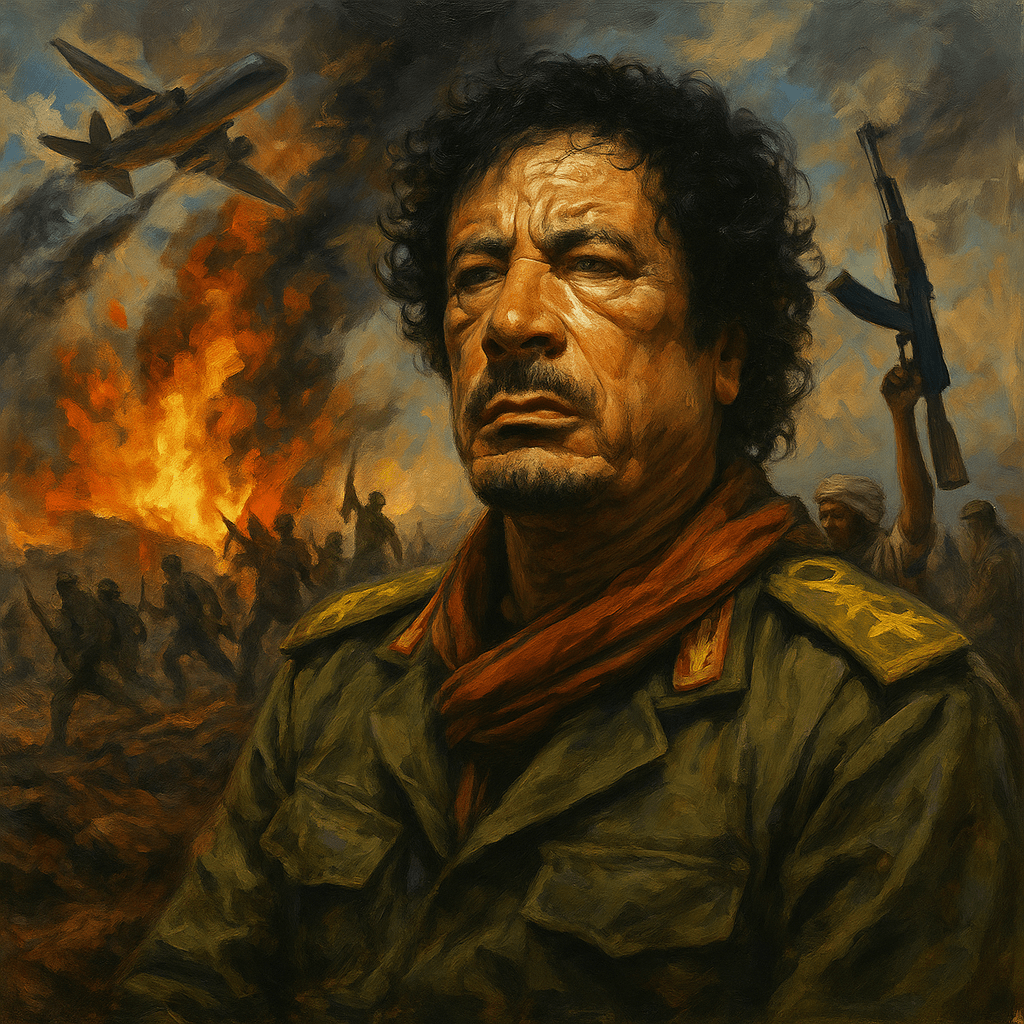
Prologue: The Man They Couldn’t Control
Before the bombs. Before the lies. Before the bayonet and the betrayal, Muammar Gaddafi was a barefoot boy in the red sands of Sirte, raised under a sky scorched by empire. He lived in a tent. He read the Quran by lamplight. He watched colonial soldiers parade through his land—and decided, at an early age, that his people would never again kneel before Europe.
For 42 years, Gaddafi led the only oil-rich country in the Global South that refused to become a petrol station for Western capital. He built homes for the homeless, clinics for the sick, farms in the desert, and schools where once there had been none. He raised Libya’s literacy rate from 25% to over 80%. He made water flow from stone with the Great Man-Made River. And still, they called him a madman.
But Gaddafi was not mad. He was dangerous—because he dreamed of a sovereign Africa. And because he had the oil, the gold, the guns, and the ideology to make it real.
“They do not want revolutionaries who speak on behalf of the poor. They want puppets who manage imperialism in a black or brown face.”
— Muammar Gaddafi, UN Speech, 2009
I. From the Sands of Sirte: Early Life & Political Formation
Gaddafi was born in 1942 in the harsh expanse of Libya’s desert interior. His family were Bedouins—nomadic herders displaced by the Italian occupation that brutalized Libya from 1911 until 1943. Italy’s fascist project killed hundreds of thousands of Libyans. The scars of colonialism were written into the very soil he walked.
Even as a boy, Gaddafi carried the revolutionary memory of Omar Mukhtar, the Lion of the Desert who resisted Mussolini’s armies. He would later say that Mukhtar’s execution by hanging was one of the defining moments of his youth: “The rope around his neck became the flag of my generation.”
His education was meager at first—but he devoured books on history, Arab nationalism, and anti-colonial struggle. In 1961, he entered the Royal Military Academy in Benghazi, not to serve the monarchy, but to overthrow it. There, he organized a clandestine group modeled after Nasser’s Free Officers in Egypt.
“I did not join the army to defend the king. I joined to train for the revolution.”
— Gaddafi, Revolutionary Memoirs, 1971
II. September 1, 1969: The Revolution of the Free Officers
In the early hours of September 1, 1969, Gaddafi’s group of junior officers moved swiftly to depose King Idris, a corrupt monarch propped up by British oil interests. Without bloodshed, they seized the key bases, radio stations, and ministries. By dawn, Libya belonged to its people.
The Libyan Arab Republic was declared. Gaddafi was just 27.
In his first public address, he didn’t flatter the military or seek applause. He announced the end of monarchy, imperialist puppetry, and foreign military bases. He announced that Libya would be free, and its oil would never again be siphoned by Shell, BP, or Esso.
“We are not kings. We are not presidents. We are the servants of the revolution.”
— Muammar Gaddafi, 1969
From day one, he began purging colonial law, nationalizing oil and banks, and expelling foreign military installations. Within a year, U.S. and British forces were gone. Libyan oil profits were redirected to education, housing, and public works. Infant mortality plummeted. The country’s literacy rate skyrocketed. In rural areas that had never seen electricity or running water, the lights finally came on.
III. The Green Book and the Birth of the Jamahiriya
In the early 1970s, Gaddafi began writing a new political philosophy: The Green Book. Part manifesto, part revolutionary manual, it rejected both liberal capitalism and Soviet-style communism as systems of elite rule. Gaddafi’s third way was simple: “Power, wealth, and arms must be in the hands of the people.”
In 1977, he declared Libya the Jamahiriya—a stateless state, a “mass democracy” governed through popular congresses, people’s committees, and local councils. Every Libyan, in theory and in many cases practice, had the right to vote directly on budgets, policies, and foreign affairs. Ministers were not elected officials—they were mandated delegates, recallable by their communities.
This was not liberal democracy. It was direct democracy. It was messy. It was often contradictory. But it was Libyan, and it was theirs.
“Representation is a fraud. Parties are a form of dictatorship. To be ruled is to be colonized, whether by a foreign army or a ballot box.”
— Muammar Gaddafi, The Green Book
By the 1980s, Libya had one of the highest standards of living in Africa. Basic food items were subsidized. Electricity was free. Housing was guaranteed by law. Education and healthcare were universal. Unemployment fell. Women gained access to education, the workforce, and legal protections. Under Gaddafi, Libya climbed from one of the poorest nations in the world to the richest in Africa by UNDP measurements.
IV. Homes, Health, and Human Dignity: The Jamahiriya in Practice
Under Gaddafi’s leadership, Libya became the envy of Africa—and a direct challenge to the West’s neocolonial order. While the U.S. built prisons and surveillance states, Libya built homes, hospitals, schools, and power grids. Gaddafi often reminded the world: “Housing is a human right, not a commodity.”
So he made it law. Rents were abolished. Landlords were banned. Every Libyan family was guaranteed a home, interest-free. The state built hundreds of thousands of modern apartments and distributed them at no cost. Homelessness, which had plagued urban Libya under the monarchy, dropped to near zero.
Electricity was made free. Education—from preschool to university—was free. Healthcare was free. Life expectancy jumped from 54 in 1969 to over 74 by the 1990s. Child mortality plummeted. Vaccination rates soared. In rural towns where colonial medicine had never reached, Gaddafi built new clinics and imported Cuban doctors. By the 1980s, over 70% of Libyans lived within five kilometers of a healthcare facility.
Women, long marginalized under tribal and religious patriarchies, were uplifted. Gaddafi’s government outlawed forced marriage, criminalized domestic violence, and promoted women into revolutionary leadership. In schools and in militias, in hospitals and in councils, Libyan women took their place in society as full and equal participants in the revolution.
“No man has the right to own the home of another. No man has the right to deny a woman the power to learn or lead. Revolution means dignity for all.”
— Muammar Gaddafi, Revolutionary Address, 1978
Unemployment dropped below 6%. Income inequality was the lowest in the Arab world. Libya’s Human Development Index (HDI) became the highest in Africa—higher than oil-rich Nigeria, higher than U.S.-aligned Egypt. The Jamahiriya system wasn’t perfect. But it was proof that an oil-rich Global South nation could serve its people—not ExxonMobil.
V. A River in the Desert: The Great Man-Made Miracle
Perhaps no project better symbolized Gaddafi’s defiance of nature, empire, and dependence than the Great Man-Made River. Started in the 1980s, it was the largest water infrastructure project in human history—an underground network of pipelines bringing pure water from deep Saharan aquifers to Libya’s cities, farms, and schools.
Over 1,300 wells—some more than 500 meters deep—fed a network of 2,800 kilometers of pipeline. This wasn’t World Bank-funded. It wasn’t built by Bechtel or Halliburton. It was Libyan-engineered, Libyan-financed, and built with public funds and revolutionary labor.
It brought over 6.5 million cubic meters of water per day to the coast, irrigating farmland and feeding entire cities. Gaddafi called it “the eighth wonder of the world.” UNESCO engineers called it “one of the most ambitious feats of engineering of the 20th century.” The people called it a miracle.
“We turned the desert into life. Not with debt. Not with charity. With revolution.”
— Gaddafi, at the Great Man-Made River Inauguration, 1991
The West never forgave him for this. They couldn’t privatize it. They couldn’t control it. And they knew: if Africa followed Gaddafi’s model—using natural wealth to serve people instead of capital—they’d lose the continent forever.
VI. The Third World Stands Up: Gaddafi and the Global South
Gaddafi didn’t see Libya as an island. He saw it as a lighthouse. He dedicated much of his life to building a united, sovereign Africa—free from IMF chains, EU bribes, and U.S. military bases. He funded the African Union, helped establish the African Investment Bank, and proposed a single continental currency: the Gold Dinar, backed by Libya’s 144 tons of gold reserves.
He offered to pay off the debts of 46 African nations. He built satellite infrastructure so African countries wouldn’t have to pay Europe for their own telecommunications. He trained thousands of African doctors, engineers, and pilots. He supported liberation movements across the continent—from the ANC in South Africa to SWAPO in Namibia to PAIGC in Guinea-Bissau.
And it didn’t stop with Africa. Gaddafi offered direct solidarity to Palestine. He honored Patrice Lumumba, Thomas Sankara, and Che Guevara. He welcomed Louis Farrakhan, Nelson Mandela, Hugo Chávez, and Evo Morales. In 1982, he hosted a summit of anti-imperialist states in Tripoli, calling for a “United Nations of the Global South.”
“The world is not the property of America. The seas do not belong to NATO. And the sky is not a parking lot for Western bombs.”
— Muammar Gaddafi, OAU Address, 2002
This is what made him dangerous. Not just that he talked revolution. But that he backed it with wealth, weapons, and will. Gaddafi didn’t beg for a seat at the table of empire. He flipped the table. And tried to build another one—circle-shaped, where every nation had a voice.
VII. The 2009 UN Speech: A Revolutionary in the Lion’s Den
In September 2009, Gaddafi stood at the podium of the United Nations General Assembly for the first time. As chairman of the African Union, he addressed the entire world—and he did not speak softly.
He ripped up a copy of the UN Charter and threw it down. “The Security Council is terrorism,” he declared, “permanent membership is dictatorship.” He called for its abolition or total restructuring to give equal voice to all 192 nations. He exposed NATO’s crimes in Iraq and Afghanistan, called for reparations to Africa, and demanded justice for the colonized and brutalized.
He mocked the “War on Terror” as a fraud. He condemned Zionism as a racist colonial ideology. He called out the hypocrisy of Western leaders who sold weapons to despots and bombed nations in the name of peace. He spoke, in clear and direct language, for the poor, the voiceless, and the colonized.
“The preamble of the UN Charter says nations are equal. But how can they be equal when one nation has the power to veto the will of the entire world? That is terrorism. That is colonialism.”
— Gaddafi, UNGA Speech, 2009
They cut his mic. The media mocked him. But the people heard him. In Harlem. In Soweto. In Caracas. In Gaza. They knew: Gaddafi didn’t come to play diplomat. He came to put the empire on trial.
VIII. The Tent and the Revolutionary Aesthetic
Western propagandists painted Gaddafi as flamboyant, eccentric, obsessed with vanity. But the truth, as always, was the opposite.
Gaddafi refused to live in presidential palaces. He often slept in his tent—even while visiting abroad. When he came to New York for the 2009 UN speech, he asked to pitch his Bedouin tent in Central Park. U.S. officials refused. But the symbolism was clear:
- A man from the colonized desert would not kneel before marble towers.
- He would not dine at imperial banquets. He would eat dates in his tent, as he always had.
- He would remain, to the last breath, a servant of the people—not a slave of luxury.
Even his military uniform—so often mocked—was not excess. It was anti-imperial pageantry. A costume of revolutionary dignity in a world ruled by suits and smiling murderers.
“I am a Bedouin. I live in a tent. I have no need for palaces. My tent goes with me—and so does the revolution.”
— Gaddafi, 2009
IX. Betrayal, Martyrdom, and the Flame That Never Died
In 2011, the empire struck back. Using the Arab Spring as cover, NATO launched a war of recolonization. It armed and funded a coalition of jihadists, defectors, tribal opportunists, and Al-Qaeda affiliates. The Libyan Jamahiriya, once the most advanced state in Africa, was branded a “dictatorship” overnight.
NATO planes bombed hospitals, universities, power plants, and water pipelines. They used drones and satellites to guide death squads. Gaddafi’s home was bombed. His children and grandchildren were murdered. And yet he stayed.
On October 20, 2011, as Gaddafi tried to escape the siege of Sirte in a convoy, NATO jets fired. Wounded and disoriented, he was captured. U.S.-armed mercenaries tortured him, sodomized him with a bayonet, and executed him on camera. Secretary of State Hillary Clinton laughed: “We came, we saw, he died.”
But martyrs do not die. They multiply.
“I will die here in Libya, as a martyr. I will not leave. This is my country, and I am one of its sons.”
— Muammar Gaddafi, Final Broadcast, 2011
In the years that followed, Libya collapsed into chaos. Open-air slave markets reappeared. Jihadists overran cities. NATO’s client state failed. And still, the media called it “liberation.”
But the people remember. In Bamako, they chant his name. In Soweto, they remember his gifts. In Harlem, in Damascus, in Managua, in Havana, his image is still carried high. Because Muammar Gaddafi was not perfect—but he was principled. And in a world ruled by cowards and liars, that made him immortal.
 Weaponized Information
Leave a comment