By Prince Kapone | Weaponized Information | April 2025
An Empire’s Fingerprints on the Ballot Box
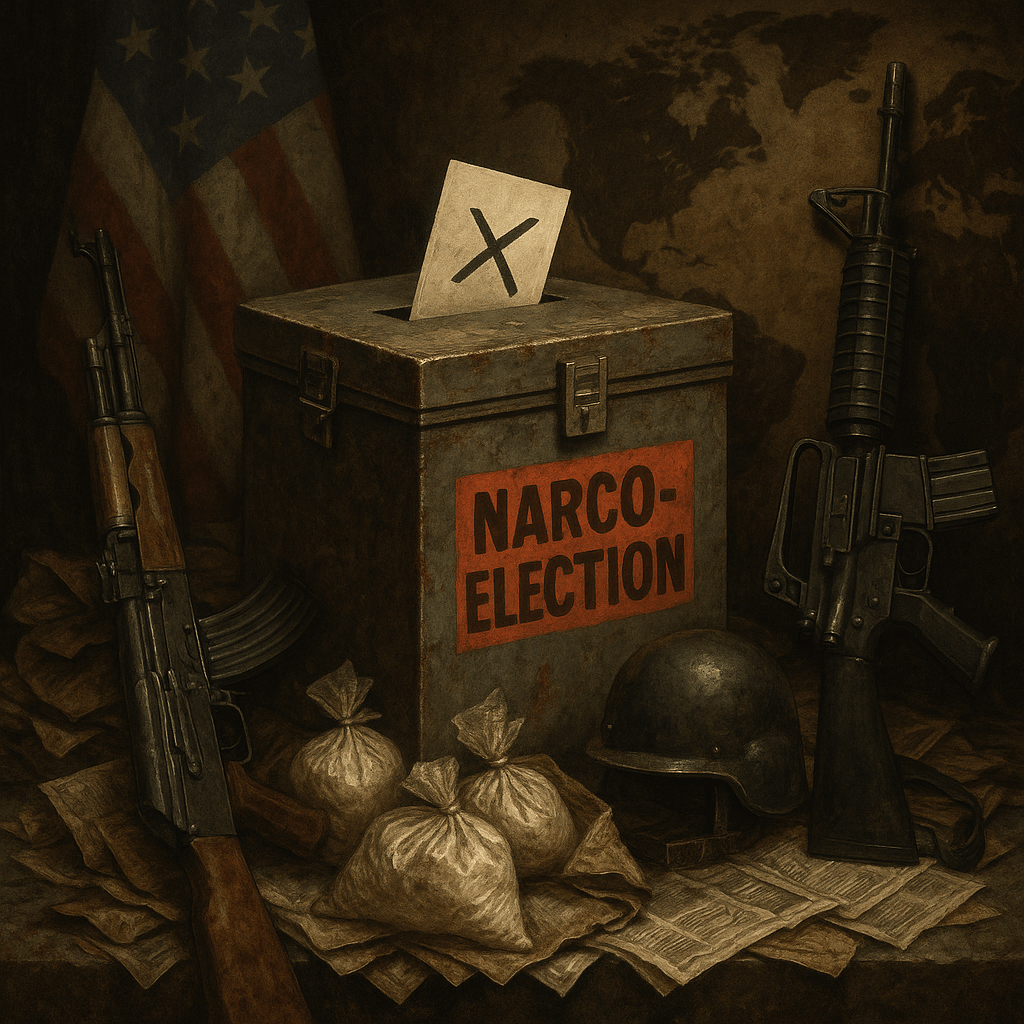
Ecuador’s 2025 presidential elections were not merely stolen — they were reprogrammed by a technofascist narco-state in service of imperial command. This wasn’t a glitch in democracy. It was a feature of empire.
The installation of Daniel Noboa wasn’t about the will of the Ecuadorian people. It was about cementing IMF austerity, suppressing popular sovereignty, and militarizing the Andes on behalf of Washington’s permanent war economy. What unfolded was a counterinsurgency masquerading as a democratic process.
This exposé draws from independent Latin American journalism, firsthand investigations, and decades of declassified material exposing the CIA’s narco-collaborationist playbook. From the Contras in Nicaragua to Uribe’s Colombia to the cocaine-flooded ports of Guayaquil, this is not a new phenomenon — it is simply the next iteration of it.
We are not here to analyze. We are here to indict.
Part I: The Fraud That Wasn’t Meant to Be Hidden
On April 14, 2025, Ecuador’s National Electoral Council (CNE) announced Daniel Noboa as the victor over Luisa González of the Citizens’ Revolution — a grassroots, working-class political formation rooted in the legacy of Rafael Correa. But before the digital ink had even dried, opposition forces, independent observers, and Latin American allies cried foul.
Venezuelan revolutionary leader Diosdado Cabello called the results “one of the most colossal scams in world political history,” linking the fraud directly to narco-cartel interests and U.S. imperial maneuvering (Telesur).
Exit polls conducted by independent firms like TresPuntoZero and MaLuk showed Luisa González with a lead throughout the day. But by nightfall, the numbers inverted. Massive statistical anomalies occurred in urban working-class precincts. Ballot box chain-of-custody protocols were broken in multiple provinces. More than 13,000 ballot boxes were challenged. Yet the CNE denied any recount, stating with a straight face that there were “no material inconsistencies” (Reuters).
Independent media outlets like Black Agenda Report revealed how U.S.-funded “democracy assistance” groups — working through USAID, the NED, and affiliated NGOs — deployed election-monitoring software and digital communication backdoors to surveil and manipulate the vote tabulation infrastructure. This was not incompetence — it was digital counterinsurgency.
This wasn’t just a stolen election. It was a dry run for algorithmic coups. With social media throttling dissent, corporate press echoing CNE lies, and U.S. diplomatic recognition fast-tracked within hours, the machinery moved with imperial precision.
This is how you crush a movement without tanks. You use the language of “transparency” while burying the truth under a mountain of code. You launder electoral sabotage through Silicon Valley partnerships, weaponized NGOs, and narcotrafficking client networks who prefer trade deals and tax havens over popular land reform.
And yet, the fraud was obvious to anyone who refused to be gaslit. It was visible in the exit polls. It was screamed by the barrios and the banlieues. It was confirmed by the rapid consolidation of imperial narratives, from the OAS to the New York Times.
González was never just a candidate. She was a stand-in for a class — and that class had to be silenced. The vote wasn’t stolen because Noboa was strong. It was stolen because the people were stronger.
Part II: Who Is Daniel Noboa? The Face of Narco-Oligarchy
Daniel Noboa is no reformer. He’s a rebrand — a neoliberal facelift for Ecuador’s centuries-old oligarchy. A fresh coat of tech-bro paint slapped over the bloodstained scaffolding of a narco-comprador state. He inherited wealth, offshore accounts, corporate monopolies, and the keys to the ports through which cocaine moves like currency. His only innovation? Learning to speak empire’s new language — algorithms, logistics, and digital security.
His family’s conglomerate, Lanfranco Holdings, sits atop a commercial empire riddled with narco-scandal. At least three failed cocaine shipments to Europe were traced back to Lanfranco-linked freight terminals. Noboa’s companies owe over $98 million in unpaid taxes — and when pressed, he responded with bourgeois honesty: he doesn’t intend to pay. (Black Agenda Report)
This isn’t just greed. This is structural impunity. While ordinary Ecuadorians are harassed for informal labor and street vending, the ruling class launders cocaine profits through shell companies with the blessing of international banks. The state’s customs intelligence division — supposedly tasked with monitoring private ports — was allocated a pitiful $33,633 in 2024. Only 17% of that was actually disbursed. The ports are not unregulated by accident. They are unregulated by design.
Journalists Andrés Durán and Anderson Boscán uncovered extensive evidence of cartel infiltration into the Ecuadorian state — implicating figures close to the Noboa political machine. Their reward? Exile. They received death threats and were forced to flee the country. Not a word from the U.S. State Department. Not a peep from the Organization of American States. Not even a murmur from the liberal NGOs who claim to protect journalists. Silence, because the revelations indicted the very system they uphold.
Noboa is not an aberration — he is the ideal client. Young, rich, market-friendly, and media-trained. He poses no threat to capital. He imposes no costs on empire. He offers up the country’s natural wealth, strategic ports, and working-class labor force to the highest bidder. And in return, he is insulated from scrutiny. This is the comprador class in its modern form — narcotic, digital, and above the law.
He does not govern Ecuador. He manages it. Like a data set. Like a shipping schedule. Like a plantation.
Part III: Operation Purga — Unmasking the Narco-State
In early 2025, the so-called “Operation Purga” broke into public view — a supposed anti-corruption drive that laid bare the depth of Ecuador’s narco-infiltration. But scratch beneath the headlines and the truth emerges: this wasn’t a purge of corruption. It was an internal housecleaning by a narco-state reorganizing itself for greater efficiency.
The revelations were staggering. Over thirty individuals, including judges, prosecutors, and legislators, were implicated in organized crime networks. Their crimes? Facilitating the release of cartel-linked prisoners, laundering money through real estate and logistics firms, and weaponizing the legal system to protect their partners in crime. Leading figures like Pablo Muentes — an influential Social Christian Party assemblyman — and Fabiola Gallardo, president of the Provincial Court of Guayas, were among those swept up (Wikipedia).
Yet beneath the spectacle of arrests, the deeper reality remained untouched. The private ports continued operating as laundering zones. The banks continued to process cartel money. The corporations continued to move product under the protective wing of the very state apparatus that pretended to regulate them.
Rather than dismantle the narco-state, Noboa’s regime moved to professionalize it. The message was clear: if you want to traffic drugs, launder profits, or broker deals, you must do so under the control of the “official” channels. Disorder was punished. Not the crime itself.
In Guayaquil — Ecuador’s economic lifeline and the country’s primary export port — violence soared. In 2024 alone, more than 5,000 violent deaths were recorded, many tied directly to cartel turf wars over port access. Yet the “solution” offered by Noboa wasn’t to dismantle the networks — it was to militarize the streets while leaving the elite logistics corridors untouched.
If this sounds familiar, that’s because it is. Honduras in the 1980s, Colombia in the 1990s, Mexico in the 2000s — everywhere the U.S. “War on Drugs” planted its boot, the result was the same: militarized repression of the poor and strategic protection of the drug routes crucial to imperial finance.
Operation Purga wasn’t a break from narco-rule. It was its logical evolution.
Part IV: U.S. Empire and the Business of Narco-States
To understand what happened in Ecuador, we must trace the bloodline of empire. This wasn’t some isolated banana republic glitch. It was the continuation of a continental doctrine — one authored in Langley, enforced through logistics, and baptized in cocaine. From Nicaragua to Colombia, from Honduras to Panama, the United States has long used narco-states as counterinsurgency weapons. Ecuador is simply the next iteration.
Start with the Contras in Nicaragua. In the 1980s, the CIA-backed rebels waged war on the Sandinista government with U.S. arms and cartel money. Investigative journalist Gary Webb revealed that Contras were allowed to traffic cocaine into the U.S. with impunity. The profits funded anti-communist terror while seeding the crack epidemic in Black communities across America. The story was denied, ridiculed, then quietly confirmed in declassified documents. Webb lost his career. The CIA kept its networks. [Jacobin]
Then turn to Colombia. Álvaro Uribe, U.S.-backed president and central figure of Plan Colombia, was named in a 1991 Defense Intelligence Agency report as having ties to the Medellín Cartel. The same report listed him as a “close personal friend of Pablo Escobar.” Yet throughout his presidency, Uribe was lavished with military aid and diplomatic cover, even as paramilitary death squads and drug exports surged. [National Security Archive]
In Honduras, the empire installed Juan Orlando Hernández — a man whose brother was convicted in U.S. courts for smuggling tons of cocaine. Prosecutors alleged JOH himself was a “co-conspirator” in the same trafficking operation. And yet, while drugs flowed and dissent was met with bullets, the U.S. armed and trained his military under the banner of “democracy assistance.” [Responsible Statecraft]
Go further back to Panama. In the 1980s, General Manuel Noriega — a long-time CIA asset — facilitated the trafficking of Colombian cocaine through military-protected routes. A U.S. operation known as Watchtower helped guide cartel flights using CIA radio beacons. Noriega eventually got too big for his leash, so the U.S. invaded in 1989. They bombed poor neighborhoods, killed thousands, removed Noriega — and kept the trafficking lanes. [Wired]
All of this is the blueprint. U.S. imperialism does not fight drugs. It manages them. It uses narco-states to destabilize leftist movements, funnel capital into friendly hands, and militarize logistics corridors. The cartels are not enemies of the state — they are subcontractors of it.
And now, Ecuador joins this bloodied lineage. The ports are privatized. The military is U.S.-aligned. The government is led by a billionaire who owes more to transnational finance than to the Ecuadorian people. Meanwhile, working-class barrios are hit with curfews, military raids, and surveillance drones — all under the logic of a “war on crime” that never touches the boardroom or the bank vault.
What does the U.S. want from Ecuador? A reliable asset state. Access to key shipping lanes. Compliance with IMF dictates. Lithium and copper for tech industries. Military staging grounds in the Pacific. In other words: logistics, extraction, and obedience. And if that requires narco-dictatorship in a pinstripe suit? So be it.
Ecuador is not a failed state. It is a perfected colony — one managed by narco-capital and disciplined by empire. And the U.S. isn’t cleaning it up. It’s collecting the rent.
Part V: Sovereignty Is a Threat They Cannot Tolerate
Luisa González wasn’t merely running for office — she was threatening to sever the imperial supply lines. Her program was crystal clear: withdraw Ecuador from IMF servitude, reject U.S. military basing agreements, and reassert control over the country’s natural and economic resources. In the eyes of the empire, that was her unforgivable crime.
In the final days before the election, anonymous U.S. intelligence officials leaked to mainstream media that Daniel Noboa was the “preferred partner” because he guaranteed “permanent basing rights” for U.S. military forces in Ecuador (Black Agenda Report). Noboa didn’t have a mandate. He had marching orders.
The 2022 bilateral treaty between Ecuador and the United States, signed under President Guillermo Lasso and now executed under Noboa, granted Washington unlimited military basing privileges across Ecuadorian territory. U.S. troops and contractors operate with full legal immunity. There are no limits on deployments. No civilian oversight. No recourse for crimes committed. Sovereignty — buried under the asphalt of imperial landing strips.
This isn’t national security. It’s permanent occupation through paper treaties and pliant presidents. It’s a Cold War-era playbook adapted to the logistics demands of 21st-century empire — where ports, minerals, fiber optic cables, and airfields matter more than ideology.
By winning the election — or rather, by having it handed to him — Noboa was tasked with delivering three strategic assets to the empire:
- Guayaquil’s privatized port system as a U.S.-aligned logistics hub for the Pacific.
- Control over Ecuador’s critical lithium deposits, essential for electric vehicle and battery production.
- A military and intelligence platform to monitor Chinese and multipolar activity along the Pacific Rim and into South America.
González, by contrast, proposed diversifying Ecuador’s partnerships — strengthening ties with BRICS nations, China’s Belt and Road Initiative, and Latin American integration blocs like ALBA and CELAC. She openly spoke about revoking unfair contracts, taxing multinational corporations, and reclaiming strategic infrastructure. For that, she was labeled a threat. Not because she endangered Ecuadorians — but because she endangered capital’s easy extraction routes.
The empire cannot tolerate even a modest assertion of sovereignty. Not in Venezuela. Not in Bolivia. Not in Nicaragua. Not in Cuba. And certainly not in Ecuador, whose strategic geography, natural wealth, and political potential make it too important to leave in the hands of its own people.
This is why elections are sabotaged. Why candidates are demonized. Why popular uprisings are met with drones, data surveillance, and economic strangulation. Because the real enemy — in the eyes of empire — is not terrorism, nor drugs, nor \”corruption.\” The real enemy is sovereignty itself. Sovereignty backed by a mobilized, organized, politically conscious working class.
In the end, it is not Noboa who governs Ecuador. It is the IMF, the Pentagon, the DEA, the Atlantic Council, and the oligarchs who have always treated the Andes as a ledger entry on an imperial balance sheet.
But no domination lasts forever. And every rigged election, every occupation disguised as \”security cooperation,\” every betrayal of the people’s will deepens the contradictions. Ecuador is not finished. Its struggle is not extinguished. It is merely entering a new phase — one where the enemies of sovereignty wear suits instead of uniforms, and the liberation struggle demands new strategies, new alliances, and the same uncompromising spirit that has animated every people’s revolt from Quito to Caracas to La Paz.
From Caracazo to Quito — The Struggle Continues
The theft of Ecuador’s 2025 election is not an isolated outrage. It is a familiar story in the long war between empire and the people — a war fought with ballots and bullets, with sanctions and surveillance, with banks and bombs. It is the latest chapter in a counterinsurgency that stretches from the jungles of Vietnam to the streets of Caracas, from the deserts of Iraq to the ports of Guayaquil.
Like the brutal suppression of the Caracazo uprising in Venezuela in 1989 — where thousands of poor people rose up against IMF-imposed austerity and were massacred by U.S.-backed regimes — the Ecuadorian elections of 2025 are part of a systemic strategy: crush popular sovereignty before it can bloom into revolutionary rupture.
Empire’s weapons evolve — from bayonets to drones, from radio propaganda to algorithmic censorship, from direct coups to digitally mediated electoral thefts. But the logic remains constant: protect capital, suppress rebellion, and control the flows of labor, minerals, commodities, and information that sustain imperial hegemony.
What the empire fears most is not armed struggle in the hills — although they fear that too. What terrifies them is the convergence of a politically conscious, organized, internationally linked proletariat — one that understands that voting within a colonial framework cannot emancipate, but organizing to dismantle that framework can.
Ecuador’s struggle is the world’s struggle. It is the struggle of every community gentrified out of existence, every indigenous nation fighting for land and dignity, every worker exploited by a machine they do not control, every prisoner chained for profit. It is the same fight whether in Quito or Harlem, in Caracas or Gaza, in La Paz or Soweto.
History has never been made by appeals to conscience. It has been made by ruptures. By the enslaved Haitians who overthrew Napoleon’s army. By the Vietnamese peasants who humbled the Pentagon. By the Bolivian miners who shut down imperial plunder with dynamite and courage.
The struggle ahead will not be easy. It will not be sanitized. It will not be won through polite reform or NGO petitions. It will require sacrifice, discipline, internationalism, political clarity, and above all, the understanding that liberation is not granted. It is seized.
Ecuador’s masses have not been defeated. They have been bloodied, betrayed, and repressed — but they remain. Their banners are not lowered. Their memories are not erased. Their struggle is not finished.
The question facing us is not whether the empire will intensify its attacks. It will. The question is whether we — the workers, the peasants, the students, the migrants, the mothers, the political prisoners — are ready to meet it with the fierce unity it fears most.
Because history is not written by the victors of stolen elections. It is written by the victors of righteous revolutions.
We remember. We resist. We organize.
We weaponize information.
This report was compiled using sources from Telesur, Black Agenda Report, Reuters, National Security Archive, and independent investigations. All citations are embedded for verification and further research.
 Weaponized Information
Leave a comment