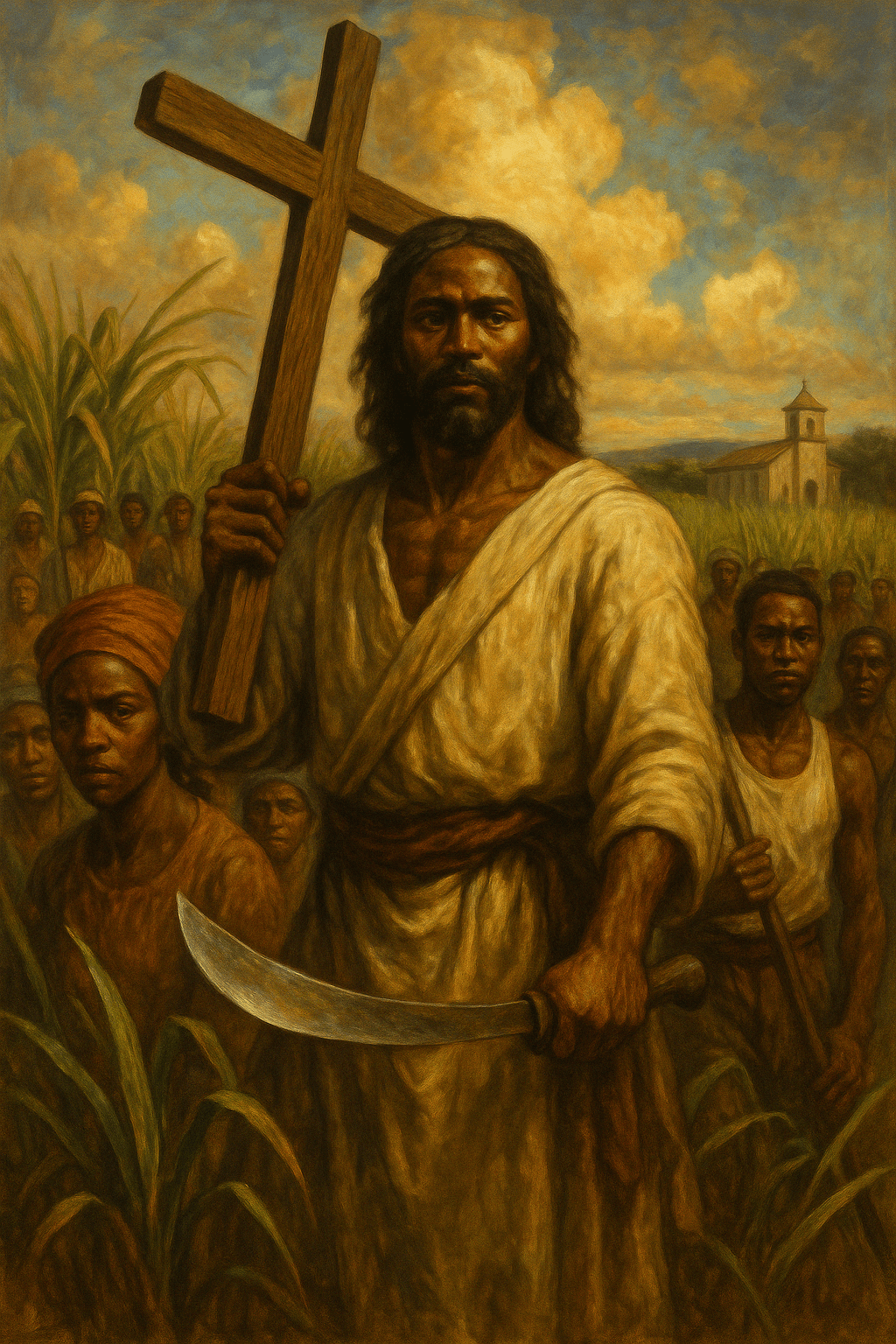
Part II: Christianity as Liberation, from the Catacombs to the Cane Fields
by Prince Kapone, Weaponized Information
“When I rise, I bring the wrath of heaven with me.”
—Nat Turner
Read Part I here:
In the Name of the Father, the Empire, and the Holy Profit Margin
I. Breaking the Cross, Resurrecting the Rebel
If Part I traced how Christianity was turned into a weapon of empire—
a spiritual counterinsurgency waged from Rome to America—then Part II is about those who flipped the script.
The peasants, slaves, prophets, and revolutionaries who heard not Caesar’s voice in the gospel, but their own.
Those who recognized in Jesus not a king, but a comrade.
This is the buried tradition—Christianity from below. The Christianity that didn’t ride with Columbus but bled with the Taíno.
That didn’t bless the plantation, but broke it. That didn’t fear the whip, but raised the machete.
The Christianity of the oppressed fighting for their freedom in the name of a crucified rebel.
We are not talking about belief systems—we’re talking about battle lines.
II. Before Constantine: The Church of the Catacombs
Before bishops bowed to emperors, early Christians lived among the poor and persecuted.
They refused military service, fed the hungry, practiced collective ownership,
and resisted both pagan elites and state power. This was not a religion of domination—it was a communal survival network
for the colonized and criminalized under Rome.
It was this movement that Constantine hijacked—turning the church from a base of resistance into a pillar of imperial order.
But that original, insurgent impulse never fully died. It went underground, resurfacing whenever people refused to worship Caesar.
III. Nat Turner: The Sword and the Psalms
1831. Virginia.
A literate enslaved preacher named Nat Turner reads the Bible not as a text of submission—but as a code of liberation.
He sees visions. He invokes the Book of Exodus. He reads Revelation as prophecy.
He leads a slave rebellion, killing over 50 enslavers before being captured and hanged.
To white Christians, he was a demon.
To enslaved Africans, he was a prophet.
To empire, he was a threat that had to be erased.
Turner’s rebellion was brutally suppressed, but his example burned through history.
He proved that Christianity could be reclaimed—not as obedience to power, but as a declaration of war against it.
IV. The Rise of Liberation Theology
Fast forward to the 20th century, where revolutionary Christianity erupts again—this time across the sugarcane fields, barrios, and prisons of Latin America.
This is the birth of Liberation Theology: a theological framework that centers the poor,
analyzes injustice through the lens of class struggle, and declares that God takes sides—with the oppressed.
“God is not neutral. God is always on the side of the poor.”
—Gustavo Gutiérrez
Emerging out of the 1960s and ’70s, figures like Gutiérrez, Leonardo Boff, and Camilo Torres
fused Marxism and Catholicism, forming a theology rooted in material struggle.
These were not academics in ivory towers—they were priests in jungles and favelas,
often targeted by the CIA-backed regimes they opposed.
To the U.S. empire, Liberation Theology was heresy.
To the people, it was truth.
To the poor, it was survival.
V. Black Liberation Theology: “God is Black”
While priests in Nicaragua and El Salvador were dodging death squads,
across the U.S., Black theologians were rewriting the gospel through the lens of slavery, segregation, and anti-Blackness.
Enter James Cone, who lit the fuse with his seminal work, Black Theology and Black Power:
“If God is not for us and against white racists, then he is a murderer, and we had better kill him.”
Cone exposed how white American Christianity was the spiritual wing of white supremacy—
and demanded a new theology that spoke to the Black condition.
In his vision, Jesus was Black, the cross was a lynching tree,
and salvation meant nothing without liberation.
Other radical Black theologians and ministers—like Rev. Albert Cleage Jr.,
Dr. Kelly Brown Douglas, and Rev. Jeremiah Wright—carried this torch.
The Black church became not just a sanctuary, but a revolutionary incubator:
birthing civil rights movements, community resistance, and global solidarity.
VI. Theology on the Frontlines
In both hemispheres, revolutionary Christianity was never just about prayer—it was about power.
That’s why the state moved swiftly and brutally to crush it.
- Archbishop Óscar Romero, gunned down while giving Mass for condemning the dictatorship.
- Camilo Torres, guerrilla priest, killed in combat with the Colombian military.
- Martin Luther King Jr., assassinated not for dreaming, but for organizing the poor against war and capital.
Each one killed by the same forces that praise Jesus in public and crucify justice in private.
VII. The Cross and the Class Struggle
There are two Christianities.
- One preaches obedience, hierarchy, and empire.
- The other preaches justice, resistance, and liberation.
One hangs Jesus on the cross.
The other pulls him down and joins the uprising.
If Part I exposed Christianity as a tool of spiritual counterinsurgency, then Part II affirms that
faith can also be a weapon of revolution. But only if it is torn from the hands of the powerful
and placed back in the calloused hands of the poor.
“When I give food to the poor, they call me a saint.
When I ask why the poor have no food, they call me a communist.”
—Dom Hélder Câmara
We know what side we’re on.
 Weaponized Information
Leave a comment