By Weaponized Information
Beijing is not playing chess with the West. It is building a different board.
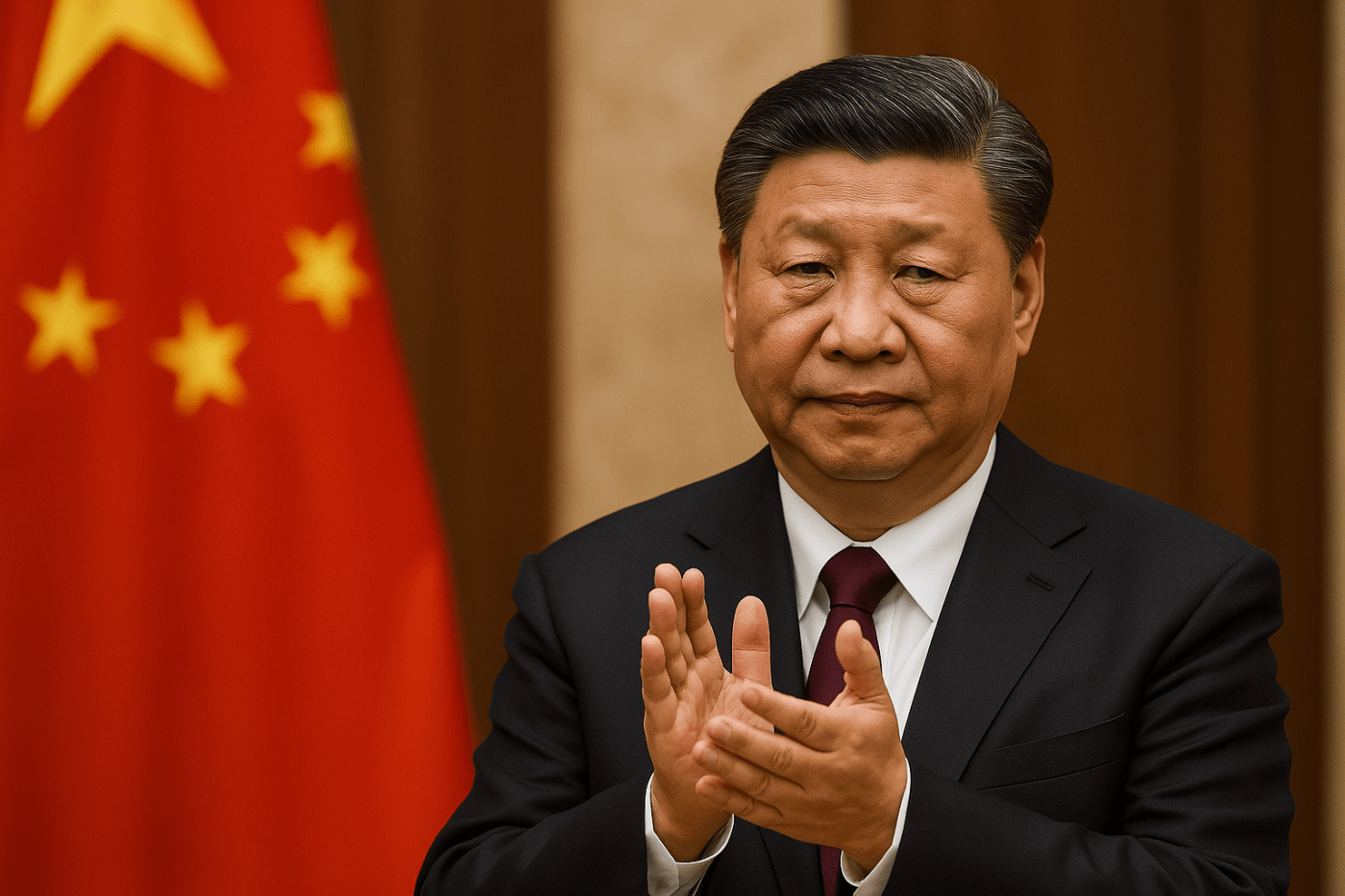
Chinese President Xi Jinping recently warned that “there are no winners in a tariff war,” a sober rebuke aimed squarely at Washington’s intensifying trade aggression. Speaking alongside Spanish Prime Minister Pedro Sánchez, Xi was calm, poised, and deliberate—an anti-Trump in both rhetoric and worldview. But this was more than diplomacy; it was a declaration that the People’s Republic is not simply reacting to U.S. trade hostilities. It is recalibrating China’s posture in the unfolding crisis of imperialism.
The Western press framed Xi’s comments as defensive. Of course they did. The imperial mind can only interpret resistance as retreat. But from the vantage point of the global South, from the base of the colonial pyramid, it’s clear: China is signaling a confident counteroffensive—not through warships or aircraft carriers, but through endurance, internal discipline, and economic fortification. In other words, Xi isn’t just swatting away tariffs. He’s coordinating a dual campaign: a global push against imperialist domination and a domestic purge of corruption that could fracture China from within.
The Crisis of Imperialism and the Desperation of Empire
What the United States calls a “trade war” is better described as imperialist recalibration through economic siege. Washington’s use of tariffs, export controls, and investment bans are part of a larger chokepoint imperial strategy: to bottle up rising powers like China, sever their lifelines, and slow their technological advancement. When sanctions and embargoes failed to isolate Iran, they tried tariffs on China. When Huawei proved resilient, they banned its chips. Now they’re targeting TikTok and threatening to sever financial pipelines.
But here’s the problem: the old tools aren’t working. The empire is discovering—painfully—that it no longer holds the monopoly on discipline or production. China can absorb economic shock because it has retained what the West long ago outsourced: its industrial base, its state planning apparatus, and its long-term strategic vision.
That’s what terrifies Washington—not just China’s economy, but its ability to operate outside the imperial script.
Cleaning House While Fortifying the Fortress
At home, Xi’s ongoing anti-corruption campaign has turned into a sweeping internal war against graft, cronyism, and elite impunity. High-level investigations have spanned across sectors, from defense to finance to regional governance. The campaign reflects a rigorous internal discipline meant to reinforce cohesion at a moment of mounting global confrontation.
This is not just bureaucratic cleanup. This is a struggle to consolidate national will, ensure ideological clarity, and prevent the kinds of fractures that have historically invited foreign interference. The battle against corruption is about more than legality—it is about survival, sovereignty, and national direction.
The Myth of the “Authoritarian Menace”
The same Western pundits who praise anti-corruption in Brazil and India call it a “power grab” in China. That’s not analysis. That’s projection. Washington’s oligarchy fears serious anti-corruption campaigns because, if done thoroughly, they inevitably target the real ruling class: financiers, monopolists, and political brokers.
In China’s case, this campaign is part of a broader national strategy to uphold internal integrity in the face of external siege. It is not for us to define its character—only to observe that its outcomes stand in sharp contrast to the free fall of institutions in the West.
Multipolarity Is Not a Buzzword—It’s a Battle Plan
China’s resistance to tariff war and its efforts to reform internal discipline are not isolated events. They are part of a deliberate, global process of constructing multipolarity as an alternative to the decaying unipolar order. That means infrastructure projects like the Belt and Road Initiative. It means BRICS+ currency swap arrangements. It means resisting chokepoint strategies in the Taiwan Strait, the Red Sea, and the South China Sea.
Xi’s warning is not a gesture. It is a signal that Beijing is preparing for long-term decoupling—not from the world, but from the institutions of imperial command.
The View from Below
We at Weaponized Information do not offer empty praise. We do not mistake multipolarity for liberation. But we do understand that every fracture in imperial coherence is a space for possibility. We recognize when a state defends sovereignty in the face of economic warfare. We observe when a nation refuses to be swallowed by the system designed to discipline it.
That’s what Xi’s two-front war represents: internal consolidation for the sake of external resilience. A nation preparing not for dominance, but for autonomy. A challenge not just to Washington’s hegemony, but to its entire operating system.
Let it be said plainly: This is not about trade. It’s about tectonics. The plates are shifting. And Beijing is not running—it’s building.
—WI Dispatch
 Weaponized Information
Leave a comment