By Weaponized Information
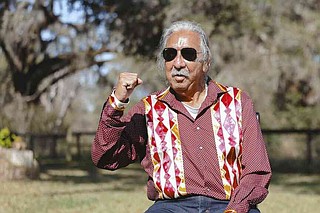
After nearly half a century in prison, Leonard Peltier is finally free—but the system that caged him remains. His release is not a resolution, but a rupture. A call to confront settler colonialism at its root.
They locked him away for 48 years.
Not because he was guilty—but because he was dangerous. Because Leonard Peltier, a son of Turtle Mountain and a warrior of the American Indian Movement (AIM), dared to remind the settler that the land beneath its boots was not its own. Because he dared to say that Mount Rushmore is carved into a crime scene. Because he stood, unflinching, on the frontlines of a colonial order that has always been enforced with badges, bullets, and broken treaties.
Now, in 2025, he walks free.
But the chains haven’t fallen off the system that put him there.
When They Say “Justice,” Check Who’s Holding the Gavel
The official story—copied and pasted by generations of corporate stenographers—goes something like this: In 1975, two FBI agents died in a shootout on Pine Ridge Reservation. Peltier was tried, convicted, and sentenced to life. Due process, they say. Rule of law, they claim.
But the trial was a farce. Evidence was fabricated. Witnesses were coerced. Key exculpatory material was withheld. Even the FBI admitted, decades later, that it couldn’t prove who fired the fatal shots. No matter. What mattered was the message: you mess with the settler state, you disappear into its dungeons.
Leonard Peltier was not imprisoned for murder. He was imprisoned for resistance.
Settler Colonialism Has No Statute of Limitations
To understand Peltier’s incarceration is to understand the structure that produced it: a settler colonial state built atop the graves and governments of Indigenous nations. The United States is not a country that happens to have committed genocide. It is a country founded by it, maintained through it, and ideologically dependent on its denial.
That is why Peltier’s mere existence—long hair, long memory, and the audacity to call the FBI an occupying army—was a threat. He wasn’t just a man. He was a breach in the narrative. A living reminder that Indigenous nations are not extinct, assimilated, or conquered—but alive, organized, and fighting for land back.
That’s why they buried him.
The FBI as Counterinsurgency Force
It’s no coincidence that Peltier was targeted by the very agency that ran COINTELPRO—a program that also assassinated Fred Hampton, destroyed the Black Panther Party, and waged psychological warfare on anti-imperialists across the country. The FBI doesn’t investigate crimes; it neutralizes resistance.
Pine Ridge in the 1970s wasn’t just a reservation—it was a war zone. A paramilitary dictatorship funded by the Bureau, armed by the BIA, and designed to crush AIM’s rise. Drive-by shootings, curfews, illegal arrests. The so-called “reign of terror” was not some anomaly—it was the natural function of settler counterinsurgency.
Peltier was captured not for what he did, but for what he represented: a revolutionary consciousness inside a nation that was never supposed to survive conquest.
What Does “Freedom” Mean After 48 Years?
His release is no triumph of American justice. It is a testament to international solidarity, tireless resistance, and the inability of empire to completely erase the truth.
But let’s not mistake symbolism for substance. Leonard Peltier is free, but the U.S. prison system still cages tens of thousands of Indigenous people. Native lands are still drilled, poisoned, and stolen. Native women are still murdered and missing with impunity. The colonial contradiction remains intact.
What Peltier’s case teaches us is not just that the U.S. government lies, but that it needs to lie—because its legitimacy cannot survive contact with the past. Or the present. Or the land.
Land Back is More Than a Slogan
Leonard Peltier’s life is part of a larger truth: the Indigenous nations of Turtle Island have never surrendered. They have been massacred, relocated, reclassified—but never erased.
From the Lakota fighting pipelines to the Apache defending sacred mountains to the Diné resisting uranium extraction, the struggle continues. What AIM raised in the 1970s—sovereignty, decolonization, self-determination—is not history. It is program.
Land back is not a hashtag. It’s a horizon.
And if the settler empire wants peace, it had better start with returning what it stole. All of it.
Our Line
At Weaponized Information, we do not cover Native issues as allies. We cover them as comrades. As people living inside the same decaying empire. As agents of the same historic task: dismantling settler capitalism and building a new world in its ashes.
Peltier is free. But the movement that bore him is still rising. And the land still remembers.
—WI Dispatch
Weaponized Information for a decolonized future
 Weaponized Information
Leave a comment