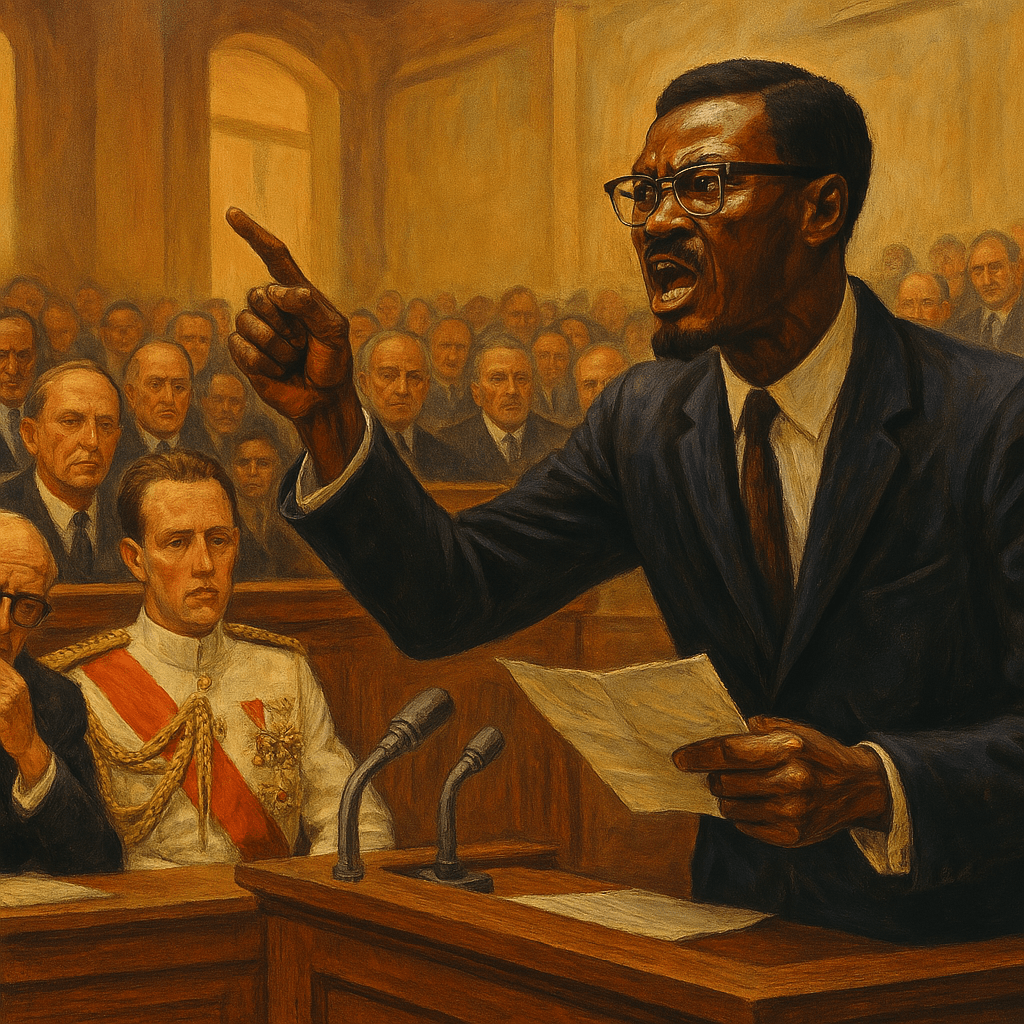
Africa’s Red Star, Extinguished Too Soon
“We are not alone. Africa, Asia, and free and liberated people everywhere are with us. The struggle of the Congo is the struggle of all peoples.” — Patrice Lumumba
Patrice Lumumba was not a puppet, not a pawn, and certainly not a servant of Western interests. He was a radical nationalist, a disciplined anti-imperialist, and an uncompromising advocate for African unity and independence. And for that, he was murdered. Brutally. Publicly. With the complicity of Belgium, the United States, and the newly minted comprador class that replaced the colonial masters.
They feared Lumumba not because he was reckless, but because he was serious. Serious about sovereignty. Serious about socialism. Serious about reclaiming the Congo—and by extension, Africa—from the bloody grip of imperialism. He wasn’t just trying to change who sat in the capital. He was trying to change the relationship between capital and the people.
Lumumba emerged not from elite circles but from the heart of the colonized working class. A postal worker turned organizer and orator, he had none of the polish of the Belgian-trained African elite. What he had instead was clarity—and courage. He saw that independence without economic control was a farce. He knew that unity without class struggle was a trap. And he said so, again and again, in a voice that shook Brussels, London, and Washington.
His life was short, his movement unfinished. But his execution lit a fire across Africa. That fire still burns in every uprising against the IMF, every anti-colonial mural, every demand to nationalize what the colonizer stole.
This article is not a eulogy. It is a warning. Lumumba was no servant. And the empire that killed him still lives—and still fears what he represents: an Africa that cannot be bought, cannot be broken, and cannot be governed from abroad.
Part I: From Worker to Revolutionary Nationalist
Patrice Lumumba didn’t emerge from the drawing rooms of colonial administrators or Western-funded NGOs. He came from the post office. From the floor of the factory. From the dirt roads of the Congo, where Belgian capitalism and white supremacy fused to strip Africa of its life.
Born in 1925 in Onalua, Lumumba was educated in Catholic missionary schools, where colonial indoctrination taught Africans they were subhuman. But even there, he stood out—not just for intelligence, but for defiance. He absorbed the rules of the colonizer not to serve them, but to subvert them.
As a postal worker and beer salesman, he became a self-taught intellectual and firebrand speaker. He read Enlightenment thinkers and African revolutionaries alike. He didn’t parrot ideology—he rearmed it. His experience among the Congolese working class made his politics sharp, grounded, and explicitly anti-colonial.
In 1958, he formed the Mouvement National Congolais (MNC), not as a tribal party but as a pan-Congolese nationalist vehicle. While others played ethnic politics, Lumumba pushed a militant program of unity, sovereignty, and socialism. He wasn’t trying to win votes—he was trying to win power. Real power. Over land. Over resources. Over the military. And he made that known.
When Congo gained nominal independence in 1960, Lumumba gave a speech that shattered the colonial illusion. While the Belgian king congratulated himself, Lumumba rose and told the world that the Congo had won its freedom through blood, sweat, and the sacrifice of its people—not the benevolence of empire. He named the crimes. He refused to kneel. It was a declaration of class war dressed in the garments of a diplomatic ceremony.
From that moment, he was marked. Washington called him a communist. Brussels called him dangerous. The settler elite called him divisive. But the people called him their leader.
Lumumba knew what he represented: the possibility that Africa could be free, united, and under the leadership of the working class. That made him the most dangerous man on the continent.
Part II: Betrayal, Coup, and Execution
Patrice Lumumba was Prime Minister of the Congo for just twelve weeks. Twelve weeks was all it took for the imperialists to decide that African independence—real independence—was too dangerous to allow. Behind the scenes, the CIA, Belgian agents, and their comprador lackeys plotted to remove him by any means necessary.
Congo, rich in uranium, copper, cobalt, and rubber, was too important to be left in the hands of a man who wanted to nationalize it. Lumumba called for control over Congo’s resources, for the ousting of foreign troops, and for African unity. But the West saw in him not a visionary, but a threat—to their mines, their corporations, their grip on Africa.
First came the internal sabotage. Congolese President Joseph Kasavubu, under pressure from Belgium and the U.S., tried to dismiss Lumumba. Then came the military betrayal: Colonel Joseph Mobutu—trained and financed by the West—staged a CIA-backed coup. Lumumba was placed under house arrest, his communications cut, his power stolen. The Congolese people protested, but the U.N.—which Lumumba had naively appealed to for help—stood by in silence.
In a desperate move, Lumumba tried to flee Kinshasa and rally loyal forces in the East. He was captured by Mobutu’s men, beaten, and handed over to Belgian-backed separatists in Katanga. There, on January 17, 1961, Patrice Lumumba was tortured, shot, and buried in a shallow grave. Then dug up, dismembered, dissolved in acid. His body was erased, but his example became eternal.
The assassination of Lumumba was not just the murder of a man—it was the attempted assassination of African liberation itself. The empire sent a message: independence that threatens capital will be crushed. They killed Lumumba to make him a lesson. But the lesson backfired.
He became a martyr. His name became a war cry. His death radicalized a generation—from the anti-apartheid fighters of South Africa to the revolutionary socialists of Guinea-Bissau, Angola, and beyond.
They buried his body—but they couldn’t bury his revolution.
Part III: The Meaning of Lumumba Today
Patrice Lumumba did not dream of merely freeing the Congo. He dreamed of uniting Africa. And not with the vague language of pan-African symbolism, but with a concrete, militant program of socialist transformation led by the continent’s working and peasant classes.
He was not alone. In Kwame Nkrumah, he found a comrade—a revolutionary statesman who understood that political independence without economic sovereignty was a trap. The two men forged a bond deeper than diplomacy. It was a shared belief that the future of Africa depended on its unity, its socialism, and its refusal to serve as a playground for foreign capital.
In their correspondence, Lumumba pledged his full support for Nkrumah’s plan to create a United States of Africa—with the Congo as its capital. He believed the heart of Africa had to become the brain of Africa. The Congo’s resources, if liberated from colonial theft, could power a continental renaissance. Not for profit—but for people. For schools, hospitals, railroads, factories. For socialism.
This was the dream they killed.
Today, the Congo remains fractured and pillaged—by multinational corporations, U.N. peacekeepers, and local warlords on foreign payrolls. But the vision of Lumumba and Nkrumah still haunts the halls of the IMF, the Pentagon, and Wall Street. Because their project was not one of identity—it was one of material liberation. Their unity was not just cultural—it was class-based.
Lumumba’s name remains radioactive because it still threatens the neocolonial order. Every time a people rises to reclaim a mine, nationalize a factory, or evict a foreign power, the ghost of Lumumba rises with them.
And so, remembering Lumumba is not nostalgia. It is strategy.
To invoke his name is to declare war on the lie that Africa must remain dependent. It is to commit to the idea that the continent has within it—not just the right—but the power to lead itself. To build a new society on its own terms.
Lumumba was no servant. He was a revolutionary African internationalist. A Pan-African communist (in our opinion). A martyr not just for the Congo, but for the united, socialist Africa that has yet to be born.
 Weaponized Information
Leave a comment