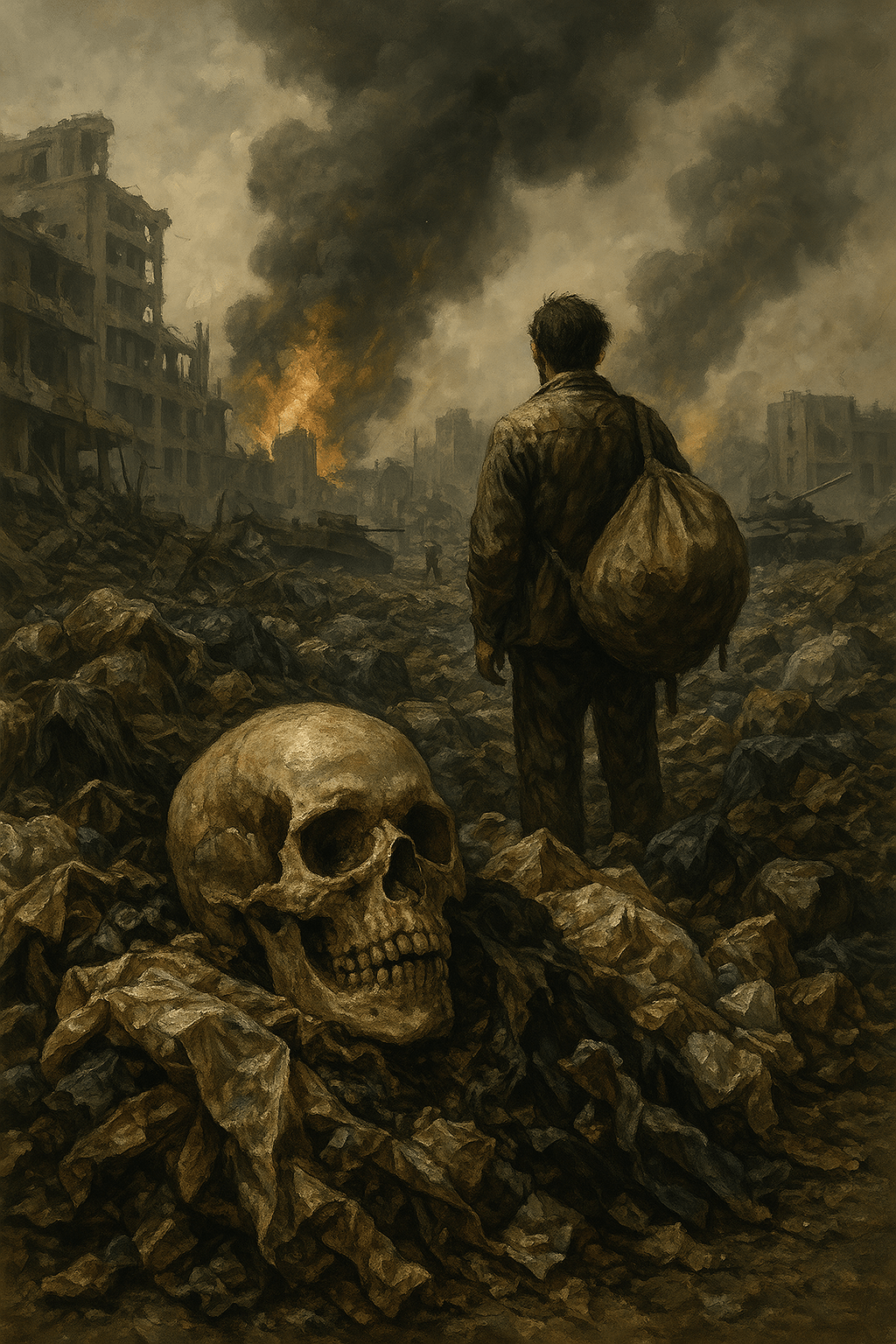
1. Kadri’s Lens, Our Terrain
Ali Kadri doesn’t mince words, and neither should we. In a world where entire countries are razed, populations made into refugees, and social life rendered unlivable, the polite explanations of economists and diplomats begin to sound obscene. This isn’t a system in need of repair. It’s a system functioning exactly as designed. Kadri’s insight is as simple as it is brutal: waste isn’t failure. It’s value. Destruction isn’t chaos. It’s strategy.
In Part 1 of this series, we argued that accumulation through destruction is not an accident of U.S. empire but an increasingly central strategy of its survival. Under Trump 2.0, the U.S. has abandoned any lingering illusions of benevolent hegemony. What remains is a stripped-down imperial operating system: dominate global chokepoints, pulverize zones of resistance, and profit from the wreckage.
Kadri’s framework helps us make sense of this scorched-earth logic. It gives us the conceptual tools to see war, collapse, and ruin as methods of imperial recalibration—not anomalies, but blueprints. In this installment, we take that lens and apply it to three case studies: Syria, Haiti, and Gaza. Each reveals how empire produces waste as a form of wealth, destruction as a mode of control, and despair as a business model.
2. SYRIA: Proxy Rule and the New Islamist Regime
There was a time when Syria dared to chart an independent course. It pursued state-led development, resisted IMF austerity, and forged alliances outside the orbit of Washington and Wall Street. That made it dangerous. Not because it threatened anyone with invasion, but because it represented the possibility of a different path.
So the empire responded the only way it knows how: it broke the country.
- The physical destruction of Aleppo, Homs, and Raqqa wasn’t just collateral damage. It was the obliteration of independent infrastructure.
- The mass displacement of Syrians served multiple functions: flooding labor markets, justifying surveillance regimes, and destabilizing regions hostile to U.S. interests.
- Reconstruction was dangled like a carrot, but only on condition of surrender. Sanctions ensured that Syria could not rebuild itself, while Western firms circled the ruins like vultures.
- The fragmentation of the state created war economies, drug routes, arms bazaars—zones of lucrative chaos.
But the most brutal element of the war on Syria was the West’s deliberate sponsorship of terrorist proxy forces. From the beginning of the conflict, the U.S., Turkey, Qatar, and Saudi Arabia funded, trained, and armed Salafi-jihadist groups masquerading as rebels. These forces, including Jabhat al-Nusra (now rebranded as Hayat Tahrir al-Sham or HTS), seized control of key areas in northern Syria.
In December 2024, Bashar al-Assad was overthrown, and HTS-aligned leader Ahmed al-Sharaa, a former al-Qaeda commander known as Abu Mohammad al-Jolani, was installed as President. In March 2025, al-Sharaa unveiled a transitional government composed of 23 ministers and ratified a temporary constitution establishing Islamic law as a source of jurisprudence.
But this new Islamist regime is already stained by blood. Amnesty International and the United Nations have documented a series of coordinated massacres in coastal regions targeting Alawite civilians and former Baathists. Entire families were executed in sectarian reprisal killings, echoing the worst crimes of the conflict’s earlier years. These atrocities, still under investigation, could constitute war crimes.
Syria was not merely collateral damage in a regional conflict. It was a crucible where the U.S. and its allies tested a new form of imperial warfare: hybrid destruction via terror proxies, sanctions, and reconstruction-without-rebuilding. What looks like devastation is, from an imperial perspective, a portfolio of opportunities. Syria was not meant to rise from the ashes. It was meant to be ash.
3. HAITI: Ruination as Management
If there’s a place on earth where Kadri’s theory walks hand-in-hand with history, it’s Haiti. Since 1804, Haiti has paid dearly for its original sin: a slave revolution that dared to imagine Black freedom and sovereignty. For that, it has been punished for centuries.
But the new punishment is managerial, not just military. Haiti isn’t bombed into submission—it’s administered into despair. And every disaster is an excuse to deepen the control.
- The 2010 earthquake was a catastrophe. The response was a heist. NGOs, contractors, and celebrity foundations raked in billions, while Haitians remained homeless.
- Development projects like the Caracol Industrial Park were sold as salvation. They were sweatshop ghettos dressed up in press releases.
- The Haitian state was effectively replaced by an NGO-industrial complex, one that governs without governing, administers without serving.
- IMF loans and aid conditionalities ensured that any attempt at national recovery would be strangled in the crib.
Today, Haiti is not merely mismanaged—it is ungoverned. There is no functioning Haitian government. Instead, foreign intervention masquerades as peacekeeping. The latest UN-backed police deployment includes Kenyan forces, whose arrival signals the continuation of external rule by other means. Meanwhile, Port-au-Prince has descended into gangsterism. Warlords with heavy weapons rule the streets, enforcing the interests of the Haitian oligarchy. These gangs do not represent popular resistance; they are counterinsurgents in gang colors, repressing the poor and extracting from the people on behalf of capital.
Kadri calls this the prevention of reproduction. Haiti is not allowed to reproduce itself as a viable nation. Its condition is curated: not total collapse, but permanent dependency. A plantation of the 21st century, except this time the crop is collapse itself.
4. GAZA: Genocide as Algorithm
There is no clearer case of waste-as-value than Gaza. It is not a tragedy. It is a business model.
- The Israeli military calls its genocidal campaigns “mowing the lawn.” It’s as casual as it is monstrous.
- Drones, facial recognition tech, autonomous targeting systems—all are battle-tested on Palestinians, then exported to police departments and border agencies around the world.
- NGOs arrive with humanitarian kits and PR campaigns. They deliver just enough aid to keep the corpse breathing.
- Every few years, the cycle restarts. Bombardment, sanctions, containment. Gaza is kept in a permanent state of catastrophe. Not to win. To maintain.
Since October 2023, over 30,000 Palestinians have been killed—the majority women and children. Entire neighborhoods, hospitals, and universities have been wiped off the map. Gaza’s power plants, bakeries, schools, and water infrastructure have been systematically destroyed. The physical devastation is total: over 60% of all buildings are damaged or gone. The people have been starved, displaced, and bombed with no safe refuge. This is not warfare. It is industrialized extermination.
Kadri reminds us that waste is not the absence of value. It is a form of value produced by empire. Gaza’s people are rendered surplus, and then consumed by a system that profits from their immiseration. It is not an error. It is an algorithm.
5. From Waste to Strategy, From Theory to Praxis
When Marx wrote about capitalism’s hunger for profit, he probably didn’t imagine drones monetizing children’s corpses or NGOs managing the ruins of an earthquake like investment portfolios. But here we are.
Kadri shows us that we’re not in a post-imperial world. We’re in a hyper-imperial one. The U.S., under Trump 2.0 and beyond, no longer seeks to integrate the world. It seeks to segment it—into zones of extraction, control, and destruction. Recalibration means breaking what you can’t buy. And when you can’t dominate through debt or trade, you dominate through collapse.
At Weaponized Information, we argue that technofascism—the fusion of digital surveillance, militarized governance, and imperial rentier logic—is not the future. It’s the present. Kadri’s analysis fits perfectly into this picture. Destruction is a business model. Waste is a strategy. Death is a currency.
But even in the wastelands, there is resistance. Gaza resists. Haiti rises. Syria survives. The empire may monetize destruction, but it cannot erase dignity. And every zone of systemic destruction carries within it the unbearable possibility: that those rendered waste may yet organize, rise, and bury the system that sought to bury them.
The clock is ticking. The wastemakers have had their turn. Now it’s ours.
 Weaponized Information
Leave a comment