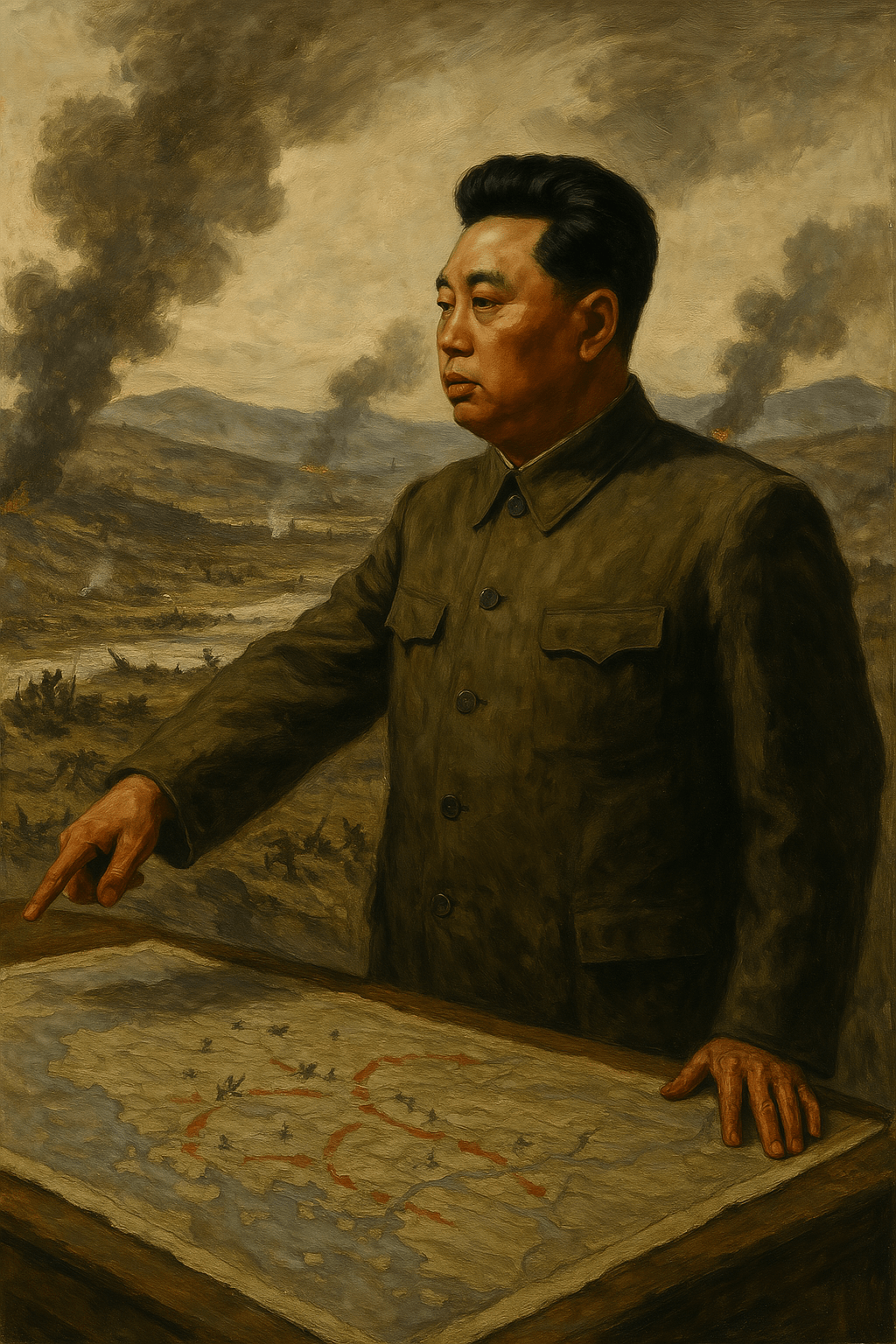
The Guerrilla Who Refused to Kneel
Before the Western world reduced his image to a cartoonish dictator, before his name became synonymous with a caricature crafted by capitalist propaganda, Kim Il Sung was something else entirely: a guerrilla fighter, a student of Marxism, a revolutionary forged in the anti-colonial war against Japanese imperialism. He was a product of Korean resistance, and a strategist in the long war for national dignity, class liberation, and anti-imperialist sovereignty.
He didn’t rise through the ranks of a political bureaucracy. He rose through the mountains. Through hunger, through battle, through years of exile and clandestine struggle. And when World War II ended, and the Korean peninsula stood poised between liberation and recolonization, it was Kim Il Sung who stood ready to lead the north into revolution.
He was no peon—not to Japan, not to the United States, not to the Soviet Union, not to anyone. That’s precisely what made him dangerous. He built a socialist state on the ruins of feudalism and colonialism, and he did it in the face of one of the most genocidal wars in modern history. He refused to let Korea be split into a comprador playground and a military colony. And he built a model—flawed, isolated, but defiant—that made Western empire seethe with rage.
Kim Il Sung didn’t just resist the U.S. war machine. He survived it. He outlived the American generals who promised to turn North Korea into a “wasteland” and dropped more bombs on it than on the entire Pacific theater of WWII. He reconstructed the country, mobilized the people, and crafted an ideology—Juche—to assert Korean autonomy in both theory and practice.
This is not a defense of bureaucracy, nor a denial of contradiction. It is a defense of historical truth. Kim Il Sung was no peon. He was a revolutionary who beat back empire with fewer friends, fewer resources, and more discipline than most will ever know.
He earned the right to be studied seriously—not mocked ignorantly. And we intend to do just that.
Part I: From Anti-Japanese Guerrilla to Revolutionary Commander
Kim Il Sung’s revolutionary credentials were not handed to him by a party congress or Soviet sponsorship. They were carved into the mountains of Manchuria and baptized in blood during Korea’s darkest period of occupation.
Born in 1912 in Japanese-occupied Korea, Kim grew up under a regime of terror. Japan didn’t just colonize Korea—it sought to erase it. Language, culture, names, land—all were seized. Millions of Koreans were conscripted, raped, enslaved, deported. The resistance was not an abstraction. It was a question of survival.
As a teenager, Kim joined underground cells fighting against Japanese rule. By his early twenties, he became a commander in the Northeast Anti-Japanese United Army, a partisan formation of Korean and Chinese communists fighting an asymmetrical war against a mechanized empire. He lived in caves. Slept in snow. Buried comrades in silence. But he kept fighting.
Unlike bourgeois nationalist leaders who appealed to imperial favor or relied on elite sponsorship, Kim believed in organizing the peasantry and building political discipline among the armed ranks. He combined Leninist strategy with the practical necessities of guerrilla warfare, forging a cadre-based resistance with a socialist horizon.
When the Japanese Empire collapsed in 1945, and Korea was “liberated” by two foreign armies—the U.S. in the south, the USSR in the north—Kim was recognized by the masses not just as a hero of resistance, but as a leader with revolutionary legitimacy. His rise was not the result of Soviet imposition. It was the convergence of years of struggle, mass support, and political clarity.
In the vacuum of post-war reconstruction, he moved quickly. He initiated land reform, seized Japanese and landlord estates, and laid the foundations for a socialist economy based on national independence. While the South reinstated colonial administrators and crushed leftist uprisings with U.S. support, Kim armed the people and restructured the north.
By the end of the 1940s, the Democratic People’s Republic of Korea had emerged. Not as a satellite, but as a sovereign state. A work-in-progress. A barricade against recolonization. And Kim Il Sung stood at its helm—not as a peon of empire, but as a guerrilla who refused to surrender.
Part II: War, Survival, and the Myth of Aggression
The Western narrative tells us that Kim Il Sung invaded the South unprovoked. That North Korea, backed by the Soviets, lunged across the 38th parallel in a power-hungry grab for domination. This lie—repeated in textbooks, media, and policy papers—conveniently erases the actual history of Korea’s partition, the U.S.-installed dictatorship in the South, and the coordinated suppression of leftist movements long before a single shot was fired.
Let’s be clear: the Korean War was not started by Kim Il Sung. It was started by imperialism.
In the South, Syngman Rhee—a U.S.-trained anti-communist zealot—was installed with zero democratic legitimacy. Backed by American military power, Rhee crushed unions, executed socialists, and massacred thousands of civilians during uprisings like the Jeju Island rebellion in 1948. These crimes were not reported—they were concealed. Meanwhile, in the North, Kim Il Sung was redistributing land, building worker and peasant committees, and consolidating a revolutionary state.
When the North crossed the 38th parallel in June 1950, it was not the start of a war—it was a continuation of a war already being waged on the people by U.S. imperialism. Kim sought to reunify Korea under the leadership of those who had fought Japanese occupation—not those who had collaborated with it.
The U.S. responded not with negotiation, but with annihilation. They dropped more bombs on North Korea than were dropped on the Pacific theater during WWII. Cities were leveled. Dams were destroyed. Civilians were incinerated. General MacArthur called for nuclear weapons. Over 3 million Koreans were killed—most of them in the North. Entire villages were napalmed into extinction.
And yet, North Korea survived.
It didn’t collapse. It didn’t surrender. It rebuilt. That survival—against impossible odds—is the material foundation of Kim Il Sung’s legacy. Not the statues. Not the slogans. But the fact that in the ashes of war, he led the reconstruction of a state that continued to resist recolonization.
This was not aggression. This was defense—of land, of people, of revolution.
To this day, the DPRK stands as the only country in the world to have driven U.S. imperialism into a stalemate. And that’s precisely why they hate Kim Il Sung. He made survival a revolutionary act.
Part III: Juche, Sovereignty, and Socialist Development Under Siege
In the wake of total war and near-annihilation, Kim Il Sung didn’t beg for loans. He didn’t invite Western NGOs. He didn’t mortgage his country’s future to the IMF or World Bank. He built—on his own terms. The reconstruction of the Democratic People’s Republic of Korea was one of the most extraordinary political-economic achievements of the 20th century.
Factories were rebuilt from rubble. Education was made universal. Health care was free. Housing was guaranteed. Agricultural cooperatives and heavy industry were rapidly developed—without private foreign capital. While South Korea remained under U.S. military dictatorship and sweatshop dependency, the North electrified its villages and eliminated illiteracy.
But Kim Il Sung didn’t just reconstruct. He theorized. And from this crucible of war, struggle, and defiance emerged Juche—a philosophy of self-reliance, sovereignty, and people-centered socialism rooted in Korean historical conditions.
Western academics deride Juche as “Stalinism with Korean characteristics.” That’s propaganda. Juche was—and is—a response to dependency, a refusal to outsource national development to foreign powers, even friendly ones. It asserted that revolution must be driven not by foreign blueprints but by the people themselves, through mobilization, ideological discipline, and independent planning.
Yes, Juche had contradictions. The concentration of power, the erosion of collective decision-making, and the rise of dynastic leadership are issues worthy of fraternal criticism. But let’s be clear: these contradictions were not unique to the DPRK—they were products of siege warfare, diplomatic isolation, and permanent imperialist threat.
Kim Il Sung had no illusions. He knew that North Korea was not building socialism in a vacuum, but in the shadow of nuclear bombers, spy satellites, sanctions, and sabotage. And yet, even under siege, the DPRK resisted. And resisted. And resisted.
Juche was not a slogan. It was a shield. A strategy. A refusal to surrender ideological or economic autonomy in a world where every inch of sovereignty is punished by empire.
Kim Il Sung did not build utopia—but he built a line of defense. A barricade that holds to this day. And for that, he remains one of the most successful revolutionaries of the modern era.
Part IV: Legacy, Criticism, and Revolutionary Lessons
Kim Il Sung died in 1994, but the world he confronted is still with us. U.S. troops still occupy the Korean peninsula. Sanctions still strangle the DPRK. Western media still peddles Cold War propaganda, reducing decades of anti-colonial struggle to memes and mockery. But among the world’s oppressed, his legacy endures.
It endures not because North Korea is perfect—it is not. It endures because North Korea survived. Because under Kim Il Sung’s leadership, it charted a path of development, resistance, and dignity without kneeling to either pole of global power. Because he turned a devastated, blockaded, isolated country into a sovereign socialist state.
There are legitimate criticisms to make. The centralization of power and emergence of dynastic rule raise difficult questions. Democratic centralism hardened into personality cult. Debate and criticism within the Party became more difficult. These are contradictions we must analyze—not weaponize. Because they did not emerge in a vacuum, but under conditions of existential threat.
What we cannot do is judge the DPRK by liberal metrics, bourgeois values, or imperialist narratives. Revolutionaries must assess Kim Il Sung not by how he appeared on CNN, but by how he resisted the greatest empire in history and built a functioning socialist state under permanent siege.
His greatest lesson is that revolution must be adapted to national conditions. Imported blueprints don’t work. Self-reliance does not mean isolation—it means sovereignty. Discipline is not repression—it is survival. And ideological clarity must always be paired with concrete material gains for the masses.
Kim Il Sung was no peon. He was a revolutionary general, a builder, a theorist, and a strategist of anti-imperialist socialism. He left behind a legacy the empire could never digest—and a people it could never conquer.
 Weaponized Information
Leave a comment