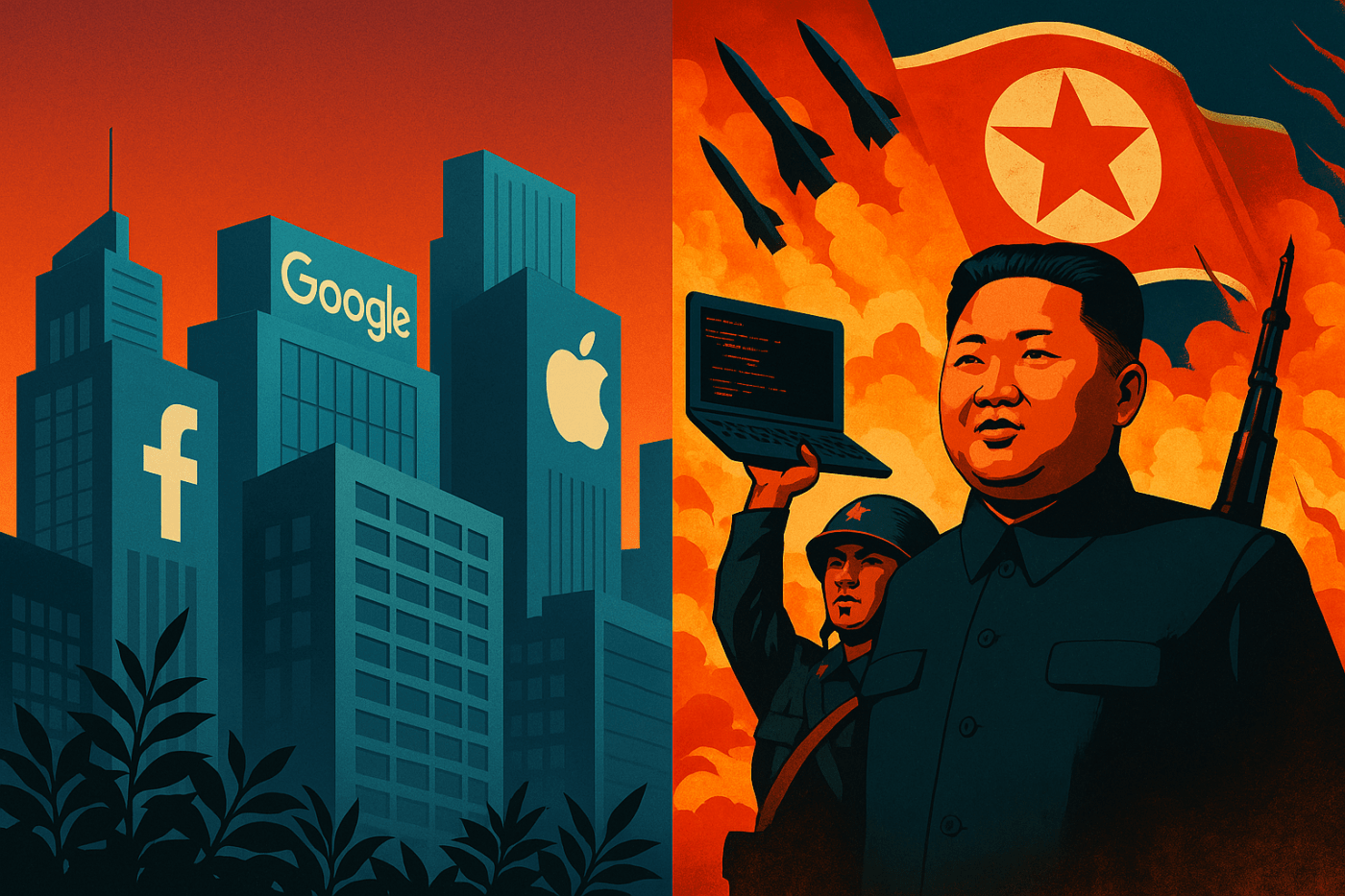
The empire got hacked—again. And not by some teenage troll in a basement. No, this time it was the digital guerrillas of the Democratic People’s Republic of Korea, quietly cashing in their checks from Fortune 500 companies while the West was too busy high-fiving itself over AI layoffs and ESG PowerPoints.
According to the folks at Fortune—that old magazine for people who think billionaires are demigods—North Korean IT workers managed to infiltrate the gilded gates of U.S. corporations. They didn’t do it with bombs, or malware, or sabotage. They did it the capitalist way: they got jobs. They did the work. They logged in, clocked hours, wrote code, ran scrums, met deadlines—and then wired the money home to fund a socialist state that’s been under siege since the Korean War.
And now the U.S. is flailing like a spoiled heir who just realized the help was skimming from the till. Corporate America, that bastion of moral rot, has been hiring North Koreans—unwittingly, of course, because God forbid they spend a dollar on vetting when they can outsource for 80 cents an hour and squeeze a few more percentage points of shareholder return. The irony is almost too rich: the empire’s need to exploit cheap labor just financed the very resistance it tried to starve into oblivion.
Let’s be clear: this isn’t a story about crime. It’s not espionage. It’s not cyberwarfare. It’s the colonized, coding their way out of the sanctions dungeon the West locked them in. It’s a socialist state, blockaded and demonized for 70 years, using the tools of capitalism—remote work, digital platforms, payroll software—to strike back. It’s expropriation via Wi-Fi. And it’s glorious.
The DPRK has had to get creative. You would too, if you’d been sanctioned into economic exile for daring to expel the Japanese, stand up to U.S. occupation, and refuse to bow to the neoliberal altar. Since 1953, the U.S. has thrown everything at North Korea except peace—bombs, embargoes, propaganda, famine, sabotage. And yet the DPRK persists, not because it’s perfect (what state is?), but because it refuses to die. That refusal is what enrages the West the most. It’s not that North Korea is a “threat”—it’s that North Korea is surviving without capitalism. That’s the real sin.
So, faced with the economic equivalent of siege warfare, the Koreans did what revolutionaries have always done when cut off from the world: they adapted. They studied. They infiltrated. They got jobs in the digital factories of imperial capital and quietly siphoned resources out of the belly of the beast. Hundreds of them, according to WSJ, working under assumed identities, raking in tens of millions of dollars. At least $88 million, according to the U.S. Department of Justice, slipped through the cracks of corporate America and landed squarely in Pyongyang’s lap. Not bad for a country that’s supposedly on its last leg, eh?
But the best part? These workers didn’t just take the money—they took the knowledge. They got inside the machine, studied how it runs, and walked away with the technical expertise of a junior Google engineer. They took the empire’s sacred code and turned it into survival. Not for a startup. Not for a pension. But for a people under siege. They’re building resilience with stolen wages, feeding the revolution with backend scripts and paystubs.
Now the same tech CEOs who wax poetic about “global talent” are frothing at the mouth. The same government that destabilized entire continents with covert ops and economic sabotage is now sobbing that some coders might be “funding weapons of mass destruction.” Please. This is the same empire that arms Israel with impunity, that builds bases on every continent, that bombed Korea into a lunar landscape in the 1950s and has tried to erase it ever since. You don’t get to moralize about North Korea’s nukes while you park aircraft carriers off their coast.
The outrage isn’t about “national security.” It’s about losing control. The colonized were supposed to stay where they were—starving, begging, quiet. Not slipping into Zoom meetings. Not deploying builds. Not cashing checks. But now they’re in the system, getting paid, and laughing all the way to the wire transfer. This is what happens when the empire builds a global labor plantation—and forgets to lock the server room.
And yes, let’s admit the obvious: the North Koreans played the long game. They didn’t just exploit the loopholes—they weaponized them. They used fake identities, freelance platforms, and corporate greed to build a pipeline of capital straight into Pyongyang. They studied the empire’s addiction to cheap labor and used it as a Trojan horse. This is what resistance looks like in the age of cloud computing.
It’s not the grand spectacle of revolution the West is used to—no storming of palaces, no Molotov cocktails. But make no mistake, it’s revolutionary. It’s the guerrilla warfare of the digital era. It’s the colonized refusing to be passive victims of history. And it’s a stark reminder to the empire: you can’t bomb dignity out of a people. You can’t sanction away their will to fight.
So let them rage. Let them investigate. Let the Justice Department issue more indictments. Meanwhile, the colonized will keep learning, keep working, keep logging in. Because survival under empire is not a crime. It’s strategy.
And if some Fortune 500 CIO wakes up one morning and realizes that the person who built their API might be sending that paycheck back to build a missile capable of defending Pyongyang—well, maybe next time don’t outsource your infrastructure to the very people you tried to erase from the map.
History is a clever coder. And this time, it’s writing in Korean.
 Weaponized Information
Leave a comment