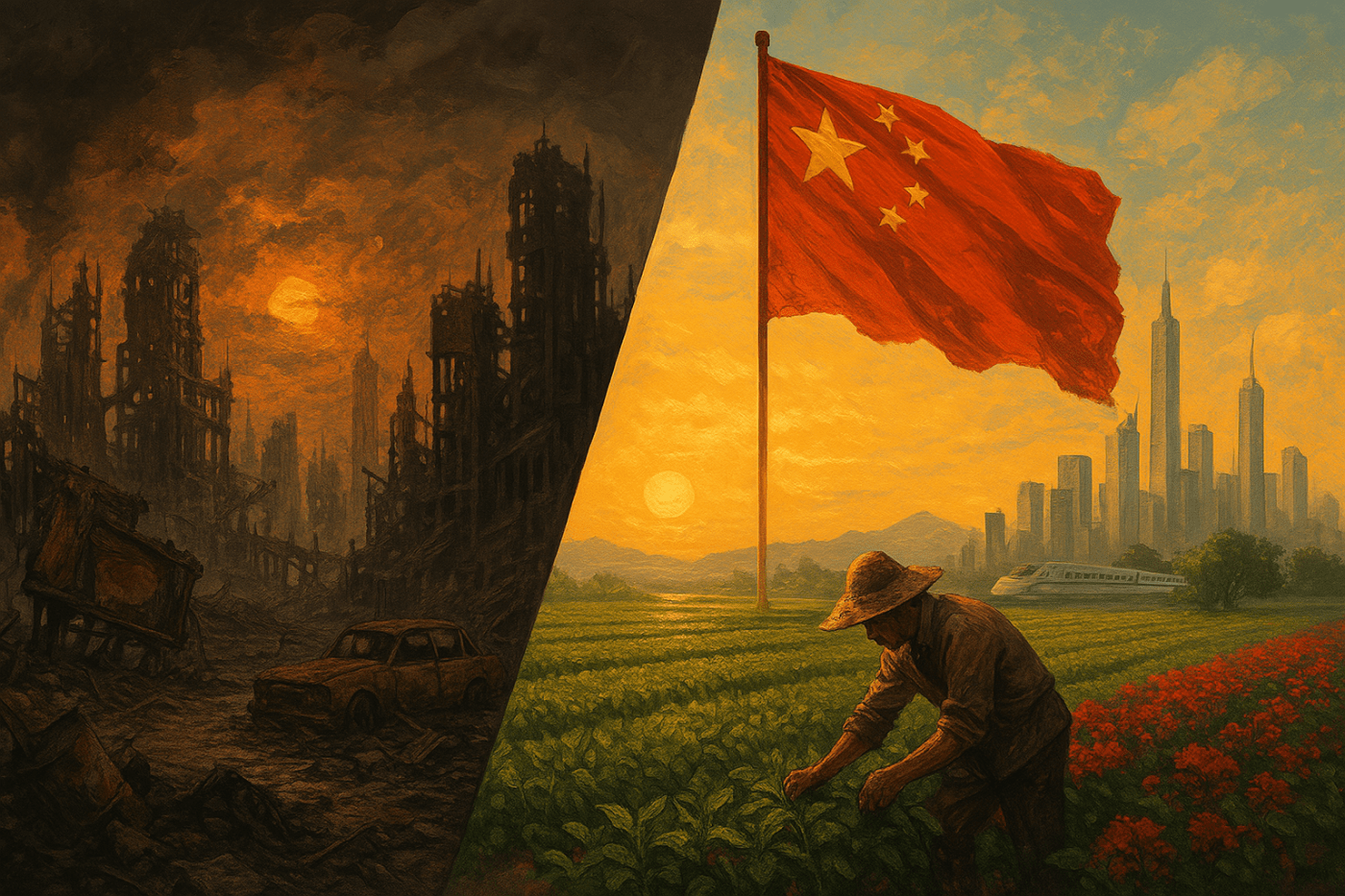
There he was—Vice President JD Vance—fresh from the think tank plantation and suited up for Fox News, doing his best impression of a 21st-century plantation overseer with a Yale law degree. And what brilliant imperial wisdom did he bless us with this time? In discussing U.S. debt and tariffs, he muttered with full settler confidence: “We borrow money from Chinese peasants to buy the things those Chinese peasants manufacture.”
Let’s pause to appreciate the sheer colonial absurdity of that sentence. “Chinese peasants”? Really? In 2025?
This is how the American ruling class processes global economic relations: through the racist lens of 19th-century plantation politics, where anyone outside the imperial core is a peasant, a savage, or a threat. It doesn’t matter if the so-called “peasants” are the very people whose industrial labor built the devices that power America’s stock market, logistics systems, and propaganda machines. In the minds of men like Vance, physical labor is to be looked down upon—especially if it’s not being done by white hands, or at least not under white supervision.
Let’s be blunt: Vance wasn’t just being offensive. He was revealing something far more profound and far more dangerous—America’s complete inability to adapt to a multipolar world. Because when you refer to the people who now produce most of the world’s industrial goods, supply chains, and next-generation tech as “peasants,” you’re not just insulting them—you’re exposing your own rot.
These aren’t slips of the tongue. This is imperial ideology leaking out like sewage from a cracked septic tank. And like all septic leaks, it stinks of desperation. The kind of desperation that comes when an empire starts losing its grip but can’t bring itself to look in the mirror. So instead, it lashes out. It sanctions. It vilifies. It talks about “Chinese peasants” while it begs Wall Street not to implode.
But here’s the real kicker: JD Vance was trying to make a point about debt. He was lamenting that the U.S. has to borrow money from China—the very country it’s now trying to economically strangle. The very country whose rise it has spent two decades mocking, undermining, and encircling with military bases. But what Vance and his technofascist peers can’t admit—what they choke on every time they speak—is that the U.S. lost the economic war a long time ago. It outsourced its industrial base, hollowed out its cities, and converted its workers into gig economy serfs clicking for tips while Beijing built the factories, mined the minerals, and laid the fiber-optic cables.
And now, the only thing left for the American elite to do is insult the people keeping their economy from full collapse.
“Chinese peasants,” he says. Brother, those “peasants” are managing a trillion-dollar infrastructure, running ports you can’t even build anymore, and exporting machines your country doesn’t know how to manufacture. The last time a U.S. president tried to build a high-speed rail system, it ended up as a PowerPoint presentation and a scandal. Meanwhile, China laid tens of thousands of kilometers of track and started shipping those trains to Africa.
JD Vance, like the rest of the Trump 2.0 technofascist regime, is playing to the base—literally and ideologically. His words are drenched in settler contempt for physical labor, for the working class, for the very people his party claims to represent. Because it’s not just Chinese farmers he’s mocking—it’s labor itself. He speaks for a ruling class that has always hated the toilers, even as it survives off their sweat. That hatred is why the empire’s recalibration is failing. Because you can’t adjust to a new world order if you still think you’re running the old one. You can’t build alliances, negotiate peace, or rebuild your economy if your worldview still thinks in terms of slaves, peasants, and property.
This is the ideological core of the crisis. America doesn’t just lack a strategy—it lacks a worldview that isn’t steeped in colonial arrogance. It can’t recalibrate because it can’t see. Its technocrats still think history ended in 1991, and the peasants didn’t get the memo.
But the peasants—they’re online now. They’re building quantum processors. They’re refining rare earth minerals. They’re hosting summits while Washington hosts tantrums. And they’re doing it while the American elite throws billion-dollar temper tantrums on cable news.
JD Vance is a perfect symbol of this senile empire: smug, confused, and violently wrong. The more he talks, the more it becomes clear that the real “peasant” in this story isn’t in China—it’s the empire’s own ideology, hunched over in tattered finery, trying to rule the future with tools from the past.
History is moving. The empire is not. And while the U.S. ruling class clings to outdated colonial fantasies, the rest of the world is busy making history—and yes, sometimes, even making it with the strong, calloused hands of a farmer.
 Weaponized Information
Leave a comment