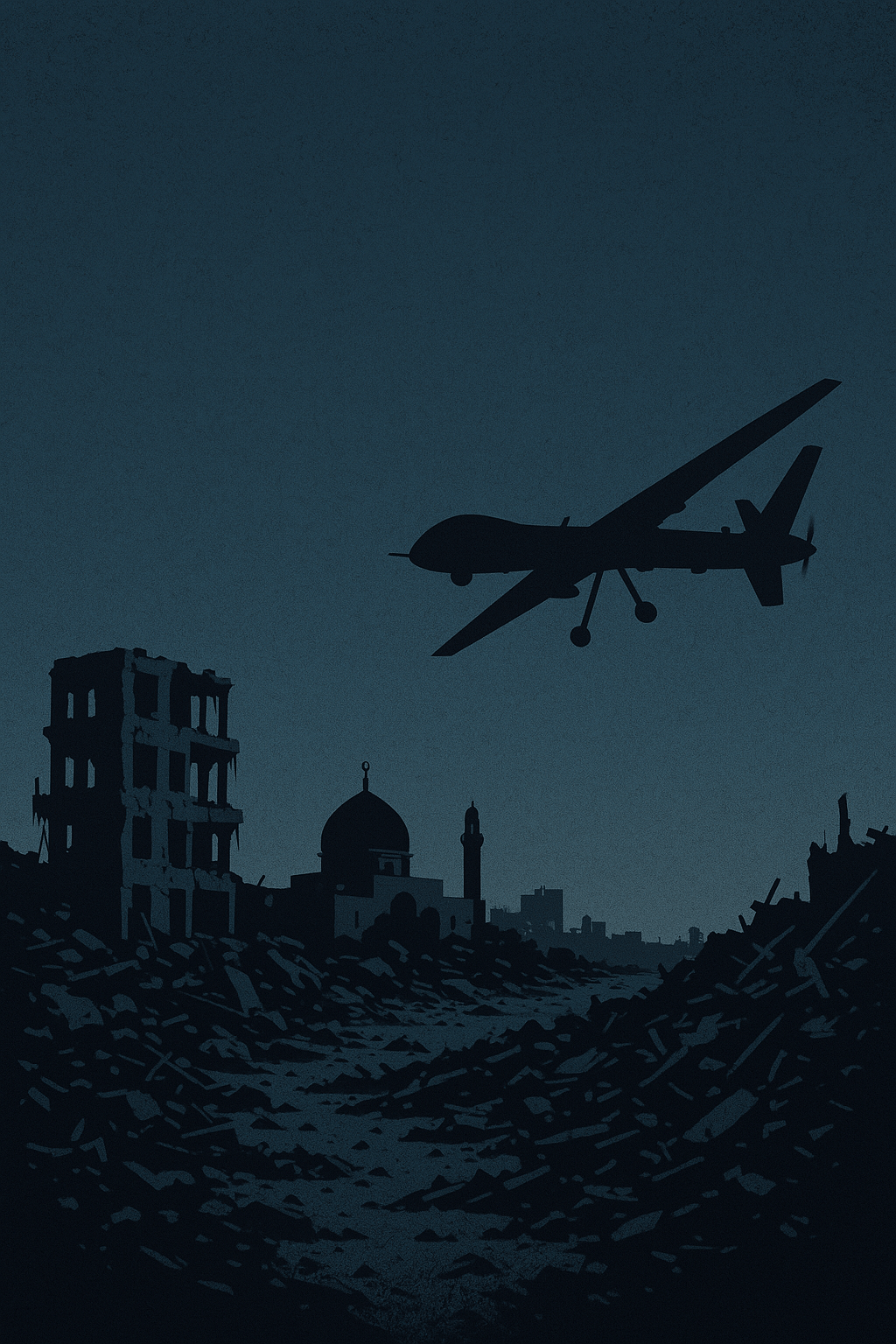
Waste Is Not an Accident—It’s the Plan
Ali Kadri doesn’t beat around the bush. In The Accumulation of Waste, he tells us plainly: we live in a system where war, death, and devastation are not unfortunate byproducts of capitalism’s success. They are the success. Waste is no longer what capitalism throws away. Waste is the product. Destruction is profitable. Death is monetized. The surplus population? An opportunity, not a problem.
In the language of polite Western economists, we’re told about markets correcting themselves, about humanitarian intervention, about failed states and fragile democracies. Kadri cuts through the euphemisms. His core insight is that imperialism, especially of the U.S. variety, adapts itself to crisis by producing destruction as value. Waste isn’t failure. Waste is the design.
This is not a new feature of capitalism, but an intensification of its oldest habit: living off the blood and bones of the global South. And yet, Kadri’s contribution is to show that we’re not just dealing with pillage anymore—we’re dealing with a system that has made destruction itself a stable economic strategy. The wreckage is part of the business model.
In this essay, we incorporate Kadri’s concept of accumulation through destruction as a vital complement to our broader analysis of the Trump 2.0 technofascist regime and the current phase of imperialist recalibration. While Kadri gives us the deep economic anatomy of how destruction produces value, we situate this within a strategic geopolitical schema: one in which U.S. hegemony is no longer sustained by global leadership or economic liberalism, but by targeted domination of chokepoints (e.g., the Panama Canal, Yemen, Greenland) and the systematic generation of waste and ruin (e.g., Syria, Gaza, Haiti). These are not two separate approaches—they are tactical variations within a single recalibration strategy designed to salvage empire in decline.
1. When Death Becomes a Business Opportunity
Kadri flips the classical theory of value on its head. Instead of labor producing value through useful work, we now have laborers producing value by being wasted. Bombed, starved, displaced. Deprived of future, stripped of social infrastructure, turned into risk premiums for capital markets. Waste is no longer the residue; it’s the centerpiece.
And let’s be clear: this isn’t just happening because things got out of hand. This is planned. There are balance sheets for this. There are Pentagon reports that estimate how many civilians can be killed before the public relations cost outweighs the tactical gain. Gaza, for example, is not a humanitarian tragedy. It is a financial opportunity wrapped in an apartheid experiment. Every missile dropped is a line item. Every surveillance app tested on a Palestinian child is a future product for a U.S. police department.
In our theory of technofascism, this is what happens when capital, the surveillance state, and imperial military force fuse into one unholy machine. Waste is digitized. Death is financialized. The world is turned into a simulation where some people’s lives are metadata, and others are just bugs to be deleted.
2. Destruction as Policy: The Logic of Imperial Recalibration
Let’s not give empire too much credit. It isn’t all-powerful. It’s reactive. It improvises. It panics. When the global economy stalls or a region resists absorption into the imperial bloodstream, the U.S. doesn’t always try to build. Sometimes it decides to break.
This is what we mean by imperial recalibration. Under the Trump 2.0 regime, this recalibration is pursued through two main mechanisms: (1) the militarization and control of global chokepoints—the Panama Canal, the Bab-el-Mandeb Strait in Yemen, and resource-rich territories like Greenland, and (2) the use of systemic destruction and waste production to punish defiance, break resistance, and generate profit. This dual-track strategy seeks to re-establish U.S. global dominance not through hegemony, but through brute force, containment, and calculated collapse.
Kadri’s notion of the “sphere of waste production” fits seamlessly into this recalibration framework. Where chokepoint control brings leverage and rent, destruction brings fire-sale accumulation and geopolitical obedience. Syria is smashed to prevent multipolar alliances. Gaza is annihilated to ensure settler supremacy and regional intimidation. Haiti is kept in ruins to prevent any spark of revolutionary Black self-determination.
3. Gaza, Syria, Haiti: Laboratories of Ruin
- Gaza: Israel’s ongoing genocide of the Palestinian people is not just tolerated by the U.S.—it’s co-sponsored. Gaza is a live-fire test zone for weapons, spyware, facial recognition tech, AI policing systems. Palestinians are rendered surplus and treated as raw material: for data, for profit, for death. Israel’s war machine is a boutique defense export model. And the empire takes notes.
- Syria: The destruction of Syria was a geopolitical reset. A sovereign state with independent alliances and a domestic economy had to be dismembered. Proxy wars, jihadi pipelines, black ops, sanctions—Syria became a bonanza of destruction-as-strategy. Millions displaced, cities razed, institutions shattered. And yet, for Western contractors, weapons makers, and intelligence agencies, this was business as usual. No one talks about rebuilding Syria. The plan was never to rebuild.
- Haiti: The original Black republic has been under siege for over two centuries. What began with colonial debt and occupation has turned into a permanent condition of managed collapse. Earthquakes, coups, UN occupations, Clinton Foundation makeovers—Haiti is a managed ruin. The more it crumbles, the more contractors arrive. Every broken road and starving child is a monetizable data point. Development is never the goal. Containment is.
4. Hyper-Imperialism and Technofascism: The Order of the Day
The Tricontinental Institute describes today’s global system as hyper-imperialist: a global cartel of imperial powers led by the U.S., consolidating control in response to the rise of China and the failures of neoliberalism. Kadri adds the material underpinning: the economy of waste, where imperialism no longer even pretends to develop the periphery. It demolishes the periphery and profits from the rubble.
And back home? Enter technofascism. Surveillance capitalism, militarized police, border fortresses, and AI governance form the internal wing of empire. The same drones that fly over Syria train on protesters in Baltimore. The same predictive algorithms used on migrants in Tijuana are sold to Amazon warehouse managers. The same logic that treats Palestinians as expendable targets treats poor Black and Brown people as redundant threats.
Conclusion: The Empire of Waste Must Fall
Kadri puts it plainly: the world has become a factory for waste. And waste—human, social, ecological—is what now fuels capital’s engine. Gaza, Syria, and Haiti are not tragic outliers. They are proofs of concept. The system doesn’t break down there. It works as intended.
This is the defining strategy of Trump 2.0’s imperial recalibration: a dual deployment of strategic chokepoint control and deliberate waste creation to reimpose imperial discipline and extract value from collapse. Kadri has helped us see that death is no longer a side effect of empire—it is one of its most efficient industries.
We are asked to mourn politely while applauding the very architects of the destruction. But to mourn without rage is to be complicit. We must understand that these zones of waste are not beneath empire’s concern. They are at its core. And unless we confront this death machine—and the class forces who run it—we will all eventually be made waste.
In the end, the future won’t be determined by who has the best markets, or the most advanced AI, or the cleanest bombs. It will be decided by whether the global working class, the colonized masses, and the wretched of the earth finally say: enough.
 Weaponized Information
Leave a comment