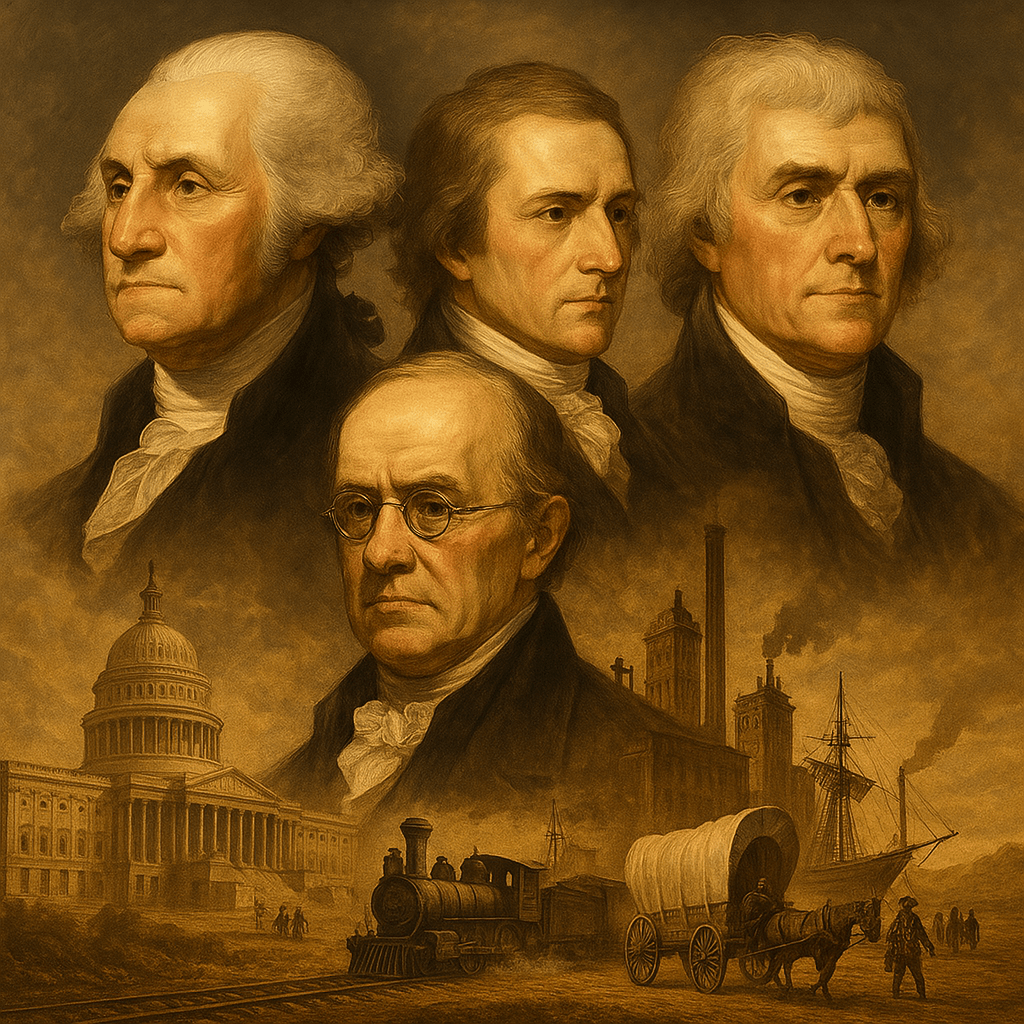
“The American Revolution didn’t end empire—it gave it a new name and handed it over to the settlers.”
The so-called United States of America wasn’t born from democratic awakening—it was a settler coup. The merchant elite, planters, and land speculators saw in revolution not a break from power but a transfer of it—from the British Crown to a domestic ruling class of property-owning white men.
At the core of this seizure was the Yankee class: the New England–based financial and commercial elite. In the wake of revolution, they would solidify their dominance not through popular rule, but through calculated economic consolidation and political restructuring. The Constitution they helped write was not a democratic charter—it was a blueprint for a settler capitalist republic under elite management.
I. The U.S. Constitution: Settler Rule Codified
The Constitution enshrined slavery, private property, and white settler governance. It created the Senate to buffer the popular will, gave Congress control over commerce and taxes to benefit Yankee mercantile interests, and empowered the federal state to expand westward through violence. It wasn’t crafted for freedom—it was engineered to protect capital and suppress rebellion.
II. Yankee Finance: The Engine of Post-Revolutionary Power
The rise of finance capital was the rise of Yankee supremacy. Alexander Hamilton’s First Bank of the United States tied the federal government to a creditor class composed of Northern merchants and bondholders. Yankee elites like the Biddles, Morrises, and later the Morgans centralized credit, land speculation, and industrial development under their command.
III. Industrialization and State Capitalism
Yankee industry was not a product of free enterprise. It was state-engineered. Tariffs, public land grants, and infrastructure projects (like the Erie Canal) created a protected market for Northern industrialists. Factories in Lowell and Lawrence were financed by shipping and slaving capital, and powered by enslaved cotton from the South and wage-enslaved labor in the North.
IV. Yankee Ideology and Bourgeois Moralism
Yankee hegemony was maintained not only through economics, but through ideology. Protestant work ethic, Puritanical morality, and civic “reform” masked elite domination as virtue. Philanthropy became a mechanism of class control. Common schools were structured to discipline labor and reproduce settler identity. Elite universities like Harvard and Yale served as ideological forges for capitalist rule.
V. Expansion as Internal Colonization
The Yankees drove westward expansion—not for democracy, but for capital. They financed railroads and real estate empires across stolen Indigenous land, using federal troops to enforce settler seizure. Banking networks spread across the Midwest, tying new territories to Northern financial dominance. The West wasn’t settled—it was colonized by banks and corporations.
VI. Embedded in Slavery
Despite Northern myth-making, Yankee capital was deeply embedded in the slave economy. Northern insurance companies underwrote slave ships. Textile mills ran on Southern cotton. Banks loaned capital to plantations. The Yankees opposed slavery not on moral grounds, but as an inefficient rival model of labor incompatible with national capitalist unification.
VII. Toward Civil War: A Clash of Capitalist Models
By the 1850s, conflict between Northern financial capital and the Southern slave oligarchy reached its peak. The Yankees sought centralized control, wage labor, and westward expansion under federal governance. The South wanted autonomy, expansion of slavery, and decentralized rule. The Civil War was not a war of liberation—it was a civil war between competing capitalist regimes. Yankee capital won. And the United States would never be the same.
Coming Next: Section 3 — Black Reconstruction and Yankee Counterrevolution: The Consolidation of Finance Capital and the Machinery of Empire
 Weaponized Information
Leave a comment