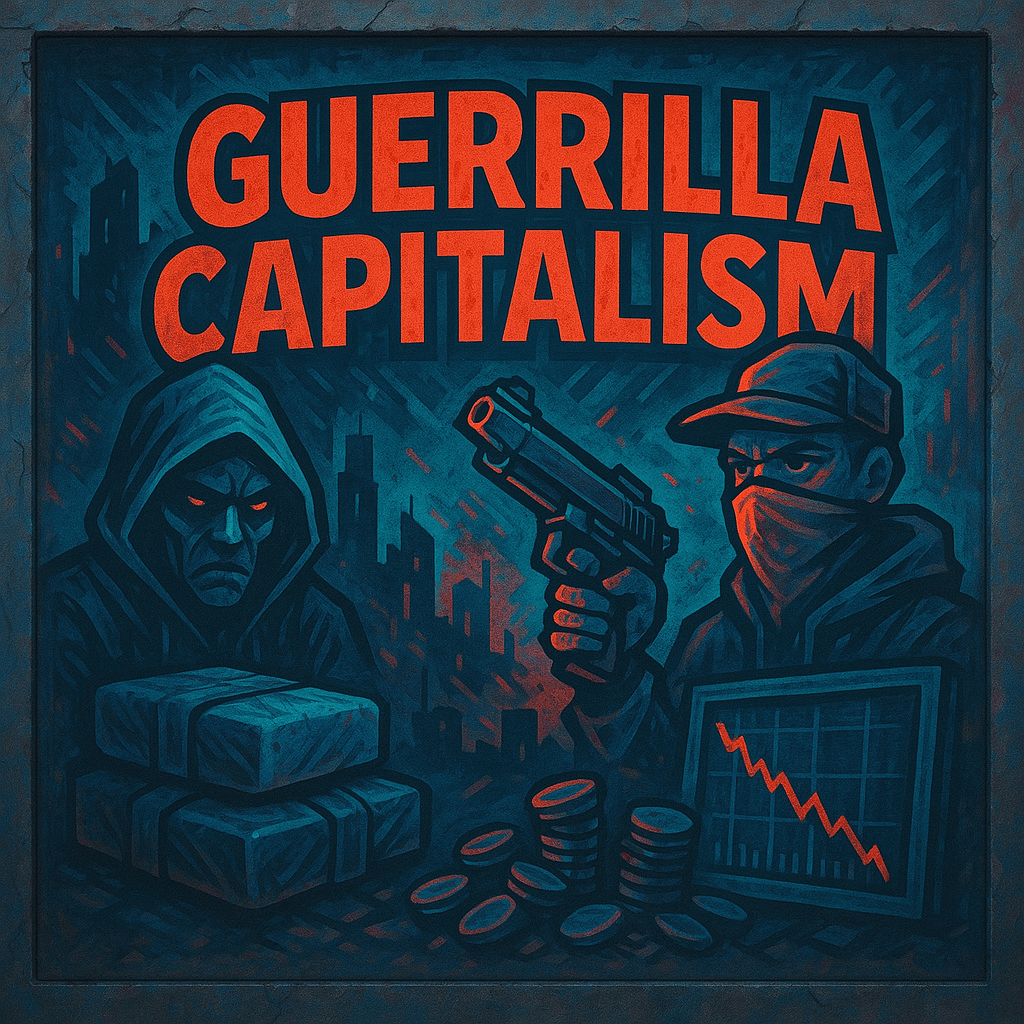
Editors Note: I’m honored to introduce our newest columnist at Weaponized Information “Booby” Bolden. We were cellmates for 2 years when I was locked up between 2009-2011, and he’s unfortunately still incarcerated today. But he is one of the main people who developed this analysis and political line with me through years of struggle in the belly of the beast so he is the first comrade I recruited for this media project. #StillLumpenOrNothin
By “Booby” Bolden for Weaponized Information
“New York streets where killers’ll walk like Pistol Pete /
And Pappy Mason, gave the young boys admiration /
Prince from Queens and Fritz from Harlem /
Street legends, the drugs kept the hood from starvin’.”
— Nas, \”Get Down\”
Capitalism, in its terminal stage, has nothing left to offer the colonized but death. When the banks crash and the bosses flee, the people do not eat paper—they eat what they hustle for. When the imperial dollar trembles, when the settler state locks its doors, it ain’t Wall Street that feeds the hood—it’s the underground economy, the informal circuit, the lumpen trade. And in that circuit, narcotics reign—not because we love them, but because we ain’t been given a better option.
Let’s get this clear from the beginning: this is no glorification of the dope game. This is a hard, scientific look at how capital operates from below. This is the view from the ghetto colony. And as Comrade Huey said, the so-called criminal is nothing but an “illegitimate capitalist”—a person forced by the state’s contradictions to seize capital through outlawed means because the legal doors have been slammed shut by white power.
Guerrilla Capitalism: Economy of the Colonized
Guerrilla capitalism is the economy of the block, the trap, the bando, the chop shop. It is how colonized people—cut off from means of production, land, credit, and dignity—create survival networks under the heel of empire. It is not abstract. It is not hypothetical. It is blood, sweat, paranoia, loyalty, betrayal, burial.
The guerrilla capitalist is the outlaw entrepreneur. He is not a free agent in a free market. He is a political prisoner-in-waiting, a surplus body in the belly of a beast that has no further need for him. What he sells—weed, coke, pills, fentanyl—is not what he chose. It is what the market made necessary. It is what the state allowed through customs and borders, only to criminalize at retail.
And in that contradiction, he flips survival into strategy.
The Historical Record: Wall Street Crashes, the Streets Eat
When capitalism collapses, the narcotics economy expands. That is not an anomaly—it is a feature of the system.
- Reagan era: When deindustrialization gutted Black labor, the crack economy filled the void. This was no accident. The state brought the dope in, flooded the zone, then criminalized the reaction.
- 2008 financial crisis: While the banks choked on their own Ponzi schemes, the global drug trade moved $320 billion in unregulated, untaxed cash. According to the UN, that money helped stabilize major banks. Translation: Wall Street got high off the block’s supply.
- COVID-19: Legal businesses shuttered. But the dope boys adapted—drones, Signal, crypto, drop spots. The trap became a distributed logistics network while Wall Street executives learned how to turn on their webcams.
What this proves is simple: narcotics are a more consistent, crisis-proof commodity than any financial instrument the empire can produce. No inflation. No speculation. Just demand, product, and distribution.
Narco-Statecraft: The Real Drug Dealers Wear Badges and Medals
America does not hate drugs. America hates losing control of them.
The U.S. state is the biggest dope runner on Earth. From the CIA’s heroin trafficking in Southeast Asia, to the Contras’ cocaine smuggling in Central America, to the protection of Afghan opium under U.S. military occupation—the state has always trafficked drugs to fund counterinsurgency and war.
And the banks? They’re in on it too. HSBC laundered nearly a billion dollars for the cartels—and got a fine smaller than their quarterly profit margin. But let a colonized youth sell a dime bag and he’ll get a decade in prison. That’s not justice. That’s colonial law in motion.
Risk and Return: The Political Economy of the Trap
Let’s talk Marx for a second. The capitalist seeks profit and expansion through any means necessary. The lumpen seeks survival. But when the system is in decay, and the legal economy shuts us out, even survival becomes an act of capital accumulation.
Selling drugs is dangerous. But so is working construction, coal mining, or flipping burgers until your body breaks down. Death is baked into every job the colonized are allowed to do. The difference is: the trap offers ownership. It offers agency—however brutal, however fragile. It offers the chance to eat without begging a boss.
The guerrilla capitalist knows he is disposable. That’s why he flips harder. That’s why he distributes like a tactician, builds networks like a general, watches his back like a soldier behind enemy lines. He knows this ain’t freedom—but it ain’t wage slavery either.
Final Word: What the Streets Already Know
This is not a love song for narcotics. This is a war cry against a system that makes narcotics the last remaining path to capital for the colonized poor.
You want to stop the dope game? End the system that made it necessary. End the colonial relations that hoard wealth in the hands of white capital. End the wars that create refugees. End the borders that criminalize survival. Until then, the streets will keep moving. The hood will keep eating. And the dope will remain—because capitalism, in collapse, will keep supplying it.
Nas was right. The drugs didn’t destroy the hood. The drugs kept the hood from starving.
And the ones who moved it? They weren’t criminals. They were illegitimate capitalists. They were survival strategists. They were soldiers in a war they didn’t start—but one day might finish.
 Weaponized Information
Leave a comment