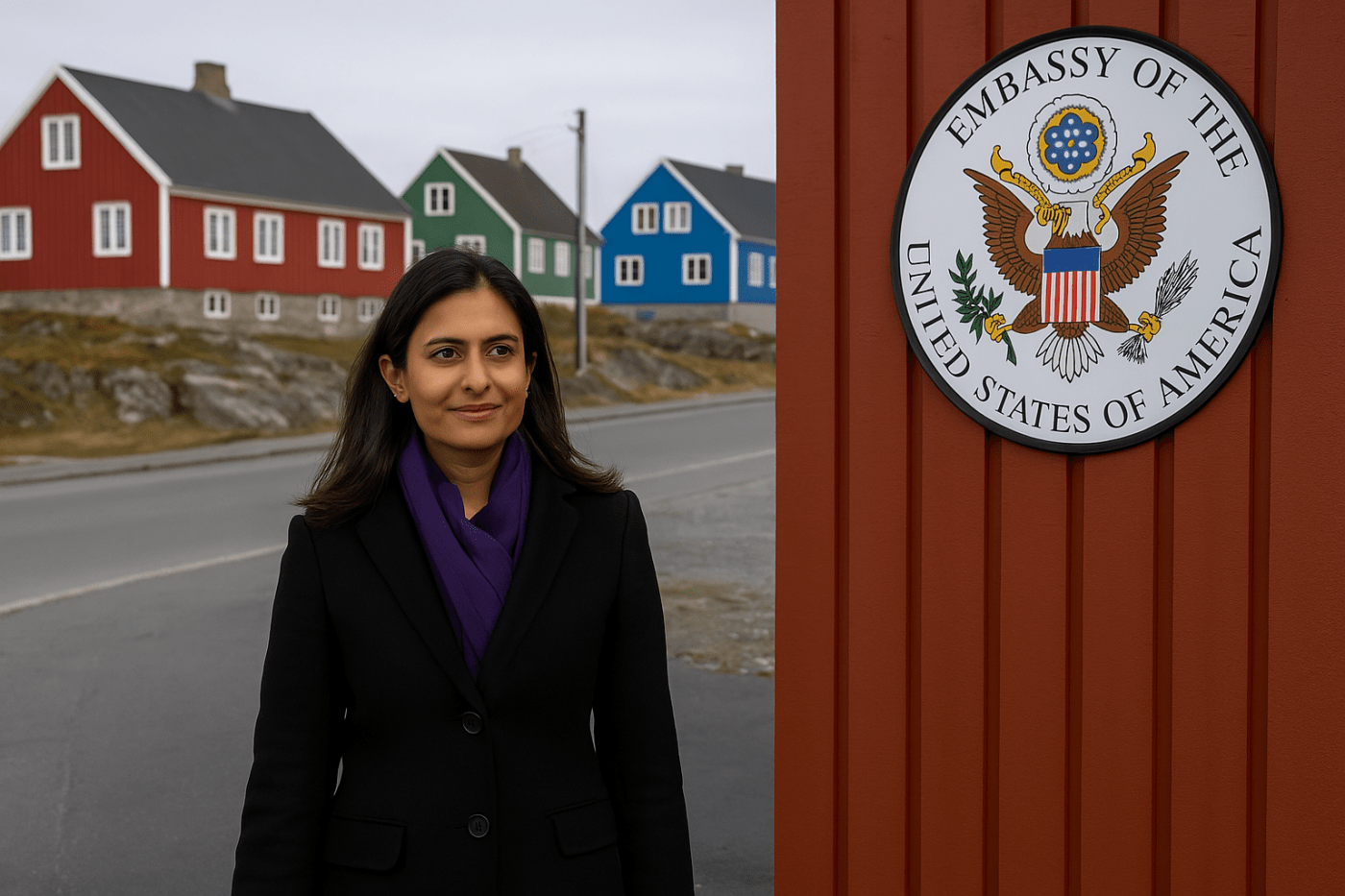
In one of the most bizarre and telling moments of U.S. diplomacy in recent memory, American officials in Greenland’s capital of Nuuk went door-to-door asking residents if they wanted to meet Usha Vance—the wife of Vice President J.D. Vance. Not a single Greenlander took them up on the offer. No crowds. No curious onlookers. No smiling children waving American flags. Just silence and shut doors.
What may seem like a diplomatic faux pas or a quirky PR blunder is in fact emblematic of a deeper crisis within the U.S. empire: the collapse of its soft power and the increasing rejection of its overtures by nations and peoples long considered peripheral and passive. That the wife of a sitting vice president could not even generate local interest in a city of 19,000 speaks volumes about how far American prestige has fallen—especially when attached to figures associated with Trumpism, Christian nationalism, and reactionary isolationism.
The Arctic as Imperial Battleground
Greenland may seem remote, but it has never been marginal to imperial power. The island is of immense geostrategic value. It hosts the U.S. Thule Air Base, a crucial radar and missile defense site located within 1,200 kilometers of the North Pole. As Arctic ice melts and shipping routes open, Greenland has become the northern frontier in the new imperial scramble—not only for military positioning but also for untapped rare earth minerals and energy reserves.
This is why Donald Trump infamously attempted to “buy” Greenland from Denmark in 2019—a move that was both ridiculed and revealing. It was ridiculed because it sounded absurdly colonial in tone, but revealing because it underscored how the U.S. views Greenland not as a nation with agency, but as a strategic asset to be acquired. That same mindset has continued under Trump 2.0, with the Vance visit and the door-to-door diplomacy serving as a soft-power follow-up to Trump’s hard-power fantasy.
When Soft Power Fails
Traditionally, U.S. imperialism has relied on a combination of military might and cultural appeal—Hollywood, pop stars, scholarships, and smiling diplomats. But in this new era of global resistance and digital transparency, that charm offensive is falling flat. Even the use of first ladies and political spouses as emissaries of goodwill—a time-tested U.S. strategy—is now failing to produce results.
Usha Vance’s Greenland visit was supposed to be a symbolic gesture of friendship and shared values. Instead, it became a symbol of how desperate and detached the American empire has become. Greenlanders, acutely aware of their colonial history under Denmark and their geopolitical value in a new Cold War, want autonomy and respect—not photo ops with imperial figures.
Who Is Usha Vance?
Usha Vance is more than a vice president’s wife. She is a representative of a new ruling-class project emerging within U.S. technofascism. As a Yale-educated lawyer and the child of Indian immigrants, she reflects the racial integration of the American ruling class without any disruption to its colonial ideology. Her husband, J.D. Vance, is a key figure in the white nationalist realignment of American politics under Trump 2.0, advocating for closed borders, Christian nationalism, and authoritarian cultural policies.
Sending Usha Vance to Greenland was not merely a diplomatic gesture—it was a calculated attempt to use a multicultural face to soften the image of a deeply reactionary regime. But the people of Greenland saw through the charade. They did not want to play extras in America’s ideological theater.
The Arctic Front in the New Cold War
Greenland is not just a sideshow. It is a frontline in the sharpening geopolitical struggle between the United States, China, and Russia. The Arctic has become a contested zone for new shipping lanes, underwater cables, surveillance networks, and military infrastructure. The U.S. has increased its diplomatic presence and investment in the region while accusing China of seeking a “strategic foothold.”
This is classic projection. The U.S. does not want to lose its imperial grip on the Arctic, even as it loses legitimacy everywhere else. And so, it sends diplomats door-to-door, hoping to manufacture the appearance of friendship and alliance. But you can’t colonize consent. You can’t force camaraderie. And in Nuuk, the doors stayed closed.
Empire Rebuffed
The incident in Greenland may appear minor, but its implications are vast. It reveals a world increasingly uninterested in the American empire’s offerings—be they bombs or brunches with a vice president’s spouse. It shows the limits of charm in a world sick of coercion. And it signals that even in places the U.S. once treated as strategic chess pieces, the people are waking up.
Greenland said no. And the empire should be afraid of how often that word is starting to echo across the world.
 Weaponized Information
Leave a comment