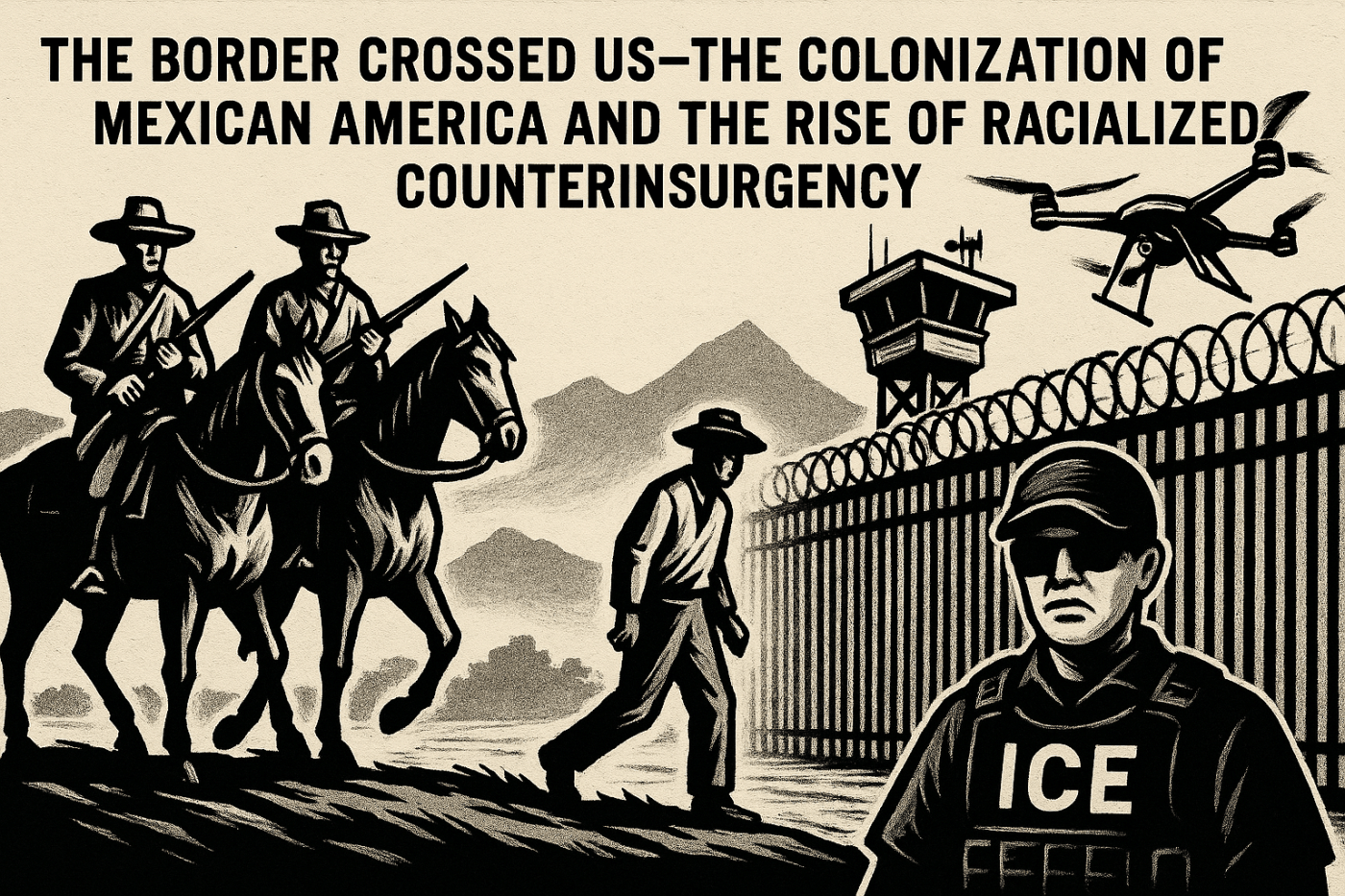
From Land Theft to Technofascism
The U.S. didn’t just annex land. It annexed people.
In 1848, under the barrel of a settler gun, Mexico surrendered half its national territory to the United States. But the so-called Treaty of Guadalupe Hidalgo didn’t just redraw borders—it redefined the logic of American conquest. Overnight, tens of thousands of Mexicans—Indigenous, mestizo, Afro-Mexican, poor, rural, revolutionary—were absorbed into a white settler state that never intended to treat them as equals.
This was not immigration. It was occupation. Not inclusion. Colonization.
I. Manifest Destiny as Colonial Doctrine
The U.S. invasion of Mexico was not a war of necessity. Even General Ulysses S. Grant called it “one of the most unjust ever waged.” The purpose was simple: to expand the slaveholding, land-grabbing empire westward. Manifest Destiny wasn’t destiny. It was white supremacy, codified as strategy.
The Treaty of Guadalupe Hidalgo guaranteed land, language, and political rights for the conquered—but these were immediately violated. Congress stripped Article X from the final agreement to eliminate protections for communal landowners and Indigenous peoples. Instead of honoring property rights, U.S. courts and surveyors worked hand-in-hand to dispossess entire communities.
The border didn’t move. Empire did. And the settler state brought with it courts, guns, railroads, and white-only democracy.
II. From Mexican Nationals to Racialized Subjects
The settlers didn’t see Mexicans as fellow citizens. They saw them as obstacles. John C. Calhoun warned against granting citizenship to “our new fellow citizens”—because they were “of the most mixed blood.”
What followed was textbook settler colonialism:
- Land theft through “legal” deception, manipulated courts, and Anglo aggression
- Mob violence via groups like the Texas Rangers and white vigilantes
- Labor exploitation on railroads, mines, and plantations
- Cultural warfare that banned Spanish in schools and criminalized Mexican identity
These weren’t isolated acts—they were state-sanctioned policies. The settler state imposed racial hierarchy through every institution: courts, police, education, and labor.
Mexicans became the first non-Black population internally colonized by the U.S. after the Civil War—an entire people rendered surplus but necessary, criminalized but exploitable.
III. Resistance from Below
But the colonized didn’t go quietly.
From the late 19th to early 20th century, Mexicans fought back:
- Victor L. Ochoa and Lauro Aguirre planned border uprisings and issued revolutionary manifestos
- The Plan de San Diego (1915) called for the liberation of Texas and reestablishment of Mexican sovereignty
- Farmworkers organized militant strikes under threat of violence or deportation
- Mutualista societies and political clubs formed to defend Mexican communities
The state responded predictably: surveillance, infiltration, and militarized policing. The Texas Rangers operated as a death squad, executing suspected rebels and burning villages. Federal agencies tracked and neutralized activists under the guise of national security.
The U.S. developed new counterinsurgency tools by practicing on Mexicans first.
IV. Deportation as a Weapon of War
In the 20th century, the U.S. replaced open annexation with economic migration and racialized labor management. But the logic of control stayed the same.
- Operation Wetback (1954) used military tactics to deport over one million people
- The Border Patrol (est. 1924) functioned as a paramilitary force protecting white labor
- Chicano activists and Brown Berets were targeted by COINTELPRO and local police
- “Reform” laws like the 1986 IRCA amnesty were used to divide movements and entrap undocumented workers
These operations had less to do with law enforcement and more to do with breaking resistance and controlling labor supply.
Immigration law became counterinsurgency by another name.
V. The Technofascist Frontier
Fast-forward to the 21st century, and the settler state has upgraded its tools. The conquest has gone digital.
- Surveillance towers and drones monitor the border 24/7
- Palantir, Amazon, and private contractors power ICE raids
- Facial recognition, biometric tracking, and AI are deployed to monitor immigrant communities
- Private detention centers operate as militarized profit machines
What started with Texas Rangers and land courts has evolved into a technological regime of racialized domination.
The settler state never stopped fighting the war it started in 1846. It just gave it new language: homeland security, national interest, “illegality.” But the logic remains the same.
The Mexican was never just a migrant.
The border was never just a line.
This is a counterinsurgency front—and always has been.
VI. Conclusion: Occupation Continues
The U.S. conquest of northern Mexico was not a past event. It’s a living structure. The descendants of those colonized are still resisting—from the borderlands to the fields, from high schools to organizing drives, from detention centers to community kitchens.
What we call “immigration policy” is the soft language of a hard empire. Behind every law is a gun. Behind every border checkpoint is a surveillance database. Behind every deportation is a history of conquest.
The only way forward is through truth. And the truth is this:
The border crossed them. And it will cross all of us—unless we destroy the system that drew it.
 Weaponized Information
Leave a comment