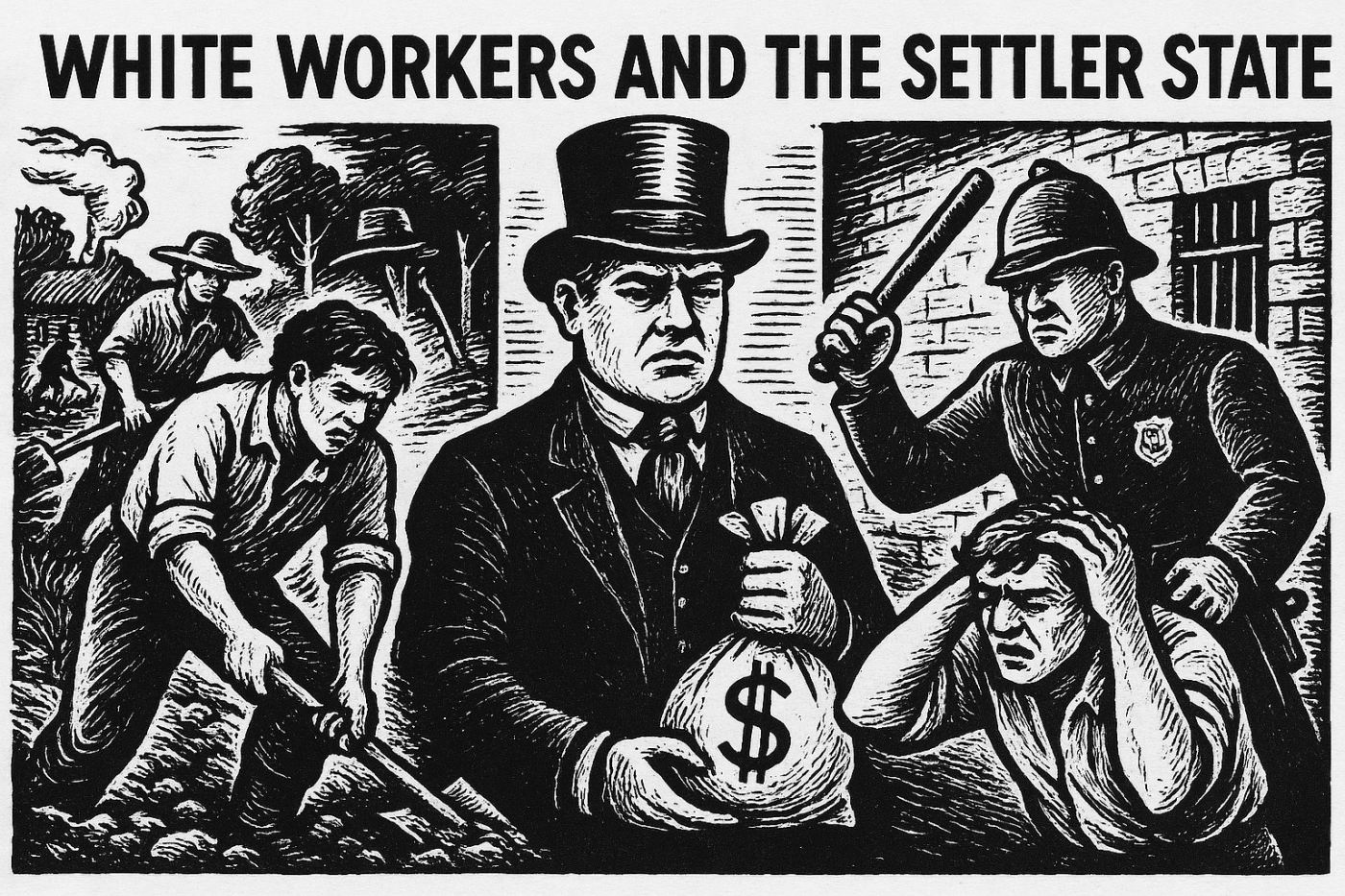
Part IV: The Wages of Whiteness and the Birth of the Settler Working Class
Race, Class, and the Making of Counterinsurgency in Colonial America
Before the ink dried on any founding document, before a single phrase about liberty or the pursuit of happiness was ever uttered, the American project had already begun in conquest and coercion. The foundation wasn’t freedom—it was land theft, Indigenous extermination, and a brutal labor regime held together by terror. There was no “new world”—there was a settler colony.
This part of the story is rarely told in schoolbooks or patriotic myths: that the white working class was not born as a revolutionary force. It was forged as a contradiction—exploited by the ruling class, but trained to serve the empire. A class divided against itself, lured into whiteness, and deployed against the colonized.
And when that contradiction started to crack—when poor whites and enslaved Africans, when the colonized and the exploited began to find common ground—the ruling class didn’t wait. It crushed them with fear, fire, and law.
I. Laboring in the Furnace of Empire
In the early colonial years, labor in North America was drawn from everywhere the empire could exploit. Africans were trafficked into chattel slavery. Indigenous peoples were captured, conscripted, or killed. And Europeans—mostly poor, debt-ridden, or criminalized—were bound in indenture. They worked alongside one another, bled together, rebelled together.
But it wasn’t solidarity the ruling class feared most. It was revolution. And when it saw glimpses of what could be, it acted with precision.
II. 1741: Fire in the Empire’s Heart
In New York City, 1741, several fires broke out in quick succession. Buildings burned, and the colonial elite panicked. The authorities accused a multiracial conspiracy of enslaved Africans, poor white servants, and marginalized free people of plotting to burn the city, kill their masters, and seize power.
Over 150 people were arrested. Thirty were hanged. Thirteen Black men were burned alive. Dozens more were exiled. The jails were expanded. The laws were rewritten.
Whether the conspiracy was real or imagined, the state made clear: unity among the oppressed would not be tolerated. The white poor could be redeemed through loyalty. But the Black rebel had no place in the settler order—only chains or the grave.
The 1741 conspiracy terrified the ruling class because it revealed a deeper truth: that those at the bottom might stop fighting one another, and start fighting their true enemy.
III. Inventing Whiteness as Counterinsurgency
After 1741, a wave of laws swept through the colonies. Slavery was fixed to Blackness—heritable, permanent, racial. Poor Europeans were given a way out: not freedom, but entry into whiteness.
They were no longer just laborers. They became settlers.
- They were promised land—if they helped steal it.
- They were offered wages—if they enforced the racial order.
- They were given status—so long as they stood on the backs of the enslaved.
Whiteness was not just a color. It was a contract.
A deal between the exploited and the empire:
You can be poor—so long as you are not Black. You can suffer—so long as you serve.
This was not liberation. It was loyalty bought with blood.
IV. Policing the White Poor
Before whiteness was fully consolidated, poor Europeans were seen as dangerous. They rioted. They refused orders. They organized. And so they were surveilled, punished, and controlled.
- Seditious speech was banned.
- Debt led to imprisonment.
- Laborers who resisted were beaten, jailed, or worse.
The ruling class understood that class rebellion could erupt from below. But it had a solution: co-opt the white poor into the settler project. Give them just enough power to protect the system that exploited them. Turn rebellion into patrol.
The early American state did not repress the poor because it hated them—it repressed them so it could use them.
V. Settler Democracy and the False Freedom of the White Worker
When the United States was born, the “people” it claimed to represent did not include everyone. Citizenship was racialized. Rights were property-based. And democracy was carefully restricted to settlers—white, male, and willing to protect the empire.
This was the deal:
- Join the militia to suppress Indigenous nations.
- Patrol the plantations to catch runaways.
- Keep the ghettos in line.
- Vote for the men who would keep land in your hands and power out of theirs.
White workers were exploited, but not colonized.
They were ruled, but not enslaved.
They were poor, but not outside the law.
And that difference—the line drawn by race—was the line the ruling class drew with intent.
VI. Conclusion: Class Rebellion Lost to Empire
The early settler republic didn’t crush working-class rebellion with violence alone. It crushed it by redirecting it—by turning solidarity into suspicion, and poverty into privilege.
Multiracial class struggle was not impossible. It was beginning to emerge. But the settler ruling class understood something many radicals still refuse to admit:
You don’t have to defeat rebellion when you can divide it.
And so they built the first counterinsurgency model of the U.S. empire—not on foreign soil, but in the towns and fields of colonial America.
They broke the back of solidarity with the whip, and broke its memory with whiteness.
If we want to build a new world, we must understand this:
The white working class was never just a victim of capitalism.
It was a conscript in the army of empire.
And it must be decolonized—not just organized.
 Weaponized Information
Leave a comment