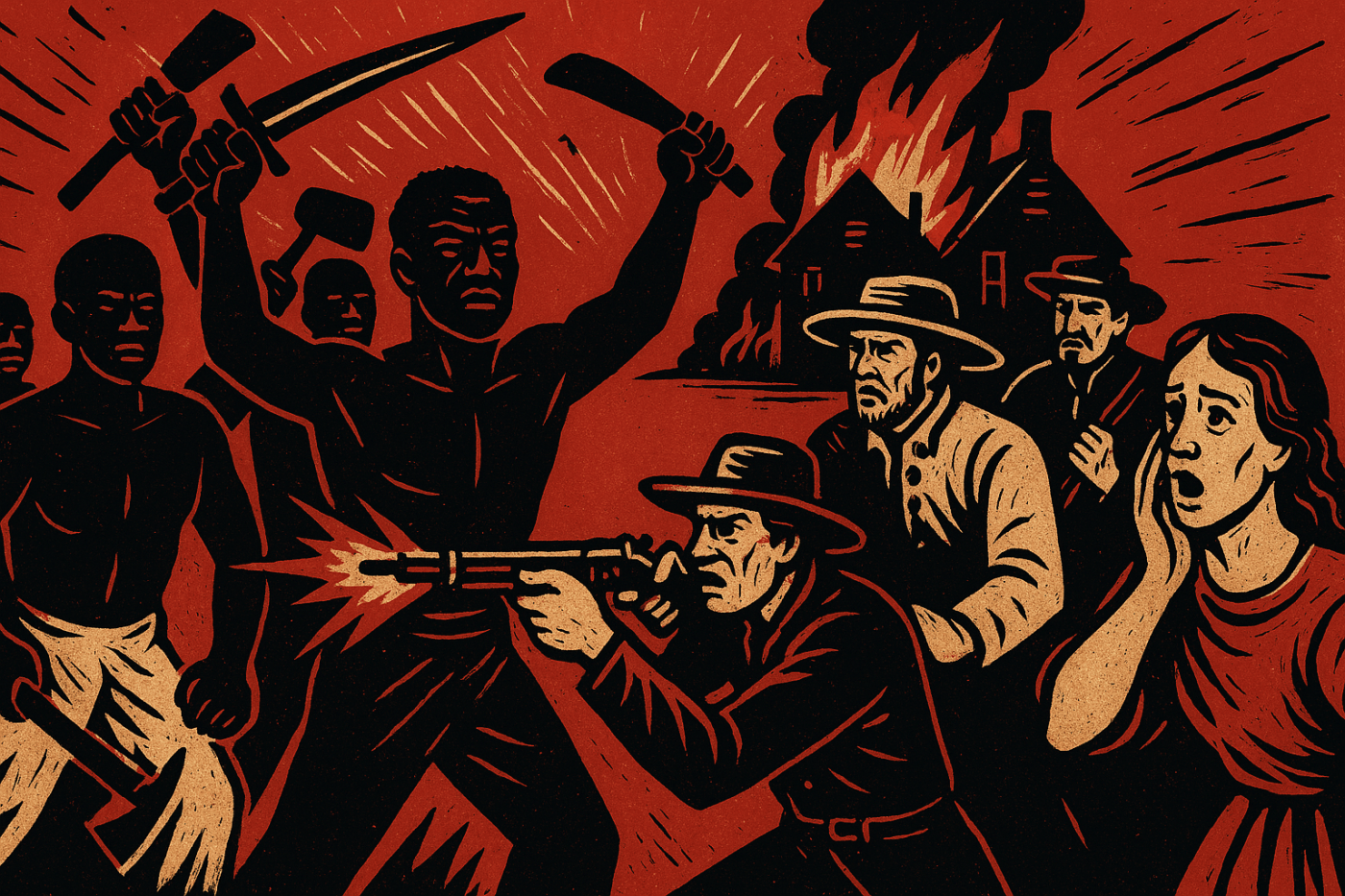
Part III: Slave Patrols, Plantations, and the Logic of Anti-Black Insurgency
Repression as Governance in the Settler Republic
Before there were police, there were patrols.
Before there were laws, there were chains.
Before there was a constitution, there was the whip and the gallows.
And behind it all, there was fear—settler fear. Fear that the enslaved might one day rise and do unto their masters what had been done to them.
That fear became policy.
That policy became law.
That law became the blueprint for the modern American state.
The plantation was not just a place of work. It was a counterinsurgency laboratory.
Its function was not only to extract labor, but to destroy resistance before it could exist.
I. Slavery as Permanent Warfare
Slavery was not a labor system—it was a war.
It was a war against memory, against speech, against mobility, against kinship, against knowledge, against hope.
The enslaved were treated not simply as property, but as enemy combatants in a conflict that never ended.
And the state—the white settler state—was built to win that war by any means necessary.
- To run away was a crime.
- To say no to an order was a crime.
- To refuse to work was a crime.
- To steal from your master—even the tools of your own labor—was a crime.
- To fight back was rebellion.
- To kill your enslaver—your captor—was called murder.
This is not law. This is colonial violence dressed up in legal language.
This is what the U.S. called justice.
In the white republic, freedom for the enslaved was always criminalized. Not by mistake, but by design.
II. The Birth of the Patrol
The first organized law enforcement institutions in America weren’t in Boston or New York.
They were in South Carolina, Georgia, Virginia—plantation zones where the enslaved outnumbered the settlers, and white power knew it.
Slave patrols were the original police:
- White men deputized to surveil, track, capture, and terrorize the enslaved
- Armed with guns, dogs, and legal immunity
- Empowered to enter Black homes without warrants
- Mandated to use deadly force
These were not rogue vigilantes. They were state agents, and every white settler man was expected to serve.
The patrol wasn’t an exception to democracy. It was democracy—for settlers.
III. The Plantation as Totalitarian Space
The plantation was not just a place where labor was stolen. It was a space where resistance was anticipated and suppressed in advance.
- Spatial segregation ensured disunity
- Enforced illiteracy maintained ignorance
- Family separation prevented bonds
- Religion was weaponized to promote obedience
- Surveillance was constant—overseers, informants, spies
This was a pre-modern police state, where everything—time, space, language, movement—was under control.
And when the enslaved broke the rules of this regime, they were punished according to law.
But it wasn’t their law. It was the law of their captors.
The U.S. legal system was never neutral. It was born on the plantation.
IV. Crime, Property, and the Inversion of Justice
Let’s speak plainly.
A person stolen from their homeland, worked to death, and stripped of identity was not seen as a victim.
The person who stole them—the one who raped, beat, and exploited them—was seen as a “property owner.”
And when that enslaved person resisted in any form, they were the criminal.
This is the inversion at the heart of settler law:
Property is sacred. Life is conditional.
And this logic didn’t end with Emancipation. It was updated.
Into vagrancy laws. Into sharecropping contracts. Into convict leasing.
Into loitering charges, stop-and-frisk, and gang databases.
Black survival was never legal in this country. It was only tolerated when it was profitable.
V. The Transition from Patrol to Police
After the Civil War, the U.S. didn’t dismantle the slave patrol system. It rebranded it.
- “Public safety” departments emerged
- Police departments were established in southern cities
- Anti-Black repression was wrapped in new language: crime prevention, law and order, civil peace
But the function remained unchanged:
- To protect white property
- To suppress Black rebellion
- To criminalize Black existence
White settlers didn’t stop fearing Black rebellion.
They just modernized the institutions that could stop it.
VI. Conclusion: Counterinsurgency as Daily Life
We must understand: for Black people in the U.S., the state has never been a neutral referee.
It has always been a military occupation force.
The enslaved didn’t just endure violence. They endured a total system designed to erase their capacity to resist.
And when they did resist—when they ran, stole back their labor, fought back, or rose in open revolt—they were punished not just by mobs, but by law.
This is what makes the American state so dangerous:
It doesn’t just repress the colonized with brute force.
It tells the world that repression is justice.
On the plantation, Black freedom was a crime.
In the ghetto, it still is.
And the badge is still a patrol.
And the court is still a slave code.
And the state is still at war.
 Weaponized Information
Leave a comment