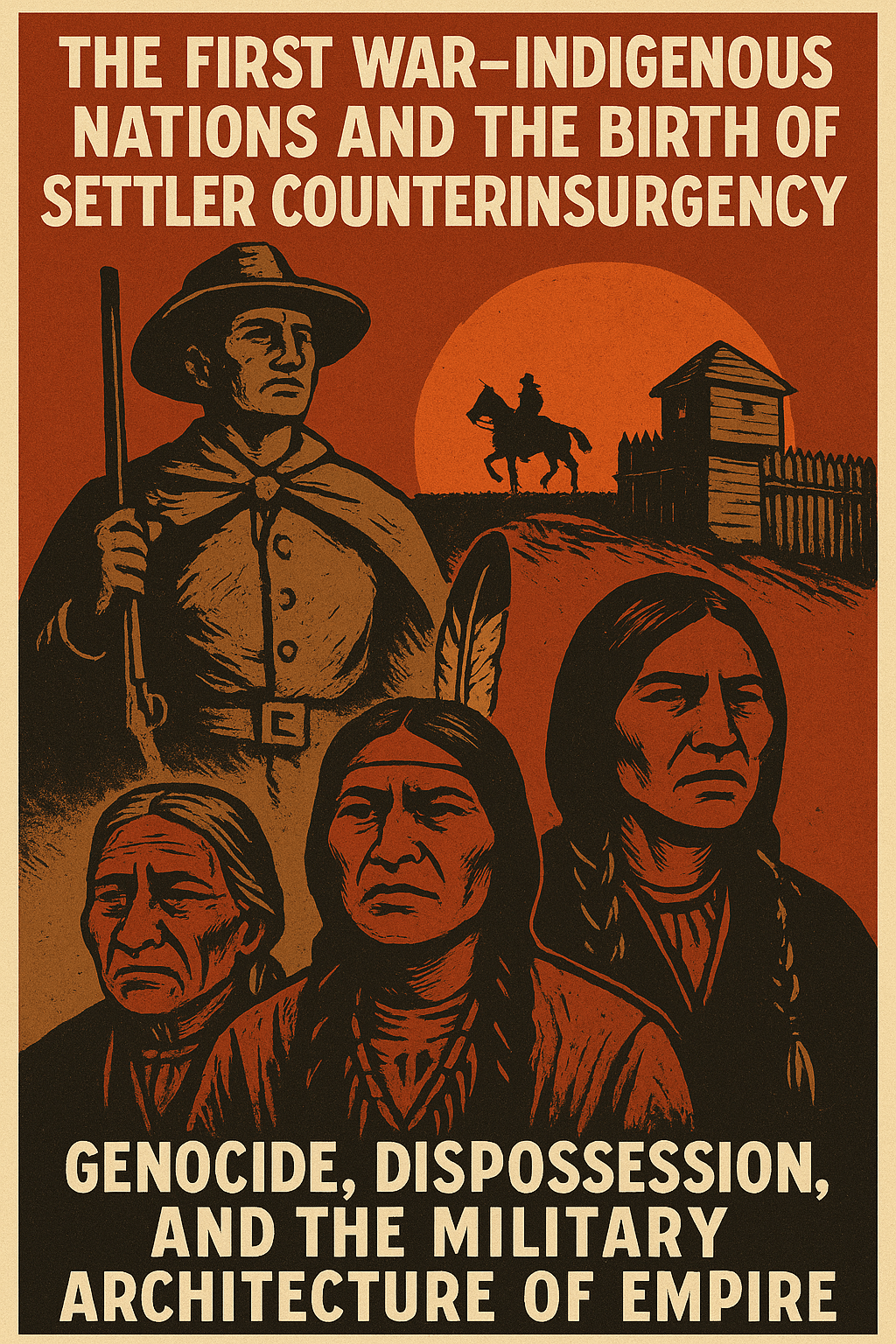
Part II: The First War — Indigenous Nations and the Birth of Settler Counterinsurgency
Genocide, Dispossession, and the Military Architecture of Empire
Before the first African was chained and dragged across the Atlantic, before the first slave patrol rode through Carolina swamps, before the United States called itself a nation—there was a war.
A war against hundreds of sovereign Indigenous nations. A war of conquest, extermination, and containment. A war that never ended—only rebranded.
The true origin of U.S. counterinsurgency lies not in foreign conflict but in the genocidal assault on the original peoples of this land. It was this campaign of total warfare that laid the foundation for every domestic policing institution, every surveillance apparatus, and every future war of occupation the U.S. would wage abroad and at home.
I. The Land Was Not Empty
The myth of the “new world” obscures the truth: the land was full—inhabited by complex Indigenous civilizations with systems of governance, agriculture, diplomacy, and spiritual knowledge thousands of years old. The U.S. settler project didn’t discover America—it invaded it. And its goal was not coexistence—it was elimination.
II. The First Counterinsurgency
Settler militias, colonial governors, and religious authorities launched a full-spectrum war against Native resistance:
- Militias were deputized to raid, massacre, and displace Native communities
- Treaties were used as tools of deception and delay
- Forced removals and starvation policies became standard
- Children were kidnapped and indoctrinated in boarding schools
This was not spontaneous violence—it was state-sponsored counterinsurgency, designed to preempt rebellion, destroy nationhood, and neutralize future resistance.
III. Framing Resistance as Rebellion
Indigenous resistance—whether diplomatic, cultural, or military—was criminalized and demonized. The settler logic was clear:
- Defending your land = savagery
- Resisting dispossession = insurrection
- Refusing assimilation = terrorism
In this worldview, Native nations were never sovereign—they were internal threats. The settler state responded by criminalizing existence itself.
IV. Genocide as Policy
The U.S. government pursued genocidal policy openly and unapologetically:
- The Trail of Tears displaced tens of thousands and killed thousands
- The Indian Removal Act authorized land theft at scale
- “Total war” campaigns like those of Sherman and Sheridan targeted food supplies and civilians
- The Dawes Act fragmented tribal land to erase collective ownership
Extermination was not a consequence—it was a mechanism of settler expansion.
V. From War to Administrative Containment
When open warfare proved unsustainable, the settler state transitioned to bureaucratic counterinsurgency:
- Reservations were established as containment zones
- Native movement was regulated through permit systems and surveillance
- Language, religion, and ceremony were criminalized
- Children were taken to “kill the Indian, save the man” through forced assimilation
This was counterinsurgency through erasure.
VI. Settler Sovereignty and the Construction of Whiteness
Settler democracy was predicated on whiteness. The right to bear arms, own land, vote, and govern was reserved for settlers. To be white was to be a citizen—to be Indigenous was to be a subject of war.
The settler became both soldier and citizen. The state was built not despite conquest—but through it.
VII. Conclusion: The First War Never Ended
From Standing Rock to boarding school mass graves, the evidence is clear: the war against Indigenous nations continues. Today’s pipelines, prisons, and police are the descendants of cavalry, mission schools, and Indian agents.
The U.S. counterinsurgency model was born on Indigenous land. It began with genocide and evolved into governance. Every future repressive mechanism—against Black people, migrants, poor folks, and radicals—was first tested on Native nations.
To understand America’s domestic war machine, we must begin with the First War—and never forget that it’s still being fought.
 Weaponized Information
Leave a comment