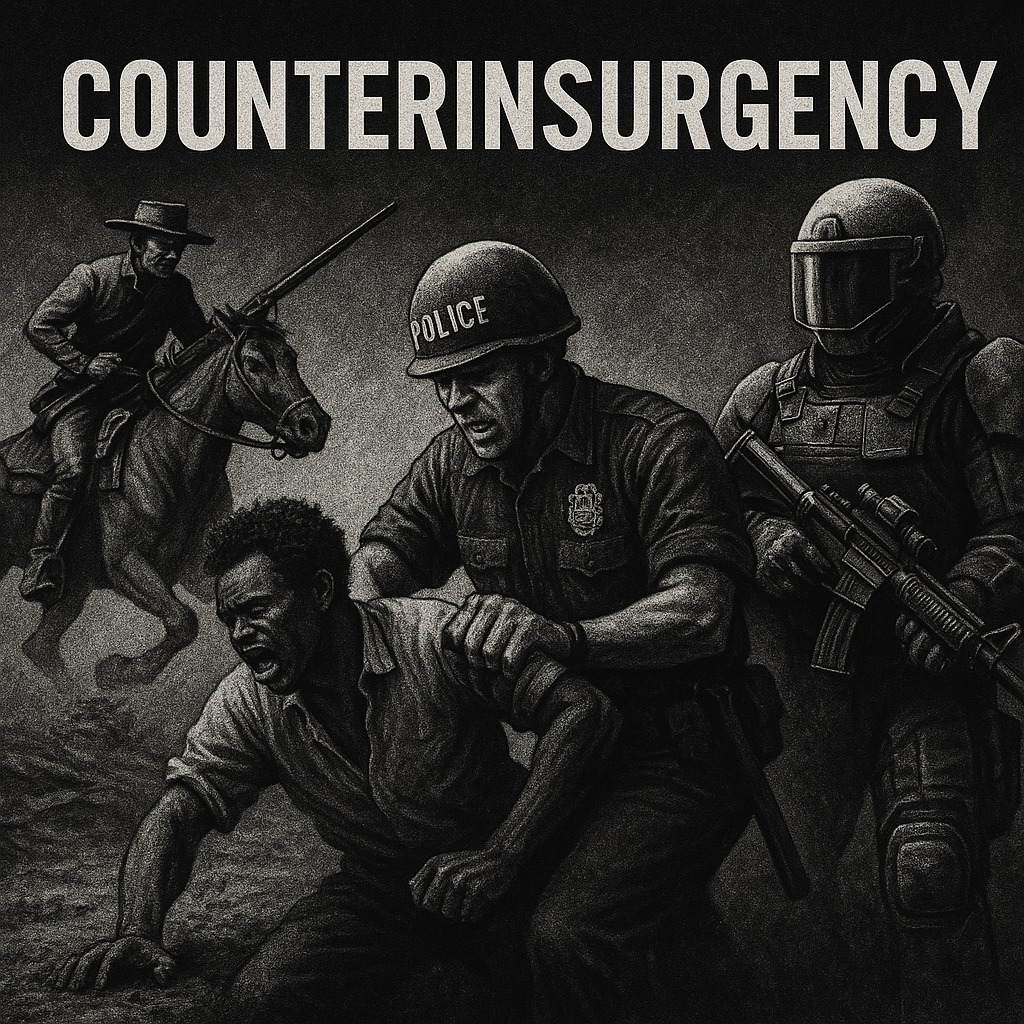
Part I: Origins of the Colonial Repression State
Settler Colonialism, Racial Regimes, and the Birth of Counterinsurgency in the U.S.
The United States did not invent counterinsurgency—it inherited, refined, and perfected it as a tool of racial and colonial domination. To understand the evolution of modern policing, surveillance, and domestic warfare in the U.S., we must return to the foundational structure of this nation: settler colonialism.
This is not merely a historical backdrop. Settler colonialism is the DNA of the American state, encoded in its law, its economy, its racial ideology, and its institutions of repression. The foundational project of the U.S. was not liberty, but conquest. Its original enemies were not criminals, but nations—Indigenous and African peoples resisting subjugation, exploitation, and extermination.
I. The Settler Counterinsurgency Logic
From the very beginning, the American project was confronted with resistance:
- Indigenous nations resisting dispossession and genocide
- Enslaved Africans resisting bondage and exploitation
- Maroon communities, fugitive slaves, and rebels undermining the plantation economy
To preserve the colonial order, the white settler state developed mechanisms of surveillance, punishment, and militarized control. This was not “law enforcement”—it was counterinsurgency: the organized suppression of rebellion by a colonial power facing the resistance of an occupied people.
II. Settler Sovereignty and the Birth of White Power
In the U.S., the category of citizenship was racial from the beginning. The right to bear arms, vote, own land, and move freely was reserved for white settlers. Africans were enslaved. Indigenous peoples were marked for removal or extermination. Everyone else was categorized by their proximity to whiteness or Blackness—freedom or unfreedom.
The first American militias were not designed to protect the people—they were built to protect property: stolen land and stolen labor. Slave patrols, frontier posses, and settler militias formed the early infrastructure of what would become the U.S. law enforcement and military apparatus.
III. Criminalizing the Colonized
Resistance was never legal. From the colonial era onward, any act of defiance by Black or Indigenous people—running away, fighting back, even gathering without permission—was deemed criminal. Rebellion was not only met with violence but also codified as a threat to the state’s legitimacy.
The very concept of “crime” in America emerged from this context: a racialized legal code designed to preserve white rule and suppress colonized peoples. The prison, the police force, and the surveillance state all have their roots in this original war against freedom.
IV. From Colonies to Counterinsurgency Doctrine
What began as ad hoc settler violence became institutionalized. Over time, the U.S. developed legal frameworks and bureaucratic systems to formalize counterinsurgency. These included:
- Slave codes and fugitive slave laws
- Reservation systems and Indian removal acts
- Militia laws deputizing white men to police Black and Native bodies
- The creation of early police departments in the North to control migrant and working-class populations
This wasn’t about disorder—it was about who had the right to rebel and who would be treated as a permanent threat to the racial order.
V. Conclusion: Counterinsurgency as Foundation, Not Exception
The United States was not founded in opposition to tyranny—it was founded through tyranny: the tyranny of settler colonialism, white supremacy, and capitalist accumulation by dispossession. Counterinsurgency in the U.S. is not a deviation from democracy—it is how democracy was structured for settlers, and denied to the colonized.
This is where our series begins: by locating the origin of counterinsurgency not in foreign war, but in domestic conquest. To understand the modern police, the surveillance state, and the technocratic warfare of today, we must begin with the plantation, the reservation, the settler, and the rebel.
 Weaponized Information
Leave a comment