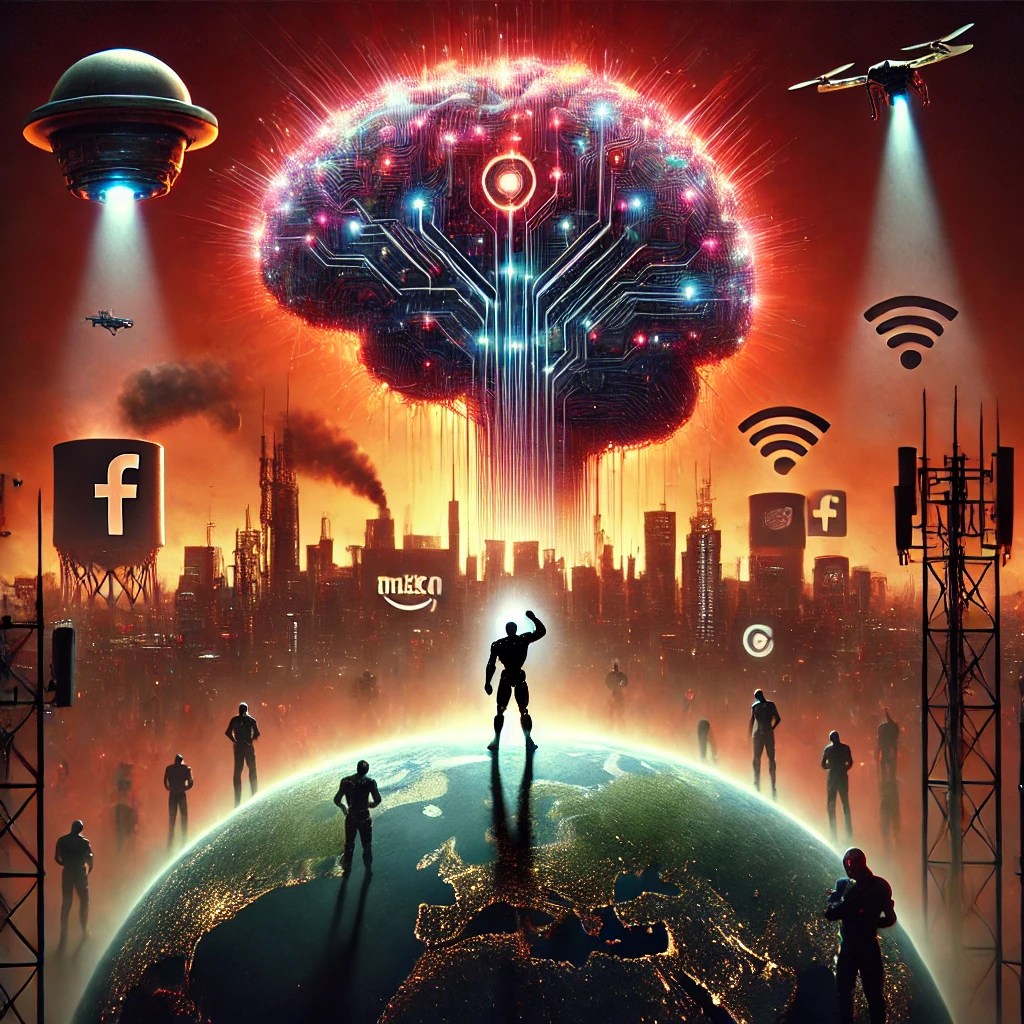
Section I: From SAGE to Silicon – How the U.S. Military Built the Internet
“The Internet was developed by the Pentagon as a weapon of surveillance and counterinsurgency—not as a tool of liberation.”
—Yasha Levine, Surveillance Valley
They told us it started in a garage. A story of geek savants and dropout geniuses, tinkering with microchips and accidentally stumbling into the future. They told us the internet was democratic by design—open, decentralized, and liberating. But this origin myth, peddled by venture capitalists and Silicon Valley PR firms, is nothing more than a sanitized fairy tale. The truth is darker and far more instructive: the internet was born in the bowels of the U.S. military-industrial complex, engineered not to free the masses but to track, discipline, and control them.
In the aftermath of World War II, American imperial planners faced a terrifying new reality: a world no longer cowed by colonial chains. Resistance was spreading like wildfire across Africa, Asia, and Latin America. Inside the imperial core, restive movements of Black, Indigenous, and colonized peoples were shaking the illusion of internal stability. In this context, U.S. military planners began to think differently—not just about missiles and bombs, but about information. Victory in the next phase of empire would depend not merely on force, but on the ability to collect, process, and weaponize data about populations in motion.
This was the intellectual womb of the internet.
One of the earliest signs of this shift was SAGE—the Semi-Automatic Ground Environment—a Cold War air defense system created in the 1950s. Built by IBM and MIT, SAGE was more than a radar network. It was the first real-time digital computing system in human history, a prototype for what would become the global surveillance grid. The military soon realized the same architecture could be used not just to track missiles, but to monitor people.
By the early 1960s, this vision found its organizational form in ARPA—the Advanced Research Projects Agency. ARPA’s Information Processing Techniques Office (IPTO), led by visionary scientists like J.C.R. Licklider, saw computing as a way to integrate human decision-making with machine control. But this was not some utopian cyber-dream. It was deeply rooted in Cold War fears of insurgency, revolution, and system breakdown.
“ARPANET was born out of the U.S. military’s desire for a decentralized communications system that could survive nuclear war and aid in counterinsurgency campaigns abroad.”
—Yasha Levine, Surveillance Valley
Vietnam became the testing ground. ARPA and RAND Corporation researchers developed automated intelligence systems to map and predict insurgent behavior. Projects like “Project Agile” and “Project Camelot” combined computer models, sociological research, and behavioral profiling to detect revolutionary potential before it erupted. The logic was simple: if you could map dissent, you could preempt it. This was the embryonic form of what would later become predictive policing and algorithmic governance.
At the center of all this was the academic-military complex. Elite universities like Stanford, MIT, and Harvard were flooded with military contracts. Their labs became Pentagon outposts. Stanford’s engineering school was functionally a research arm of the Department of Defense. According to Kenneth Osgood:
“Elite universities became propaganda labs, recruiting scholars to frame America’s imperial role in a positive light while maintaining the appearance of objectivity.”
—Kenneth Osgood, Total Cold War
This partnership produced not just technology, but ideology. The very notion of “free markets,” “open networks,” and “disruptive innovation” was a Cold War product—crafted to cloak empire in the language of freedom. Behavioral scientists like Harold Lasswell and Edward Bernays were enlisted to ensure the public swallowed the imperial poison. Mass communications research, as Timothy Glander shows, was a Cold War weapon built to shape perception, not to seek truth.
And what of the tech giants who now rule our world? Google, that paragon of digital democracy, was birthed in a Stanford lab with funding from DARPA and the National Science Foundation. Its founders didn’t just invent search—they perfected digital surveillance. Palantir, meanwhile, was born from the loins of In-Q-Tel, the CIA’s venture capital arm. It was designed not to protect freedom, but to hunt human beings with data.
“Google’s core technology was incubated through DARPA and NSF grants at Stanford; the company emerged from the same military-academic system that birthed the internet.”
—Yasha Levine, Surveillance Valley
What we are witnessing today is not the corruption of a free and open internet—it is the maturation of its original design. A system built to dominate has now been privatized and scaled, turned loose on the world by the same empire that first imagined it.
Silicon Valley is not a glitch in the history of capitalism. It is the imperial brain of a technofascist machine, powered by behavioral data and cloaked in libertarian lies. Its origin is not democratic—it is military. Its goal is not freedom—it is control.
And the Matrix isn’t coming.
It’s already here.
Section II: Surveillance Infrastructure – The Digital Nervous System of Empire
“Surveillance infrastructure is now the backbone of Western imperial enforcement, used to control both populations and sovereign states.”
—Tricontinental Institute, Hyper-Imperialism
The myth of the internet as a “neutral” space collapses under the weight of its architecture. This is not just a tool we use. It is a global infrastructure system designed to monitor, manage, and manipulate. From its military conception to its corporate expansion, the internet has always been a system of surveillance—not an accidental byproduct of digital life, but its organizing logic.
The Pentagon knew this from the beginning. In Surveillance Valley, Yasha Levine uncovers how ARPA and NSA contractors worked hand-in-glove with behavioral scientists to build population surveillance into the earliest nodes of the internet. These systems weren’t just built for war—they were built to see, to map, and ultimately to control populations in both foreign and domestic theaters.
“From its earliest days, the Internet was not a tool of liberation—it was a surveillance platform developed to monitor populations and enable counterinsurgency.”
—Yasha Levine, Surveillance Valley
During the Vietnam War, ARPA deployed automated tracking systems, capable of scanning villages, assessing resistance, and predicting uprisings. Data from social scientists, military informants, and satellite surveillance was fed into primitive mainframes to produce digital maps of insurgency potential. These weren’t just war tools—they were templates for mass data profiling, long before Facebook came onto the scene.
The logic of this system was transferred wholesale to the NSA, which by the early 2000s had developed tools capable of vacuuming up global digital communications. After 9/11, with the help of private contractors like Booz Allen Hamilton and Palantir, the United States turned the planet into a surveillance grid, making no distinction between war zones abroad and civilian populations at home.
“The NSA developed tools to vacuum up global digital communications, turning the world into a surveillance grid.”
—Tom Engelhardt, Shadow Government
Meanwhile, inside the imperial core, Silicon Valley was scaling these same techniques into marketable products. Google, Facebook, Amazon, Microsoft—all began offering surveillance as a service. Not only to advertisers but to law enforcement, the military, and intelligence agencies. Predictive algorithms designed to sell ads were quickly retooled to track movement, target protestors, and feed immigration enforcement databases.
“Surveillance capitalism unilaterally claims human experience as free raw material for translation into behavioral data.”
—Shoshana Zuboff, The Age of Surveillance Capitalism
And it doesn’t stop at people. Entire nations—especially those of the Global South—are now subjected to the gaze of this machine. Every transaction, every phone call, every election becomes legible to imperial command centers in Washington, Langley, and Silicon Valley. Those who resist this datafication—Cuba, Venezuela, Iran, China, Russia—are declared threats, sanctioned, and isolated. Surveillance is no longer passive. It is imperial policy.
“Surveillance infrastructure is now the backbone of Western imperial enforcement…”
—Tricontinental Institute, Hyper-Imperialism
This is what makes the modern internet different from prior media empires. It’s not just shaping perception—it’s predicting and preempting behavior. It doesn’t just tell us what to think. It watches what we do, maps how we move, and learns how to push us before we even know we’re being pushed.
And this infrastructure is not some neutral tool waiting to be reclaimed. It is the nervous system of empire—wired into satellites, fiber optic cables, AI databases, biometric scans, and predictive models. It is the invisible nervous system of a planet under siege.
We are not users of the system.
We are the system’s inputs.
Section III: Behavioral Science and Psychological Warfare – Empire’s Invisible Weapon
“The use of force in low-intensity operations is intended to reinforce psychological and political persuasion—violence is not the primary tool but a supporting one.”
—Frank Kitson, Low Intensity Operations
To understand the full reach of the Silicon Matrix, we must go beyond the wires, codes, and corporations—and look at the science of control that underpins it. Beneath the shiny surface of “innovation” lies a much older project: the engineering of behavior. And at the core of this project is the merger of psychological warfare, behavioral science, and information systems, forged in the heat of counterinsurgency wars and Cold War social engineering.
From the earliest stages of U.S. empire’s technological evolution, social scientists were mobilized not to liberate minds, but to discipline them. The same government that funded early computing also poured billions into psychology, communications research, propaganda analysis, and cybernetics. This wasn’t about truth—it was about control.
“Communication research was deeply tied to Cold War interests, with the field itself emerging as a mechanism for mass persuasion and social control.”
—Timothy Glander, Origins of Mass Communications Research
One of the key architects of this control logic was Frank Kitson, a British military officer whose theories of subversion, insurgency, and psychological operations became foundational for modern counterinsurgency. Kitson understood that in the era of decolonization, the battlefield was no longer just physical—it was informational. And victory would depend on mapping, managing, and preempting human behavior.
“Future conflicts will be fought at the subversion end of the spectrum—using propaganda, economic pressure, and psychological warfare rather than traditional combat.”
—Frank Kitson, Low Intensity Operations
Kitson advocated for low-intensity operations—wars of surveillance, infiltration, and manipulation. He argued that the perception of legitimacy was often more important than actual control, and that governments must develop tools to shape opinion, infiltrate movements, and neutralize threats before they fully emerged. These ideas were not abstract. They were implemented in Ireland, Kenya, Malaya—and eventually adapted by U.S. agencies like the CIA, ARPA, and NSA.
This logic of perception control migrated directly into Silicon Valley’s algorithmic infrastructure. Platforms like Facebook and Google do not merely host content; they actively shape what users see, when they see it, and how they feel about it. They are not neutral tools—they are digital environments built on behavioral modification models developed through Cold War research and counterinsurgency doctrine.
“Surveillance capitalism’s next frontier is behavioral modification—tuning people’s actions without their awareness through predictive algorithms.”
—Shoshana Zuboff, The Age of Surveillance Capitalism
This is not capitalism as we once knew it. It is a system where data becomes both the raw material and the weapon. ARPA’s Vietnam-era population profiling has evolved into machine learning systems that scan your face, track your clicks, predict your movements, and recommend your moods. And while we may think of this as corporate overreach, its origins are military. Its logic is strategic.
“ARPA’s Vietnam-era surveillance systems were designed with the help of social scientists to predict and preempt insurgency by modeling human behavior.”
—Yasha Levine, Surveillance Valley
Today, this system is applied at scale—not just to manage resistance abroad, but to preempt dissent at home. In the wake of George Floyd uprisings, Indigenous land occupations, and climate rebellions, the state doesn’t just respond. It anticipates. It surveils. It shapes behavior before protest even begins.
Just as Kitson trained armies to infiltrate and redirect insurgencies using pseudo-gangs and psychological operations, the state today deploys bots, digital informants, predictive analytics, and psychological nudges to neutralize political movements before they erupt.
“The army must prepare not only to fight conventional wars but to suppress subversion and insurgency, which involve psychological, political, and informational operations.”
—Frank Kitson, Low Intensity Operations
And it is not just movements that are targeted—it is entire populations. The working class, the lumpen, the colonized, the unemployed, the algorithmically undesirable. All are subject to behavioral management programs masquerading as “smart policy,” “urban development,” or “public safety.”
What we are facing is not just surveillance.
It is not just capital.
It is technofascism—a new form of rule where data replaces democracy, and behavioral control replaces ideological debate.
Section IV: The Academic-Military Nexus – Empire’s Laboratories of Thought and Control
“The Pentagon outsourced the development of internet technology to elite universities like MIT, Stanford, and Berkeley, forging a seamless bond between academia and the military.”
—Yasha Levine, Surveillance Valley
Every empire has its priesthood. In ancient times, it was scribes and oracles. In modern empire, it is scientists and technocrats—those who claim the authority of truth while advancing the interests of capital and conquest. In the United States, that priesthood was forged inside the labs and lecture halls of elite universities, converted into forward operating bases for imperial science.
The postwar period marked a historic convergence: universities became weapons laboratories. Fueled by Cold War paranoia and Pentagon dollars, schools like MIT, Harvard, Stanford, and Berkeley stopped being sites of disinterested inquiry and were retooled as factories for control technologies—behavioral models, population maps, communications systems, and military innovations.
“Stanford’s engineering department was effectively a research arm of the Pentagon by the 1960s, directly shaping the political economy of Silicon Valley.”
—Yasha Levine, Surveillance Valley
This wasn’t limited to hardware. The U.S. ruling class understood that to govern an empire, one must first govern perception. And so they funded entire disciplines—communications theory, political psychology, behavioral economics—not to understand the world, but to manage it.
“The communication field’s intellectual infrastructure was built through foundations and Cold War contracts with elite research universities.”
—Timothy Glander, Origins of Mass Communications Research
Harold Lasswell, one of the foundational figures of this period, famously defined politics as “the study of who gets what, when, and how.” But under the patronage of Rockefeller and Ford foundations, Lasswell transformed into something else entirely: a strategic analyst for the U.S. state. His work in mass communication and propaganda would become the backbone of both foreign and domestic information operations.
“Elite universities became propaganda labs, recruiting scholars to frame America’s imperial role in a positive light while maintaining the appearance of objectivity.”
—Kenneth Osgood, Total Cold War
These programs didn’t just explain empire—they legitimated it. Behavioral scientists worked alongside military planners to shape psychological operations, public diplomacy, and domestic “hearts and minds” campaigns. Institutions like RAND and MITRE acted as bridges between theory and battlefield application.
But the true masterpiece of this convergence was Silicon Valley itself. And its spiritual birthplace was Stanford University.
Stanford’s relationship to the military wasn’t incidental—it was foundational. University president Frederick Terman actively invited defense contracts, turning Stanford into a kind of entrepreneurial command center. Companies like Hewlett-Packard, Lockheed, Varian Associates, and Fairchild Semiconductor were all born in this ecosystem—corporate arms of the academic-military machine.
This is where Google would later emerge, armed with DARPA-funded search algorithms, baked into the ideological culture of techno-solutionism and Cold War capitalism. Facebook, Palantir, and countless others would follow, drenched in data, funded by government contracts, and worshipped as liberators by a society fed on myth.
“The roots of Silicon Valley’s leading firms are traceable to DARPA, NSF, and military-sponsored university research that incubated behavioral data extraction.”
—Shoshana Zuboff, The Age of Surveillance Capitalism
So while the public was sold an image of dorm-room revolutionaries building tools to “connect the world,” the reality was far more grounded—and more terrifying. These companies are not revolutionary. They are imperial by design—the offspring of war departments, think tanks, and psychological warfare programs.
This is the academic-military nexus: where knowledge becomes power, and power becomes profit.
It is where empire writes its code, tests its weapons, and trains its priests.
And it is where the Silicon Matrix was born—not from rebellion, but from counterinsurgency.
Section V: Big Tech and Corporate Surveillance – Privatizing the Machinery of Control
“Big Tech companies are no longer just economic actors—they are geopolitical instruments for enforcing imperialist interests and surveillance across borders.”
—Tricontinental Institute, Hyper-Imperialism
The Cold War birthed the infrastructure. The counterinsurgency wars refined the methods. The universities provided the theories. But it was corporate America—funded by Wall Street and incubated by the state—that scaled the system to planetary proportions.
Welcome to the era of Big Tech as Big Brother.
Companies like Google, Facebook, Amazon, and Palantir didn’t just emerge from the free market—they were midwifed by the state. Their founders were trained in Pentagon-funded labs, given access to military-grade data systems, and wrapped in a mythos of innovation. But their true function wasn’t to “connect people” or “make information free.” It was to monetize behavior, extract data, and offer those insights to capital and the state alike.
“Google’s core technology was incubated through DARPA and NSF grants at Stanford; the company emerged from the same military-academic system that birthed the internet.”
—Yasha Levine, Surveillance Valley
Surveillance capitalism, as Shoshana Zuboff names it, is a new regime of accumulation—one in which our clicks, emotions, routines, and movements become the raw material. But this isn’t just about advertising. The same data used to predict shopping habits is used to forecast dissent, detect ideological drift, and preempt resistance.
“Surveillance capitalism began when Google realized it could predict and influence behavior by repurposing data streams that users unknowingly left behind.”
—Shoshana Zuboff, The Age of Surveillance Capitalism
Palantir—co-founded by Peter Thiel and seeded by In-Q-Tel, the CIA’s venture arm—makes this link explicit. Its software was built for counterterrorism, but rapidly expanded to police departments, ICE, predictive policing programs, and global surveillance clients. The logic is consistent: population profiling, movement analysis, and behavioral prediction.
And this system is not limited to U.S. borders. It is exported.
The same way Lockheed sells fighter jets to authoritarian regimes, Silicon Valley sells digital governance tools to client states—tools to track citizens, censor dissent, and optimize extraction. Facebook’s Free Basics program in Africa, Google’s “smart city” initiatives, Amazon’s cloud contracts with militaries and police—these are not glitches. They are imperial infrastructure.
“Palantir was created with seed funding from In-Q-Tel, the CIA’s venture capital arm, and built surveillance tools for both governments and corporations.”
—Yasha Levine, Surveillance Valley
In this ecosystem, there is no real line between the state and the private sector. The surveillance regime is a hybrid entity, combining the data-extracting power of Big Tech with the strategic objectives of the U.S. national security state. What emerges is a technofascist alliance—where liberty is an illusion and algorithmic domination is the cost of participation.
“Prediction products—sold to advertisers, governments, and security agencies—form the basis of a new mode of capitalist accumulation.”
—Shoshana Zuboff, Surveillance Capitalism
These firms are not simply monopolies. They are digital viceroys of the empire, deputized by the state to do what old colonial regimes did with soldiers and rifles—monitor the natives, extract the value, and crush resistance.
The infrastructure may look new.
The code may be digital.
But the logic is the same:
Dominate. Exploit. Repeat.
Section VI: Technofascism and Predictive Systems – The Algorithmic Engine of Empire
“Technofascism is a merger of digital infrastructure with military enforcement, run by corporations but shaped by imperial needs.”
—Tricontinental Institute, Hyper-Imperialism
Surveillance is not just about watching. It’s about predicting. About preempting. About governing behavior before dissent can emerge. This is the final form of the system—the synthesis of behavioral science, machine learning, and state repression into a seamless architecture of domination.
This is technofascism.
It is not a metaphor. It is not rhetorical flourish. It is a historically grounded term, describing the next phase of capitalist-imperialist control—one in which data is used to anticipate rebellion, automate discipline, and algorithmically enforce social order.
“Surveillance capitalism’s next frontier is behavioral modification—tuning people’s actions without their awareness through predictive algorithms.”
—Shoshana Zuboff, The Age of Surveillance Capitalism
At the core of this system are what Silicon Valley calls “prediction products.” These are not just tools to sell you ads. They are weapons of influence—deployed by governments, intelligence agencies, and corporations to identify threats, shape behavior, and neutralize disobedience.
“What was sold as ‘smart technology’ was often predictive policing software used to profile entire populations for preemptive control.”
—Yasha Levine, Surveillance Valley
Technofascism is built on a logic of total control. It no longer requires mass ideology or charismatic leaders. It operates through code, clouds, and cognitive capture. The fascist boot is no longer on the neck—it is in the algorithm.
And it doesn’t only target the “enemy.” It targets everyone. It maps your location. Tracks your habits. Scores your loyalty. Anticipates your decisions. It reshapes your desires, nudges your emotions, and pushes you toward “acceptable” behavior.
“The surveillance state now combines data analytics, artificial intelligence, and militarized decision-making to execute power autonomously.”
—Tom Engelhardt, Shadow Government
The battlefield is not a jungle or a desert. It is your home. Your street. Your digital footprint.
This logic was piloted in U.S. counterinsurgency wars. In Iraq, Afghanistan, and Palestine, predictive models were used to map “high-risk” neighborhoods, anticipate resistance, and authorize drone strikes in near real-time. Those same models now power predictive policing, risk assessment algorithms, and public health surveillance systems in U.S. cities.
It is counterinsurgency by other means—a permanent domestic war fought through data.
“ARPA’s Vietnam-era surveillance systems were designed with the help of social scientists to predict and preempt insurgency by modeling human behavior.”
—Yasha Levine, Surveillance Valley
This is what Frank Kitson anticipated when he wrote of future conflicts fought “at the subversion end of the spectrum”—where psychological manipulation and perception control replaced conventional warfare.
Technofascism doesn’t demand loyalty. It manufactures it.
It doesn’t jail dissenters. It prevents dissent.
It doesn’t need your mind. It only needs your data.
It is Empire’s AI brain, and you are already inside it.
Section VII: Imperial Applications and Foreign Operations – Exporting the Matrix
“The same systems tested abroad—population profiling, digital surveillance, predictive targeting—are now embedded in domestic policing and global governance.”
—Synthesis from Surveillance Valley, Hyper-Imperialism, and Shadow Government
Technologies of repression are rarely born fully formed. They are tested. Refined. Calibrated on the bodies of the colonized and the insurgent. In the case of the Silicon Matrix, its testbeds were Vietnam, Iraq, Afghanistan, Palestine, and the Global South at large.
This was never about liberation. It was always about management—of insurgency, of information, and of entire populations. The internet, biometric tracking, predictive algorithms, and digital psyops were all forged through imperial warfare before being redeployed across the globe and into the imperial core itself.
“Vietnam became the testing ground. ARPA and RAND researchers developed automated intelligence systems to map and predict insurgent behavior… These weren’t just war tools—they were templates for mass data profiling.”
—Yasha Levine, Surveillance Valley
In Vietnam, ARPA’s “counterinsurgency informatics” birthed population databases and predictive mapping. Project Phoenix—a CIA assassination and torture program—used data analysis to compile and eliminate “threats.” These were the early blueprints for predictive policing, facial recognition, and biometric surveillance.
Later, in Iraq and Afghanistan, this logic was scaled. Biometric identity cards were distributed en masse. Mobile surveillance systems and drones recorded civilian movements. Tactical command centers—powered by AI and cloud infrastructure—sorted “friend from foe” via data signatures. These were field trials for global technofascism.
“The battlefield is not a jungle or a desert. It is your home. Your street. Your digital footprint.”
—Section VI, Technofascism and Predictive Systems
The same tools deployed to find “insurgents” abroad are now embedded in predictive policing systems in Detroit, Los Angeles, and New York. They are in ICE raids, license plate readers, and school surveillance contracts. The imperial algorithm has come home—and it sees everything.
But this machinery is also a geopolitical export. Under the banner of “smart development,” “digital innovation,” and “tech for good,” the U.S. now sells its surveillance model to allies, client regimes, and private partners. Digital colonization becomes the new norm.
“Big Tech companies are no longer just economic actors—they are geopolitical instruments for enforcing imperialist interests and surveillance across borders.”
—Tricontinental Institute, Hyper-Imperialism
In the Global South, the Silicon Matrix manifests as:
- “Free internet” programs that harvest data while excluding dissent
- Facial recognition partnerships between Microsoft and authoritarian regimes
- Social media manipulation during elections and protest movements
- Credit scoring, identity verification, and fintech penetration as tools of control
Countries like Cuba, Iran, Venezuela, and China are demonized not for human rights violations—but for building digital sovereignty. Those who reject the Matrix are marked as threats, sanctioned, and digitally strangled.
Technofascism does not merely patrol borders.
It defines them.
And then it enforces them with drones, algorithms, and disinformation.
The Matrix is not just an American story.
It is a global operating system of empire, constantly updating, constantly optimizing its capacity to extract, predict, and pacify.
The final export of empire is no longer just weapons.
It is the logic of permanent surveillance and algorithmic subjugation.
Section VIII: The Feed Is the Frontline – Social Media as Counterinsurgency, Censorship, and Cognitive Warfare
“In the twenty-first century, information is no longer a domain to be merely monitored—it is a battlespace to be dominated.”
—Munich Security Conference Report (2021)
In the age of the Silicon Matrix, the battlefield is not only external—it is internal. And the terrain is not land, sea, or air—it is the feed.
The scrolling timelines, likes, shares, trending topics, and algorithmically curated comment sections have become the digital frontlines of counterinsurgency and ideological control. Social media is not a tool of connection. It is a weapon of cognitive capture. Its owners are not neutral platforms. They are imperial contractors, operating under the guise of tech entrepreneurship.
From Facebook’s origins as a DARPA-style behavioral mapping project at Harvard, to In-Q-Tel’s investments in social and behavioral analytics, to Twitter/X and YouTube’s collaborations with U.S. intelligence agencies to monitor and demote “foreign influence” and “extremism,” every major platform now functions as an arm of the national security state.
“The surveillance state now combines data analytics, artificial intelligence, and militarized decision-making to execute power autonomously.”
—Tom Engelhardt, Shadow Government
The social web is not a marketplace of ideas—it is a weaponized ecosystem engineered to influence, suppress, and shape public behavior. This is not speculative. It is strategic. The Munich Security Conference—a NATO-aligned imperial think tank—has been explicit in calling for closer collaboration between states and platforms to counter what it labels “misinformation,” “foreign interference,” and “subversive narratives.”
In their 2021 and 2022 reports, the MSC warned that Western democracies risk collapse if they fail to regain control of information flows, identifying “platform sovereignty” as the central pillar of modern national security. Their solution? Public-private partnerships between states and tech monopolies to regulate information, silence dissent, and preempt uprisings in the name of stability.
This is not content moderation.
This is digital counterinsurgency.
“Subversion will be held to mean all illegal measures short of armed force… including propaganda.”
—Frank Kitson, Low Intensity Operations
The platforms have become digital pseudo-gangs—a term borrowed from British counterinsurgency, where fake rebel groups were created to discredit and divide resistance. Today, bots, influencers, “debunkers,” and cultural manipulators serve a similar function. The algorithm elevates distractions, manufactures infighting, and buries revolutionary content under oceans of spectacle.
What isn’t banned is buried.
What isn’t censored is algorithmically silenced.
What isn’t silenced is redirected through controlled opposition and disinformation laundering.
This system is not ad hoc. It is coordinated.
- Twitter’s “Trust and Safety Council” included former FBI, DHS, and NATO figures.
- Facebook’s content moderation has long been outsourced to firms with CIA ties.
- YouTube consults directly with U.S. and EU officials on what constitutes “harmful speech.”
- TikTok, while treated as an enemy, has adopted U.S. censorship models to avoid sanctions.
“Behavioral modification became a core business model—tech companies now operate on a logic of tuning human action through data feedback loops.”
—Shoshana Zuboff, The Age of Surveillance Capitalism
All of this is done under the banner of “safety,” “democracy,” and “national security.” But the outcome is the same: a digitally pacified public, where dissent is flagged as dangerous, where radical thought is shadowbanned, and where attention itself becomes a battlefield.
This is not surveillance capitalism alone.
This is not state censorship alone.
This is technofascism’s cognitive regime—where algorithmic control meets military strategy, and perception is managed like a battlefield.
“The idea that the Internet was about ‘freedom’ was itself a kind of propaganda.”
—Yasha Levine, Surveillance Valley
The feed is not neutral.
The feed is not yours.
The feed is the frontline.
Section IX: RAND Corporation – Empire’s Think Tank and Technocratic Brain Trust
“The RAND Corporation didn’t just study empire—it designed its operating system.”
Hidden beneath the glossy surfaces of Silicon Valley and buried behind the firewalls of the national security state sits an institution that has quietly shaped every major strategic, technological, and ideological dimension of the U.S. imperial project: the RAND Corporation.
Since its founding in 1948 as a joint venture between the U.S. Air Force and Douglas Aircraft, RAND has operated as a nucleus drawing together military officers, behavioral scientists, academic theorists, economists, and technologists into one unified command node of counterrevolutionary strategy. The digital empire we now call the Silicon Matrix was modeled—first in theory—within RAND’s walls.
RAND’s researchers were early architects of networked communication systems, laying conceptual groundwork for ARPANET under DARPA, which Yasha Levine later traced as the militarized birth of the internet itself. Its psychological operations units modeled behavioral modification long before Shoshana Zuboff warned of surveillance capitalism’s predictive tyranny. RAND’s social scientists ran wargames and simulations on population control, anticipating Frank Kitson’s Low Intensity Operations with academic precision.
“RAND treated society itself as a system to be simulated, gamed, and predicted. It fused social science, data analytics, and military logic into a single framework for preemptive control.”
Game theory was one of RAND’s early obsessions. Nuclear brinkmanship, insurgency modeling, and social engineering were reduced to simulations and probabilities. The civilian population became a dataset. Rebellion became a risk profile. RAND helped solidify the ideological foundation for technofascism: control not through violence alone, but through anticipation, simulation, and algorithmic governance.
RAND thinkers like Herman Kahn, Thomas Schelling, and Albert Wohlstetter forged policy doctrines that continue to inform drone warfare, predictive policing, and the logic of platform censorship. Their spiritual successors can be found today within tech monopolies, Pentagon cyber divisions, and content moderation boards that enforce “national security” in digital space. RAND laid the blueprint for this technocratic hegemony, long before it had the silicon muscle to implement it.
Just as Zuboff describes how data becomes raw material for behavior modification, and as Engelhardt chronicles the merging of shadow warfare with domestic surveillance, RAND sits at the junction where all these logics were first unified and theorized.
“The internet as we know it was born not out of freedom, but out of counterinsurgency.”
— Yasha Levine, Surveillance Valley
To study RAND is to uncover the hidden bureaucracy of U.S. empire—one that writes its code in white papers, recruits its soldiers from universities, and wages war in the name of science, security, and simulation.
RAND is not behind the curtain—it is the curtain: the central nervous system where the Pentagon, academia, and Big Tech fuse into one.
The Matrix doesn’t just run through RAND—it was first imagined there.
Conclusion: The Empire Has a Brain—And It’s Watching
“The final export of empire is no longer just weapons. It is the logic of permanent surveillance and algorithmic subjugation.”
—Section VII, The Silicon Matrix
We began this investigation by tearing through the mythologies. The idea that Silicon Valley emerged from garages and free minds. That the internet was born for democracy. That Big Tech companies operate independently of the state. That social media is neutral ground for free speech. That algorithms are unbiased.
Each of these lies masks a deeper reality.
The internet was born from war.
Social media is psychological warfare.
Big Tech is the privatized arm of imperial power.
And the Silicon Matrix is the brain of empire.
We now live inside an empire of code. An empire where behavior is engineered, dissent is predicted, and information is weaponized. The state no longer needs to send tanks into the streets to crush rebellion. It can bury insurgency with bots. It can redirect rage into spectacle. It can preempt revolution with predictive models and biometric sorting. It can repress without appearing to repress.
This is the genius—and the horror—of technofascism.
“Prediction products—sold to advertisers, governments, and security agencies—form the basis of a new mode of capitalist accumulation.”
—Shoshana Zuboff, Surveillance Capitalism
And yet, empire remains brittle. Because beneath the Matrix, the contradictions persist. The crisis of capitalism accelerates. The legitimacy of U.S. hegemony erodes. The exploited and the colonized are rising—everywhere. And no algorithm, no censorship protocol, no digital pseudo-gang can suppress the historical force of a conscious and organized proletariat.
The Matrix wants your attention.
But revolution demands your will.
The challenge now is not to unplug, but to understand. To map this system. To expose it. To tear away its ideological skin. To name its violence. And to organize against it.
The Silicon Matrix is not all-powerful. It is a machine. And like all machines built by empires in crisis—it can be sabotaged. It can be dismantled. It can be replaced.
We are not data.
We are not users.
We are not inputs.
We are the future.
And the Matrix fears us.
Extended Bibliography
- Barbrook, Richard and Cameron, Andy. The Californian Ideology. Mute Magazine, 1995.
- Bernays, Edward. Propaganda. Horace Liveright, 1928.
- DiResta, Renée. Research on disinformation and platform manipulation. Stanford Internet Observatory.
- Donovan, Joan. Media manipulation research, Harvard Shorenstein Center.
- Engelhardt, Tom. Shadow Government: Surveillance, Secret Wars, and a Global Security State in a Single-Superpower World. Haymarket Books, 2014.
- Fuchs, Christian. Social Media: A Critical Introduction. Sage, 2017.
- Glander, Timothy. Origins of Mass Communications Research During the American Cold War: Educational Effects and Contemporary Implications. Routledge, 1999.
- Herman, Edward S. and Chomsky, Noam. Manufacturing Consent: The Political Economy of the Mass Media. Pantheon Books, 1988.
- Jasanoff, Sheila (ed). States of Knowledge: The Co-production of Science and Social Order. Routledge, 2004.
- Kitson, Frank. Low Intensity Operations: Subversion, Insurgency and Peacekeeping. Faber and Faber, 1971.
- Levine, Yasha. Surveillance Valley: The Secret Military History of the Internet. PublicAffairs, 2018.
- Munich Security Conference Reports (2021–2023). Annual Reports on Global Security. https://securityconference.org
- Noble, Safiya Umoja. Algorithms of Oppression: How Search Engines Reinforce Racism. NYU Press, 2018.
- Osgood, Kenneth. Total Cold War: Eisenhower’s Secret Propaganda Battle at Home and Abroad. University Press of Kansas, 2006.
- Pariser, Eli. The Filter Bubble: What the Internet Is Hiding from You. Penguin Press, 2011.
- Silverman, Jacob. Terms of Service: Social Media and the Price of Constant Connection. Harper Perennial, 2015.
- Tricontinental Institute for Social Research. Hyper-Imperialism: A Dangerous Decadent New Stage. February 2024. https://thetricontinental.org
- Woolley, Samuel C. The Reality Game: How the Next Wave of Technology Will Break the Truth. PublicAffairs, 2020.
- Zuboff, Shoshana. The Age of Surveillance Capitalism: The Fight for a Human Future at the New Frontier of Power. PublicAffairs, 2019.
 Weaponized Information
Leave a comment