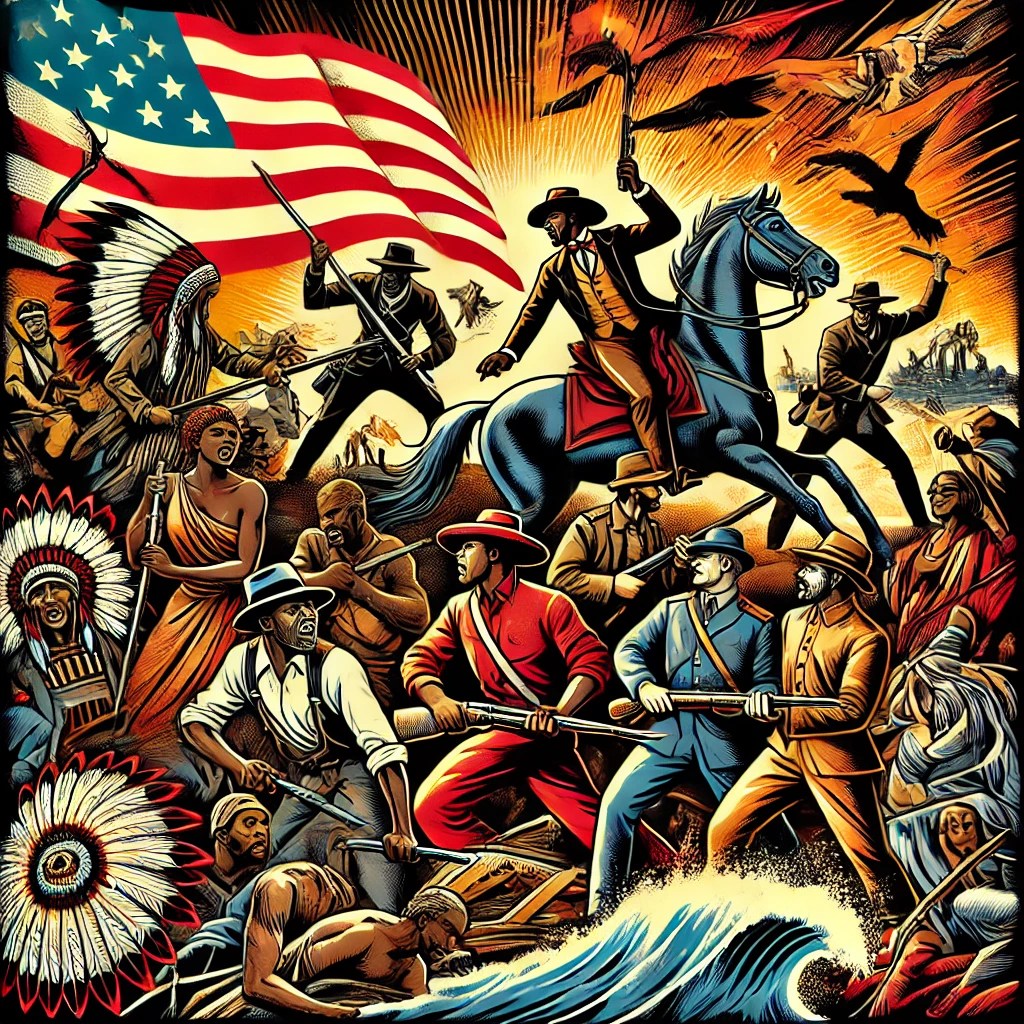
I. The House That Genocide and Slavery Built
By the 19th century, the United States had become the crown jewel of capitalist expansion—a rising empire built on land theft, slavery, and an ever-expanding frontier of human misery. The country marketed itself as the land of liberty, yet its economy depended entirely on unfree labor and mass displacement.
- Indigenous land theft wasn’t an accident—it was state policy. Manifest Destiny wasn’t just a slogan; it was a battle plan for empire.
- Chattel slavery wasn’t an archaic Southern institution—it was the backbone of global capitalism. Cotton and sugar from U.S. plantations fed the industrial revolutions of Britain and the North.
- Poor whites weren’t independent yeoman farmers—they were foot soldiers of settler colonialism. Given land stolen from Native nations and a racial identity to defend, they became willing enforcers of the system.
But contradictions were growing. The expansion of slavery into new territories was triggering a national crisis, not because the ruling class wanted to end racial capitalism, but because they couldn’t agree on how to manage it.
Indigenous nations were fighting back harder than ever, enslaved Africans were turning every plantation into a war zone, and even white capitalists were starting to realize that the system couldn’t hold together much longer. The United States wasn’t just growing—it was unraveling.
The Civil War wasn’t a tragic accident. It was the natural result of an empire too big, too brutal, and too divided to sustain itself.
II. Slavery and the Plantation Economy: The Engine of Capitalism
By the early 1800s, the United States was the beating heart of global racial capitalism. Slavery was no relic of the past—it was the most advanced labor system the world had ever seen. It built modern finance, industrial production, and global markets.
- Cotton from the South fed the textile mills of England and the North, making industrial expansion possible.
- Northern banks and insurance companies financed the slave trade, profiting from the sale of human beings.
- The U.S. government, from the presidency down to local courts, functioned as the legal machinery that kept slavery running.
Enslaved Africans weren’t just producing wealth—they were the wealth. They were human capital, bought and sold as financial assets. Their labor produced the raw material that built global empires, while their bodies became the currency of a world ruled by capital.
Yet, the enslaved never stopped resisting.
- They fought back on plantations—slowing production, sabotaging equipment, and poisoning crops.
- They ran away, forming maroon communities in forests, mountains, and swamps.
- They staged full-scale revolts—Haiti had already set the standard, and the Nat Turner Rebellion (1831) showed that U.S. slavery was a powder keg waiting to explode.
The ruling class knew that enslaved Africans weren’t passive—they were at war. And this war was escalating.
III. The Indigenous Wars: The U.S. Settler State Expands West
While enslaved Africans fought for their freedom in the South, Indigenous nations were waging a century-long war for survival against the U.S. government. Settlers, backed by federal troops, were seizing land under the banner of Manifest Destiny, a fancy term for wholesale genocide in the name of profit.
But this wasn’t just about land—it was about capitalism’s endless hunger for new markets and resources.
- Settlers needed land to farm, mine, and exploit for profit.
- Industrial capitalists needed western expansion to drive economic growth.
- Politicians framed Indigenous resistance as an obstacle to “civilization.”
The result? A campaign of extermination.
- The Trail of Tears (1830s): Tens of thousands of Indigenous people forcibly removed from their lands, thousands dying in the process.
- The Seminole Wars (1816–1858): Enslaved Africans and Indigenous fighters waged guerrilla warfare against the U.S. Army, proving that multiracial resistance was a real and growing threat.
- The Indian Removal Act (1830): Andrew Jackson’s signature genocide policy, legalizing mass displacement and land theft.
The more land the U.S. stole, the more contradictions it created. Every new piece of stolen land came with one crucial question: Would slavery expand with it? This wasn’t just a moral debate—it was a war over the future of racial capitalism.
IV. The U.S. Invasion of Mexico: Settler Colonialism Goes Global
If Indigenous genocide and slavery were the twin pillars of U.S. expansion, then the annexation of Mexico (1846-1848) marked the moment the U.S. declared itself an imperial power.
This was more than just stealing land—this was about consolidating U.S. control over global trade routes, resources, and labor exploitation.
- The Gold Rush (1848) flooded California with white settlers, pushing Indigenous and Mexican communities into economic subjugation.
- U.S. elites openly debated whether these new territories should be slave states, proving that the fight over racial capitalism wasn’t just about the South.
- Mexican landowners and workers were dispossessed, setting the stage for a racialized labor economy that persists today.
V. The Civil War: The Settler State Implodes
By the 1850s, the contradictions of racial capitalism had reached their breaking point. The U.S. ruling class wasn’t fighting over morality—it was fighting over how best to structure capitalism for the next stage of expansion.
- Southern elites wanted slavery to expand indefinitely, ensuring their economic control over the U.S. economy.
- Northern industrialists wanted “free labor” to dominate new markets—not because they opposed racial capitalism, but because they wanted workers who could be exploited without being owned.
But the decisive force in this struggle wasn’t the ruling class—it was the resistance of enslaved Africans themselves.
- The Underground Railroad wasn’t just an escape route—it was an underground resistance movement.
- John Brown’s raid on Harpers Ferry (1859) proved that armed struggle against slavery was on the table.
- The mass escape of enslaved Africans to Union lines forced the North to reckon with abolition—not as an ideal, but as a military necessity.
VI. The Struggle Continues
The Civil War ended chattel slavery, but it did not dismantle racial capitalism. Instead, it forced the U.S. ruling class to reshape white supremacy into a new economic order.
This is where Part 5 picks up: Black Reconstruction, Counter-Reconstruction, and the birth of the modern racial state.
 Weaponized Information
Leave a comment