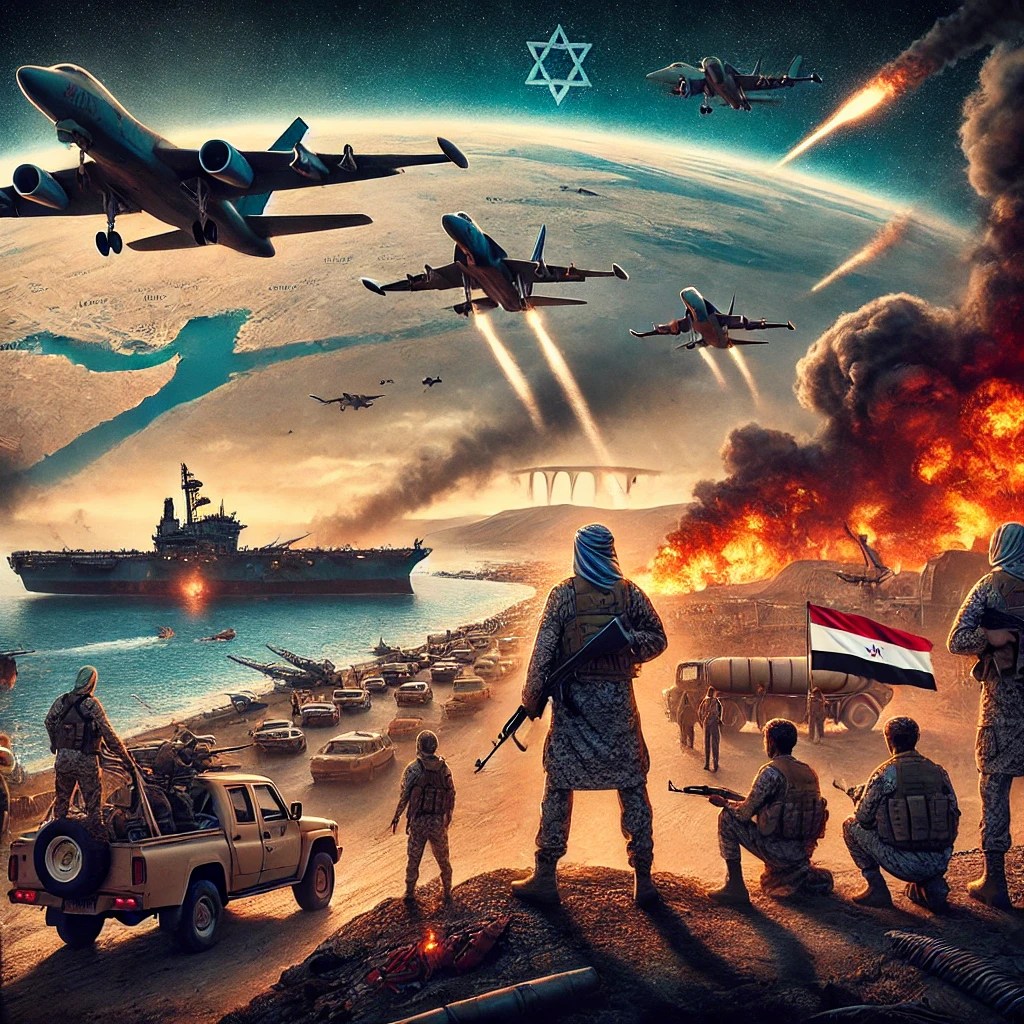
The world’s great self-appointed protector of “freedom” and “security” is once again raining missiles on a country that has neither attacked nor threatened it. This time, the target is Yemen. The justification? “Defending international shipping”—a phrase that, in Washington’s dialect of Newspeak, means eliminating any force capable of challenging U.S. control over global trade routes.
Donald Trump, freshly reinstalled in the Oval Office as the beleaguered figurehead of a declining empire, has dusted off the old playbook: bomb first, invent a pretext later. His administration claims that the Houthis, those ungrateful rebels in Yemen, have been disrupting commercial shipping in the Red Sea—an offense so severe that it apparently necessitates immediate military strikes. This, we are told, is about keeping the world’s supply chains running smoothly. It is, of course, nothing of the sort.
The truth is far simpler and far uglier: the United States is waging war on Yemen to tighten its grip on a crumbling imperial order.
Chokepoints, Not “Freedom”
Let’s be clear about what’s at stake. The Bab-el-Mandeb Strait, that narrow passage of water between Yemen and Djibouti, is a crucial artery of the global economy. Roughly 10% of the world’s trade, including vast amounts of oil, passes through it.
In simpler terms: he who controls the chokepoint, controls the lifeblood of global commerce.
For decades, the United States has operated under the assumption that the world’s waterways belong to it—not in a legal sense, of course, but in the way that a feudal lord assumes his lands belong to him. The Houthis, however, refuse to acknowledge this divine right of empire. Worse still, they have aligned themselves with Iran, that great pariah of U.S. foreign policy, and in doing so, they have violated the unspoken rule of imperial geography: no nation may control its own territory if that territory is of strategic importance to Washington.
The Houthis’ crime, therefore, is not that they threaten shipping. It is that they threaten the U.S. monopoly over shipping.
Israel: The Enforcer of Empire
It is no accident that Israel, Washington’s well-armed outpost in the Middle East, has played a leading role in this conflict. It was Israeli fighter jets that first struck Yemen before Trump escalated the bombing campaign.
Israel is not just an ally of the United States. It is the spearhead of Western imperialism in the Middle East, an entity designed not just to exist but to enforce.
To understand Israel’s involvement in Yemen, one must understand its broader function:
1. Policing the region on behalf of the empire—striking down any force that dares to challenge the established order.
2. Waging war on behalf of U.S. capital—ensuring that pipelines, shipping routes, and resource corridors remain firmly under Western control.
3. Acting as a permanent military outpost—an extension of the U.S. war machine, strategically placed in the heart of the world’s richest energy region.
Israel’s attacks on Yemen, then, are not acts of national defense. They are acts of imperial enforcement, part of the larger effort to tighten the noose around Iran.
From Sana’a to Tehran: The Next War is Already Here
The bombs falling on Yemen are not the end of this story. They are the opening act of a much larger campaign—one that leads, inevitably, to Tehran.
For decades, the United States has dreamed of regime change in Iran. The problem, of course, is that Iran refuses to collapse on schedule. Decades of economic strangulation, CIA-backed subversion, and direct military provocations have failed to achieve the desired effect. And so, the empire has returned to its preferred method of problem-solving: war.
The strategy is clear:
First, weaken Iran’s allies—take out the Houthis, Hezbollah, and the Iraqi Popular Mobilization Forces.
Second, tighten the economic siege—block Iran’s ability to export oil, cut off its access to global finance.
Third, provoke a direct conflict—push Iran into a confrontation that the United States and Israel can use as a pretext for escalation.
Trump’s Rhetoric: Theatrics for a Dying Empire
Trump, for his part, has played his role with all the grace of a collapsing circus act. In a recent press conference, he declared:
“Iran is behind every move the Houthis make. They think they can disrupt the global economy without facing consequences. We will not allow it.”
One might be forgiven for thinking that Trump was describing the United States, which, over the past two decades, has left a trail of obliterated economies and shattered nations in its wake.
National Security Adviser Mike Waltz, not to be outdone, went even further:
“All options are on the table when it comes to Iran.”
“All options,” of course, is Washington code for bombing, sanctions, coups, and every form of barbarism the modern war machine can produce.
Hyper-Imperialism in Action
The attack on Yemen is not just another war—it is a blueprint for how hyper-imperialism functions in the 21st century:
No boots on the ground, just drones in the sky.
No occupation, just economic siege.
No diplomacy, just ultimatums.
This is imperialism in its purest form—no longer clothed in the pretense of nation-building, no longer pretending to bring democracy. Just war, extraction, and enforcement.
The Resistance Responds
But the empire is not invincible. The Houthis have survived years of bombardment. Hezbollah has grown stronger despite decades of Israeli aggression. Iran has not only withstood but adapted to every form of U.S. sabotage.
Each missile dropped on Yemen, each blockade imposed on Iran, only deepens the commitment of those who refuse to be ruled. The more Washington tightens its grip, the more resistance emerges to break that grip apart.
The Decline of Empire is a Dangerous Thing
Yemen is not the last war. It is not even the most important war. It is a prelude—a trial run for the final battle against Iran. The United States, facing decline, is lashing out in all directions, desperate to reclaim the dominance that is slipping through its fingers.
But history is a cruel judge. Empires that must bomb their way to relevance are not empires in ascendance. They are empires in retreat.
Washington’s war machine can burn Yemen. It can starve Iran. It can send Israel on as many bombing runs as it pleases. But in the end, the forces it seeks to crush are not the ones in decline.
 Weaponized Information
Leave a comment