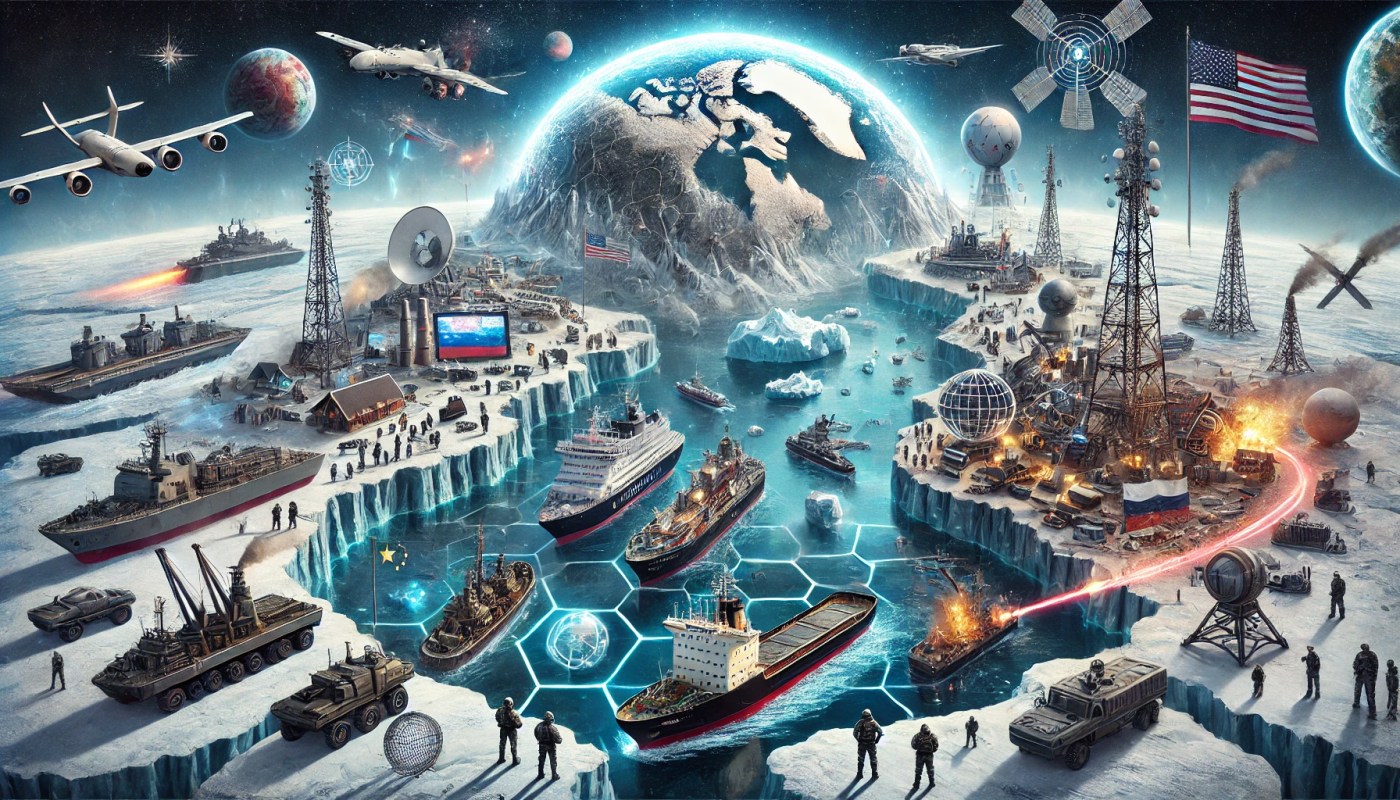
In August 2019, then-President Donald Trump, in his usual mix of imperial arrogance and real estate hustler bravado, casually suggested that the United States should buy Greenland. The idea was so ludicrous that the Danish Prime Minister dismissed it as “absurd,” prompting Trump to throw one of his characteristic tantrums, canceling a planned visit to Denmark in retaliation. The media had a field day, treating the whole affair as yet another bizarre episode of the Trump reality show.
But beneath the theatrics, something far more serious was at play. Trump’s interest in Greenland wasn’t just the impulsive fantasy of a failed businessman—it was an expression of a deeper U.S. imperial ambition that has been in motion for years. The Arctic is melting, and with it, a new scramble for control over resources, trade routes, and strategic military positioning is unfolding. Washington, panicked by its slow descent from global supremacy, is looking for any remaining footholds to maintain its dominance in a multipolar world. Greenland, sitting on a motherlode of rare earth minerals, oil, and natural gas, is one such foothold.
This essay situates Greenland within the broader framework of U.S. imperialist recalibration—the strategy of adapting to decline through militarization, economic nationalism, and securing key chokepoints to sabotage the rise of rival powers. If Greenland was a joke to the media, it wasn’t to the U.S. strategic planners who have long regarded it as a prize worth fighting for.
To understand why Greenland is so central to Washington’s ambitions, we must examine three key dimensions of its importance:
1. Its economic value, particularly its deposits of rare earth elements (REEs) and other strategic minerals. With China dominating global supply chains for these resources, Greenland offers the U.S. a potential alternative.
2. Its geopolitical and military significance as an Arctic stronghold, home to Thule Air Base, a cornerstone of U.S. missile defense and surveillance operations. Controlling Greenland ensures Washington’s dominance over Arctic security.
3. The rise of Arctic trade routes, particularly Russia’s Northern Sea Route (NSR) and China’s Polar Silk Road, both of which threaten to reshape global commerce outside of U.S. control.
We will also analyze U.S. think tank and military strategy documents that reveal Washington’s long-term objective: to tighten its grip over Greenland through economic dependence, diplomatic coercion, and military leverage. If it can’t buy Greenland outright, it will ensure that it remains within the U.S. sphere of influence.
As the world fractures into a multipolar order, the Arctic is becoming a battleground where Washington is desperately trying to reassert its dominance. Greenland is not just an island—it’s a front line in the struggle over the future of imperialism.
Greenland’s Economic Value: The Resource War Beneath the Ice
If Trump’s Greenland gambit seemed like a joke, it was only because he said the quiet part out loud. Greenland is a resource bonanza, and U.S. planners have been eyeing it for years. The island is home to some of the world’s richest deposits of rare earth elements (REEs), uranium, and untapped fossil fuel reserves—all of which are critical to the technological and military supremacy of modern empires.
Rare Earth Elements: The Empire’s Tech Dependency
REEs are indispensable for producing everything from smartphones and electric vehicles to fighter jets and missile systems. The problem? China controls about 70% of global rare earth production and nearly 90% of the processing capacity. In other words, Washington’s war machine is dependent on Beijing for its supply of strategic minerals.
Greenland offers an escape from this dilemma. The Kvanefjeld deposit alone is one of the world’s largest untapped sources of rare earth elements and uranium, while the Tanbreez project holds an estimated 30% of the world’s rare earth reserves. If the U.S. can lock down Greenland as a secure supply hub, it can break its dependency on China and dictate global mineral markets on its own terms.
Arctic Oil and Gas: Washington’s Energy Anxiety
Beyond minerals, Greenland sits atop an estimated 17.5 billion barrels of oil and 148 trillion cubic feet of natural gas. As Arctic ice melts and shipping routes open, the pressure to extract and control these resources has intensified.
Russia has already established itself as the dominant Arctic energy superpower, flooding the market with natural gas from projects like Yamal LNG. If the U.S. fails to secure Greenland’s energy reserves, it risks falling further behind in the global energy race—an unacceptable prospect for an empire built on the control of oil and gas markets.
Economic Warfare: How Washington Uses “Aid” as a Weapon
Washington understands that outright annexation is out of the question. So instead, it is trying to absorb Greenland through economic dependency.
In 2020, the U.S. announced a $12 million aid package to Greenland, framing it as “economic assistance” while making it clear that it expected Greenland to align more closely with U.S. interests.
U.S. diplomatic efforts have focused on blocking Chinese investment in Greenland’s mining and infrastructure sectors, ensuring that Greenland remains tethered to Western capital.
This is classic imperial strategy: first, create dependency—then, dictate the terms of sovereignty.
Greenland as a U.S. Military Outpost
Economic interests are only part of the equation. Greenland is a key node in the U.S. global military network. Washington already maintains Thule Air Base, its northernmost military installation, which plays a central role in Arctic surveillance and missile defense.
Thule Air Base: The Pentagon’s Arctic Watchtower
Thule was originally built in the 1950s to monitor Soviet nuclear activity. Today, it has been upgraded to serve as a critical hub for:
Ballistic missile early warning systems, tracking potential ICBM threats from Russia and China.
Space surveillance operations, monitoring satellite movements in the Arctic region.
Arctic warfare readiness, serving as a launchpad for future military operations in the region.
With Russia expanding its Arctic military footprint and China increasing its economic presence, Washington is now looking to expand Thule’s capabilities—further militarizing the region under the pretext of national security.
The Arctic Trade Routes: Russia and China’s Challenge to U.S. Hegemony
Greenland isn’t just about resources or military bases—it’s also about who controls the future of global trade. As the ice melts, new shipping routes are emerging that could redraw the global economic map.
The Northern Sea Route: Russia’s Arctic Corridor
Russia, recognizing the Arctic’s strategic value, has aggressively developed the NSR, which runs along its Arctic coast and serves as a shorter, cheaper alternative to the Suez Canal. Moscow controls the entire route, meaning any ship that wants to pass must abide by Russian regulations.
By 2030, Russia plans to handle 80 million tons of cargo via the NSR, positioning itself as a dominant player in global shipping.
Russia’s fleet of nuclear-powered icebreakers ensures year-round access, giving it control over Arctic trade flows.
This poses an existential threat to U.S. maritime dominance. If Russia controls the Arctic’s major shipping lanes, it can bypass traditional U.S.-controlled trade routes, undermining Washington’s economic influence.
China’s Polar Silk Road: A New Maritime Order
China, despite having no Arctic territory, has declared itself a “Near-Arctic State” and is integrating the region into its Belt and Road Initiative (BRI). The goal? Secure Arctic trade routes and energy access before the U.S. can lock them down.
China has poured billions into Arctic infrastructure, including ports and research stations.
Chinese shipping giant COSCO has begun testing Arctic shipping routes, preparing for a future where the NSR is a major commercial corridor.
This explains Washington’s sudden interest in Greenland—if it loses Greenland, it loses its last major foothold in the Arctic power struggle.
The Struggle for Arctic Hegemony
Greenland is not a frozen backwater—it is a flashpoint in the new great power struggle. The U.S. sees it as an economic asset, a military outpost, and a last-ditch effort to maintain Arctic supremacy. But as Russia and China entrench themselves in the region, Washington’s grip is slipping.
The ice is melting, and with it, so is the illusion of unchallenged U.S. dominance.
 Weaponized Information
Leave a comment