
There’s a certain thrill in watching an empire stumble. The mighty United States, which spent the last seventy-five years dictating the terms of global trade, war, and governance, is finally losing its grip. The arrogance of unipolarity—the belief that Washington could bomb and sanction its way to eternal dominance—is unraveling.
The headlines write themselves: China refuses to bow. Russia refuses to retreat. The Global South—long dismissed as an afterthought—has begun to chart its own course. Even Europe, once a loyal lapdog, is showing signs of disobedience. The IMF, once feared like a god, now has clients who won’t return its calls. The dollar, for so long the world’s primary currency, is slowly being challenged. The cracks are showing, and U.S. imperialism, for the first time in decades, looks vulnerable.
All of this should be cause for celebration. And yet—here we are, still being worked to death, still being surveilled, still struggling to afford food, rent, and medical care. The empire’s decline hasn’t exactly translated into relief for the rest of us. If anything, the system is getting meaner, not weaker.
That’s because imperialism doesn’t just “end.” It evolves. It does not sit back and allow itself to be swept into the dustbin of history. Instead, it shapeshifts—finding new ways to keep the rich rich and the poor poor, new ways to maintain control even as the global balance shifts.
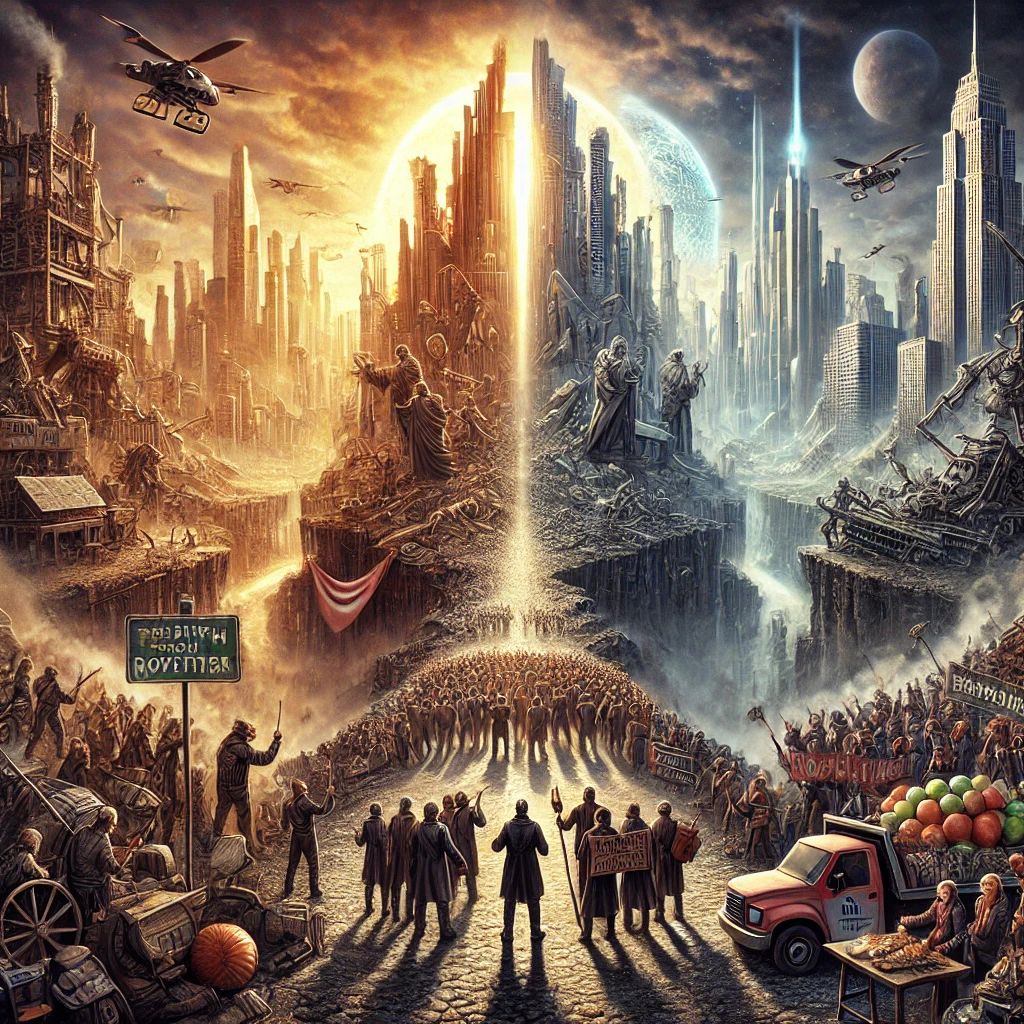
The real question, then, is not whether the U.S. is losing power, but what is replacing it. Will we see the birth of something genuinely liberatory? Or will we just get a new arrangement of the same system—one with new bosses, new enforcers, but the same brutal logic?
From “Globalization” to Technofascism
For decades, the ruling class swore by globalization. It was their religion, their magic bullet. If we just let the markets do their thing, they promised, everything would work out. American companies would spread their wings, cheap labor and cheap goods would flow endlessly, and the world would become one big happy shopping mall.
That dream is dead. The pandemic shattered the illusion of limitless supply chains, China refused to play the role of an obedient workshop, and the American working class—tired of being squeezed—became harder to pacify.
Now, the empire is changing its strategy. The future of imperialism isn’t globalist—it’s technofascist.
The new strategy is less about soft power and more about hard control. It’s about:
Digital surveillance: If the U.S. can’t run the world through trade deals, it will do it through technology. AI policing, facial recognition, and data tracking ensure that rebellion can be detected and crushed before it even begins.
Weaponized supply chains: If the U.S. can’t outcompete China, it will simply cut off its access to semiconductors, minerals, and financial markets. Trade is no longer about efficiency—it’s about leverage.
A militarized border regime: Not just to keep people out, but to keep workers in. The ruling class is perfectly happy with undocumented labor—so long as it stays scared and cheap. What they don’t want is mobility, workers leaving when wages drop, or mass movements linking struggles across borders.
Austerity at home, militarism abroad: The U.S. economy isn’t designed to provide for its people—it’s designed to funnel wealth upward. When the old mechanisms of control fail, brute force steps in. The military budget rises, while social spending gets slashed. The message is clear: there’s money for war, but not for you.
This is the next stage of imperialism. It is not the end of the empire—it is a desperate attempt to save it.
Multipolarity: A Mixed Blessing
Of course, all of this is happening because the world is changing. The U.S. is no longer the only player on the board.
China has emerged as the great economic counterweight, refusing to be bullied into submission. Russia, despite years of sanctions and NATO encirclement, remains defiant. The Global South—Latin America, Africa, the Middle East—is increasingly rejecting Washington’s economic stranglehold. The BRICS nations are expanding, the dollar is being challenged, and new trade routes are being carved outside of U.S. control.
All of this is good news—to a point. A world where Washington doesn’t dictate everything is obviously better than the one we’ve been living in. But let’s not get ahead of ourselves.
Because multipolarity, by itself, is not liberation. It is simply a different arrangement of power.
China may reject U.S. imperialism, but it still operates within a capitalist world system. Its banks, its billionaires, and its corporations exist within the same global market logic as their Western counterparts.
Russia may defy NATO, but it is still an oligarchic state. The fact that its oligarchs hate the U.S. does not make them natural allies of the working class.
The Global South may be shaking off U.S. control, but it is still deeply tied to global capitalism. Even as countries reject the IMF, many remain dependent on foreign investment, commodity exports, and a financial system still largely structured to benefit the wealthy.
Multipolarity weakens U.S. power, but it does not, by itself, dismantle the logic of imperialism.
If we are not careful, we will simply trade one set of bosses for another.
Where Do We Go From Here?
If history has taught us anything, it’s that power does not collapse on its own. The ruling class does not wake up one morning and decide to surrender.
If we want a world free of imperialism—not just a different version of the same system—we have to seize this moment of crisis and push it to its breaking point.
1. Build Independent Power
We cannot rely on governments—neither in the imperial core nor the Global South—to liberate us. That is our task.
Worker-owned industries that are not tied to the whims of global capital.
People’s assemblies that make decisions outside the framework of the bourgeois state.
Community defense to protect against state repression and fascist violence.
2. Exploit the Cracks in the System
The U.S. is internally divided.
The tech oligarchs, the oil barons, and the finance capitalists are all fighting over how to maintain control.
Europe and Japan, long loyal to Washington, are starting to look for exits.
The Global South is rejecting U.S. dominance, but has not yet broken from capitalism.
Every contradiction in the system is a battlefield. We must identify them, expose them, and push them to their limits.
3. Make Multipolarity Work for Us
Support de-dollarization and the rejection of IMF austerity.
Demand that multipolar states reject not just U.S. control, but imperialist finance altogether.
Forge internationalist movements that break through the boundaries of the nation-state.
We cannot afford to be passive spectators.
History Is Being Decided Now
The empire is falling—but that doesn’t mean we’re free. It just means we have a choice.
Either we let capitalism rebrand itself in a new form, with new bosses, new imperial centers, and new enforcers…
Or we tear it out at the root and build something that actually serves the people.
This moment—the interregnum—is a battlefield. It will not last forever.
The ruling class is already making their move.
The question is: will we?
 Weaponized Information
Leave a comment