
When we talk about Google, we’re not talking about a plucky start-up that “changed the world” with a better search engine. We’re talking about an arm of the U.S. empire—a tool of surveillance, war, and repression wrapped in the language of innovation.
The story we’ve been sold—two nerdy Stanford grads, Larry Page and Sergey Brin, tinkering in a garage and changing the world—is a fairytale for the tech-obsessed. The real story is more familiar: state power and corporate wealth, moving hand-in-glove to dominate markets, suppress dissent, and extend U.S. imperial hegemony.
From Day One: Google and the State
Google was never just a private company—it was a state project from day one. Page and Brin’s research was bankrolled by the National Science Foundation, with defense interests watching closely. The CIA’s venture capital arm, In-Q-Tel, backed Keyhole Inc., which became Google Earth. When Google snapped up Keyhole, it wasn’t chasing a cool app for tourists; it was acquiring geospatial tech already in use by the Pentagon for precision bombing and battlefield operations.
Google was built with government money, nurtured by the military, and designed to serve power.
War and Surveillance: Google’s Real Business Model
This was never about helping you find the best pizza in your neighborhood. It was about building the infrastructure of global surveillance.
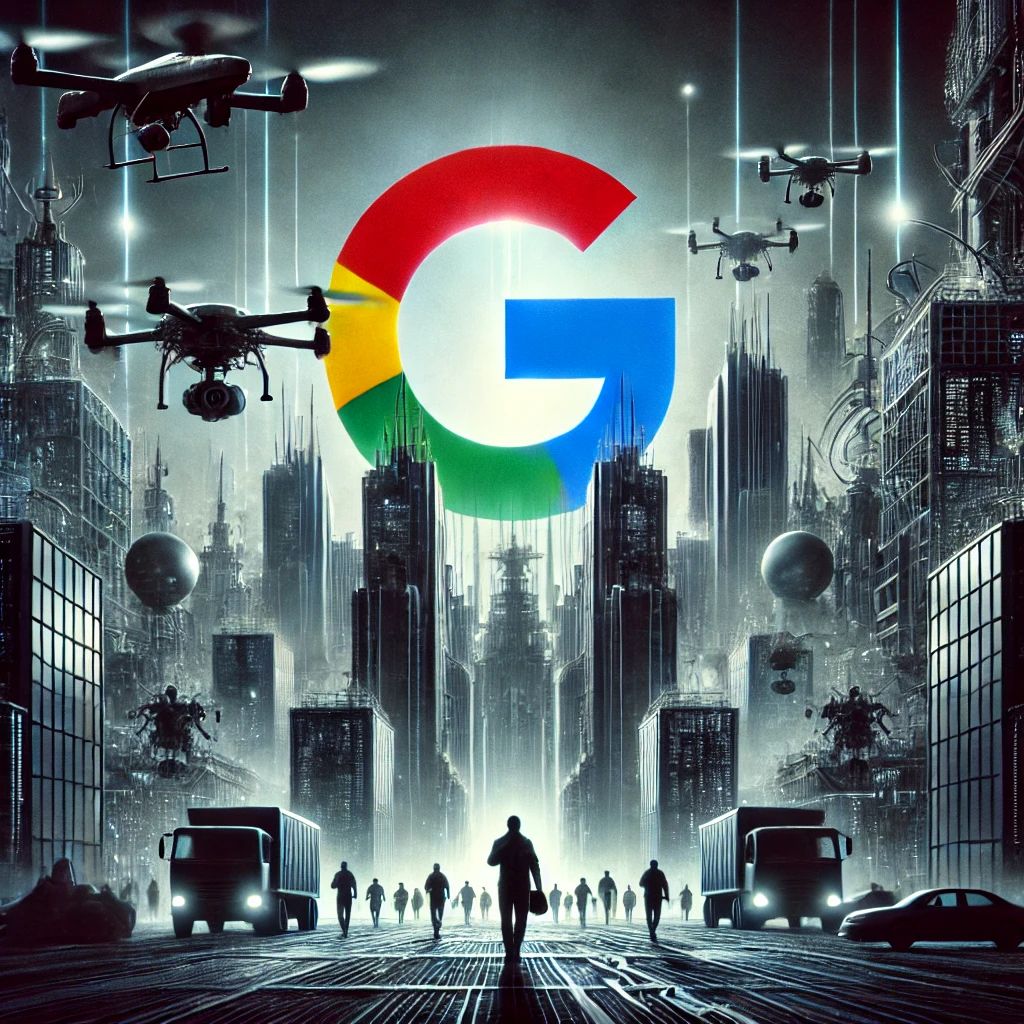
When the “War on Terror” kicked off, Google became a key partner. The National Geospatial-Intelligence Agency (NGA) and the Pentagon poured money into Google’s mapping and data analysis tech. Project Maven, a collaboration between Google and the Department of Defense, used artificial intelligence to enhance drone strikes—those same drones that slaughtered wedding parties in Afghanistan and bombed families in Yemen.
When Edward Snowden exposed the NSA’s PRISM program in 2013, we saw Google’s deeper role. The company was handing over data on millions of users—without consent, without oversight—directly to the U.S. surveillance state. Your search history, your emails, your movements: all vacuumed up and weaponized.
Google didn’t resist. It cashed the checks.
Censorship as Imperial Policy
After Trump’s election in 2016, the panic over “fake news” provided a new opportunity. Under pressure from Congress and the intelligence community, Google tightened its algorithms—not to promote truth, but to bury independent voices. Socialist publications, anti-imperialist websites, and critical journalists saw their traffic plummet overnight.
Google became an unofficial Ministry of Truth. The line between Silicon Valley and Washington blurred further. Now, the tech giants actively police what we can see, hear, and read—all in the name of “combating disinformation.” But whose truth are they defending? Whose interests are they serving?
Google, Zionism, and Occupation
Let’s be clear: Google is also complicit in settler-colonial genocide. Through Project Nimbus, Google and Amazon secured a billion-dollar contract to provide cloud services to the Israeli military and government. This is the same state that is ethnically cleansing Palestinians, bombing Gaza into rubble, and turning the West Bank into an open-air prison.
Google’s technology is not neutral—it enables apartheid. The tools that power Google Maps also help map out illegal Israeli settlements. The cloud services that store your photos are also storing the data the Israeli state uses to track and target Palestinians.
Several Google employees protested Project Nimbus. They were ignored. Some were fired. Because when profits collide with principles, we know which wins.
Google Under Trump’s Technofascism
Now, in Trump’s second term, the stakes are even higher. With Elon Musk installed as the head of the Department of Government Efficiency (DOGE), the regime is gutting what remains of the social state. USAID, the NED, and other “soft power” agencies are being dismantled. Bureaucrats are being sacked.
But let’s notice what’s not being touched: The military budget is ballooning. Pentagon contracts are thriving. The oil giants, Wall Street banks, and tech monopolies like Google are sitting comfortably.
Trump’s vision is clear: a streamlined state that serves corporations and crushes dissent. Google is not just surviving this transition—it’s thriving. Reports suggest Google is already reviving its military AI collaborations, with the Pentagon eager to harness its data-mining capabilities for the new era of “great power competition.”
China is the new target, and Google’s surveillance and algorithmic control will be key weapons in the economic and information war.
Technofascism in Plain Sight
This is what technofascism looks like:
– A militarized surveillance state fused with corporate monopolies.
– A government that defunds social programs while handing billions to defense contractors and tech giants.
– A media landscape controlled by a few platforms that decide what is “real” and what is “fake.”
– Dissent algorithmically erased.
– Workers atomized, their every movement tracked.
Google is not a bystander. It is a central architect of this system.
A Note of Urgency
We cannot afford to see Google as just another big tech company. It is a political institution, deeply embedded in the machinery of U.S. imperialism. Every “free” service—Gmail, YouTube, Google Drive—comes with a hidden cost: your data, your freedom, your right to dissent.
As Trump’s technofascist order tightens its grip, the role of Google will only grow more dangerous. The surveillance tools built under the banner of convenience are now instruments of control. The algorithms designed to “organize information” are now filtering reality itself.
What Is to Be Done?
Lenin once said that exposing the workings of power is the first step toward revolution. We must see Google for what it is: an appendage of empire, a weapon of capital, an enemy of democracy.
Workers—both in tech and beyond—must organize. We must demand the abolition of surveillance capitalism and the dismantling of the military-tech complex. We need platforms that serve the people, not the state.
The struggle is not just against Trump. It is against the entire system that produced Google—the system that now threatens to digitize repression on a scale we have never seen.
History moves quickly in moments of crisis. We are in one now. The question is: will we watch passively as the digital walls close around us, or will we tear them down before it’s too late?
 Weaponized Information
Leave a comment