
I. The Technofascist Moment: Repression in Real Time
When Israel launched its brutal assault on Gaza in 2024, the bombs didn’t just fall from the sky—they were accompanied by a digital crackdown that stretched across continents. In the United States, students protesting the slaughter were arrested, suspended, and expelled. Organizers had their bank accounts frozen, their personal information leaked, their social media accounts shut down. Palestinian voices were silenced online—posts deleted, videos removed, entire accounts erased—while corporate media repeated Israeli talking points like a script handed down from Washington.
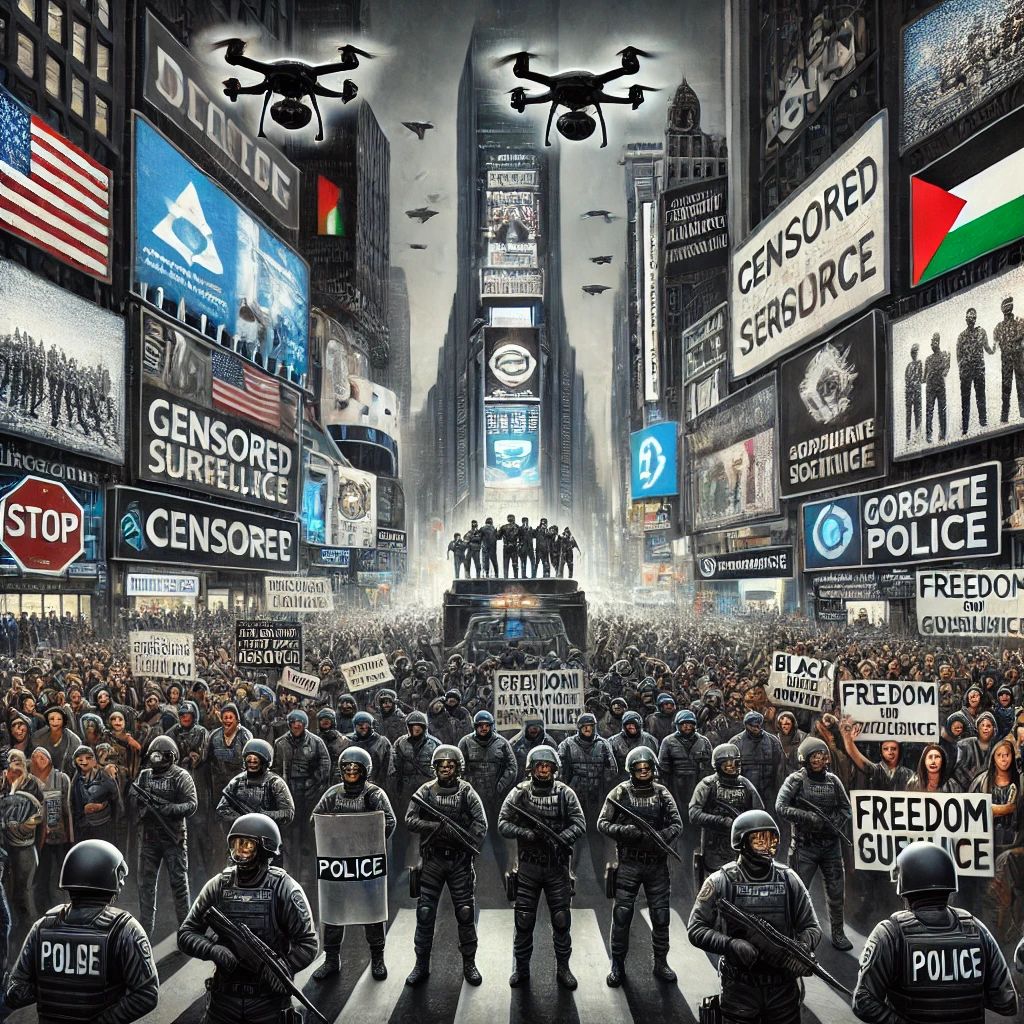
What we saw was not just censorship. It was the full machinery of repression—police, courts, banks, media, tech platforms—working together to crush resistance. This is what power looks like in the age of technofascism. The state doesn’t need to declare martial law when it can simply cut your digital lifeline. You won’t see soldiers in the streets because the policing is happening through your phone, your bank, your job, your university.
It’s easy to see Gaza as distant, but for those paying attention, it’s clear that the same system being used to strangle Palestinians is being fine-tuned for use against all of us. The same tools, the same playbook, the same goal: to crush any challenge to the system that keeps wealth and power in the hands of a few.
But this system—technofascism—didn’t appear overnight. It’s the result of decades of trial and error, as the ruling class learned how to perfect the art of control, both at home and abroad. To understand how we got here, we need to trace the path—from the war on Black revolutionaries in the 1960s, to the hollowing out of working-class communities, to the post-9/11 surveillance state, to today’s seamless fusion of corporate tech and state repression.
II. COINTELPRO: Crushing the Black Revolution
In the late 1960s, the U.S. government faced a problem. Black communities were rising up—not just against racism, but against the entire system of capitalist exploitation and imperial domination. The Black Panther Party, the League of Revolutionary Black Workers, Malcolm X’s Organization of Afro-American Unity—they weren’t just talking about civil rights. They were talking about power. They were talking about socialism.
The state responded with war. The FBI’s COINTELPRO program targeted Black leaders for assassination, framed activists on false charges, planted informants to destroy organizations from within. Police kicked down doors and left bodies in their wake—Fred Hampton murdered in his bed, George Jackson shot down in a prison yard.
But the goal wasn’t just to eliminate individual leaders. It was to make organizing itself dangerous. To isolate radicals from their communities. To turn every phone call, every meeting, into a potential trap.
And it worked. By the late 1970s, the Black liberation movement, and with it the entire radical tendency of the US Left, had been crushed. But the methods developed during COINTELPRO didn’t disappear. They became the foundation for everything that followed.
III. Deindustrialization: Breaking the Black Working Class
With the revolution crushed, the ruling class turned to the next phase: dismantling the economic base of Black power. Throughout the 1980s and 90s, factories closed across the country, hitting Black working-class communities hardest. The industrial jobs that had provided stable wages and union power vanished. Neighborhoods that had been hubs of labor and political organizing were left to rot.
This wasn’t just economic restructuring. It was counterinsurgency by other means. The ruling class understood that a stable, organized working class—especially a Black working class—was a threat. So they deindustrialized. They flooded communities with drugs and guns. They passed “tough on crime” laws—pushed by figures like Joe Biden and Bill Clinton—that turned poverty into a prison sentence. Three strikes. Mandatory minimums. Entire generations of Black men disappeared into the carceral state.
Deindustrialization wasn’t just about profits. It was about making sure the working class—especially the Black working class—never had the power to rise again.
IV. The War on Terror: Merging State Power with Corporate Power
September 11, 2001, gave the ruling class the excuse it needed to take repression to a new level. Under the cover of fighting terrorism, the state expanded its surveillance powers beyond anything imagined under COINTELPRO. The Patriot Act allowed the government to spy on citizens without warrants. The NSA began collecting every phone call, every email, every internet search. Drones patrolled the skies over Pakistan and Yemen, killing “suspects” without trial—while police departments in the U.S. quietly began acquiring military-grade equipment.
But the real shift wasn’t just in government power. It was the merger of state surveillance with corporate technology. AT&T built secret rooms to funnel data to the NSA. Google and Facebook quietly handed over user information. Tech companies became partners in repression, often without a court order or public debate.
This was the birth of what we now call technofascism: a system where the lines between government and corporations blur, and repression is outsourced to the platforms we rely on every day.
V. 2014: The Information War Begins
For a while, this system worked. Corporate media cheerleaded every war, every invasion, every drone strike. But by the 2010s, cracks were showing. Social media allowed alternative voices to break through. Videos from Ferguson showed the world what militarized policing looked like in Black communities. Livestreams from Gaza exposed Israeli war crimes in real-time. Outlets like RT and Al Jazeera challenged U.S. narratives on Syria and Ukraine.
The ruling class panicked. Suddenly, “disinformation” became the buzzword. Russian trolls. Fake news. Bots. The reality was simpler: the empire was losing control over information. People were seeing the truth.
The response was swift. Tech platforms were pressured to change their algorithms. Accounts critical of U.S. foreign policy were banned or throttled. Independent journalists were smeared as Kremlin agents. RT was deplatformed. Palestinian activists found their posts disappearing.
What we were witnessing was the final consolidation of technofascism. The state didn’t need to pass new laws. It simply leaned on Big Tech. And Big Tech, eager to protect its profits, fell in line.
VI. Trump and the Consolidation of Technofascism
Trump didn’t create this system. He inherited it. But under his watch, the mask slipped. Protesters were snatched off the streets by unmarked federal agents. Surveillance of Black activists intensified. Google began working with the Pentagon on AI drone targeting. Amazon built data systems for ICE to track and deport migrants.
The system is no longer just about surveillance. It’s about preemptive control. Predictive policing. Facial recognition. Algorithms that determine who gets a loan, who gets a job, who gets flagged as a threat.
It’s a system designed not to keep you safe, but to keep you in line.
VII. Where We Stand Now
Technofascism is the ruling class’s response to crisis. U.S. imperialism is in decline. The working class—Black, Brown, and white—is restless. Palestine, Ferguson, Amazon warehouses—it’s all connected. The system is tightening its grip because it knows its time is running out.
Our task is to see this system clearly. To understand that repression isn’t just coming—it’s already here. But also to see that every tool of repression is a sign of weakness. They wouldn’t need all this surveillance, all this control, if they weren’t afraid.
So, we keep building. We organize on the ground, in the streets, in our communities. We create our own media. We tell the truth. We build the power they fear.
Because their system is strong, but it is not invincible. And our future will not be decided by algorithms, but by us.
 Weaponized Information
Leave a comment