
EDITORIAL NOTE:
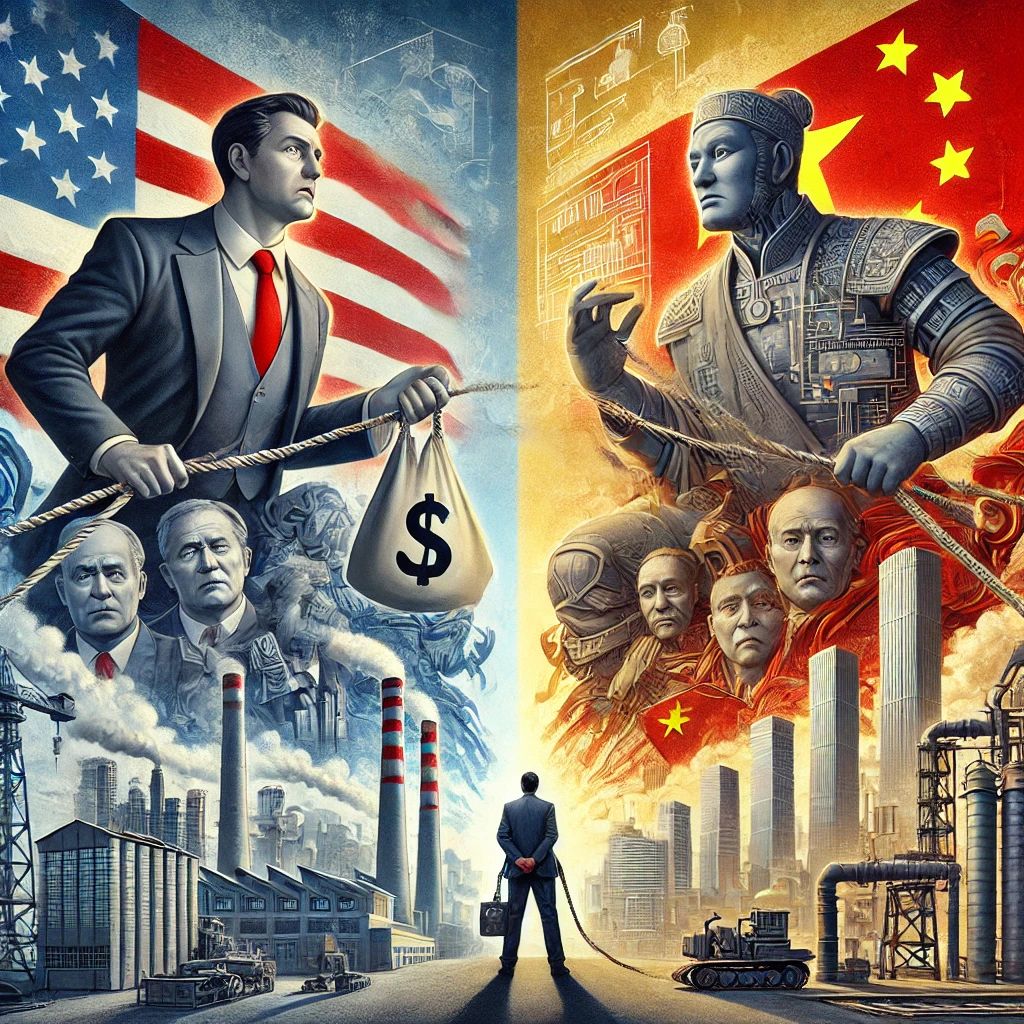
The U.S. ruling class, in its greed and arrogance, deluded itself into believing that opening China to Western capital would lead to its eventual subjugation. They assumed that as U.S. investment poured in, China’s economy, political system, and culture would be eroded from within—much like the Soviet Union in the 1990s. The bet was that China’s ruling elite, once integrated into global capitalism, would prioritize personal wealth over national sovereignty, gradually dismantling socialism in favor of Western-style oligarchic rule. U.S. corporations readily agreed to technology transfers, naively believing that by the time China developed any real technological capacity, it would already be a compliant junior partner in the U.S.-led imperialist order.
This assumption was rooted in both hubris and racism. Washington’s strategists believed China lacked the intellectual or organizational capacity to absorb and apply advanced technology in a systematic way. They thought China would remain a low-cost manufacturing base, forever dependent on U.S. corporations for innovation and global market access. Instead, China weaponized market reforms—leveraging foreign capital to build up its industrial base while maintaining strict state control. By the time the U.S. realized what had happened, China had not only caught up but had begun challenging Western dominance in key industries.
Now, in a desperate attempt to reverse history, the U.S. is launching a full-scale economic war—sanctioning Chinese tech firms, blocking semiconductor exports, and pushing for decoupling. But the damage is done. The same capitalists who once laughed at China’s demands for technology sharing now rage about “theft” and “coercion.” In reality, they were outmaneuvered at their own game. They eagerly sold the rope, and now they are watching as China uses it to pull itself to new heights—leaving the U.S. scrambling to contain the consequences of its own shortsightedness.
The China Gamble
In the 1970s, the United States hit a wall. The postwar economic boom was over, the Vietnam War had drained the treasury, and the dollar—once the foundation of the global financial system—was on life support. American industry, once the envy of the world, was falling behind. Japan and West Germany were eating into U.S. market share, inflation was running wild, and working-class wages had stagnated.
Desperate to save their sinking ship, the American ruling class made a bold move: they bet the future of U.S. capitalism on China. The idea was simple—open China up, flood it with American investment, and use its cheap labor to manufacture goods at rock-bottom prices. In return, China would prop up the U.S. economy by keeping inflation low, absorbing American capital and financing US debt. It was supposed to be a one-sided relationship. The U.S. would remain in charge, and China would play its assigned role in the global capitalist order.
The China Gamble was the U.S. bet that market integration would weaken China’s state control and ensure its subordination. Instead, China leveraged the opportunity to strengthen itself, unacceptable to the U.S. which opted to provoke a new Cold War to contain China’s rise.
The 1970s Crisis and the End of the American Dream
By the early 1970s, the cracks in the U.S. economy were impossible to ignore. The country had spent decades living beyond its means, printing money and running deficits under the assumption that the world would keep accepting the dollar. But as European and Asian economies recovered from World War II, they started questioning the deal. When Nixon took the dollar off the gold standard in 1971, it was a desperate move to keep U.S. economic dominance intact. In reality, it marked the beginning of a long decline.
Then came the OPEC oil embargo in 1973, a direct consequence of U.S. imperial arrogance in the Middle East. Oil prices quadrupled overnight, sending shockwaves through the global economy. American industry, already struggling, was now dealing with skyrocketing costs. This was the birth of stagflation—rising inflation combined with stagnant growth, something mainstream economists had claimed was impossible. But this was the stage of Monopoly Finance Capital.
The ruling class had to find a new way to make money. The answer? Financialization and offshoring.
The Turn to China
At first, U.S. capital flowed into places like Mexico, South Korea, and Taiwan—anywhere with cheap labor and weak labor protections. But no country could match China’s potential.
When Nixon visited Beijing in 1972, he wasn’t just playing Cold War chess against the Soviet Union. He was laying the groundwork for a future where U.S. capital would flood into China, turning it into the world’s factory. In the late 1970s, as China embarked on economic reforms under Deng Xiaoping, American business elites saw their opening.
By the 1990s, under Clinton, the U.S. went all in. Corporations shut down factories across the Midwest and moved production to China, where wages were a fraction of what they were in the U.S. At the same time, Wall Street bankers made a killing by pumping money into Chinese markets, expecting endless profits.
It worked—for a while. Cheap Chinese goods kept inflation down, even as real wages in the U.S. flatlined. The working class was kept afloat by debt, not wages. The U.S. stopped producing and started consuming, relying on Chinese labor and Chinese capital to sustain its economy.
The 2008 Crash and the End of the Illusion
The 2008 financial crash exposed the limits of this model. Wall Street had turned the U.S. economy into a giant casino, propped up by debt and speculation. When the bubble popped, it became clear:
The U.S. no longer had a productive economy—just finance, real estate, and tech monopolies.
The working class was drowning in debt, with no path to stability.
China, instead of collapsing, used state planning and investment to build its own industries.
This was the moment when the U.S. ruling class realized the China gamble had backfired. Instead of staying a cheap labor pool for American corporations, China had built its own industrial base, developed its own technology, and emerged as a global economic power in its own right.
The Shift to Cold War 2.0
The cracks started showing under Obama, who launched the Pivot to Asia—a strategy to contain China’s rise. Trump escalated the conflict with trade wars and sanctions during his first term, Biden more or less continued the same trajectory, and now the second Trump regime has fully committed to a tech war, attempting to cut China off from advanced semiconductors and trying to cripple its tech sector.
Why? Because the old model is dead. The U.S. can no longer use China to prop up its economy while maintaining unchallenged global dominance. The same elites that once celebrated China’s rise are now waging economic war against it, desperately trying to turn back the clock.
But history doesn’t work that way.
The Last Stage: Financialized Capitalism Turns to Technofascism
The U.S. ruling class can’t bring back manufacturing, because that would require paying American workers decent wages. It can’t compete with China’s state-led industrial model, because that would mean admitting that neoliberalism has failed. So what’s the alternative?
Technofascism.
Mass surveillance and AI-driven social control to manage domestic unrest.
Harsh austerity to squeeze every last drop of wealth from the working class.
Censorship and corporate-state fusion to silence anti-imperialist dissent.
Escalating military aggression to prevent the Global South from breaking free of U.S. hegemony.
The war against China is really a war to preserve American capitalism in its final, decaying stage. It’s not about democracy, human rights, or any of the usual propaganda. It’s about the fact that the U.S. economy has no real productive base left and is now relying on force—economic, digital, and military—to maintain control.
The Road Ahead
The U.S. ruling class has run out of tricks. The era of financialized capitalism is ending, and something new is emerging—a multipolar world, with China at its center. The only question is: what will the U.S. working class do?
For decades, working people were told to accept deindustrialization, stagnating wages, and endless war because there was no alternative. But there is an alternative. The ruling class made its choice—it bet on China, it lost, and now it wants to drag the whole world into a new Cold War.
The choice for the rest of us is simple: go down with the system, or build something new.
 Weaponized Information
Leave a comment