
For decades, the U.S. foreign policy establishment has operated on a simple rule: Any country that refuses to submit must be crushed, starved, or turned into an ungovernable wasteland. Iraq, Libya, Syria, Gaza—the list goes on. But Russia? That’s a different story. A nuclear-armed power with vast resources and a deep historical memory, Russia was never going to roll over like a two-bit Chump. The U.S. tried anyway, and now it’s watching its entire imperial project unravel in real-time.
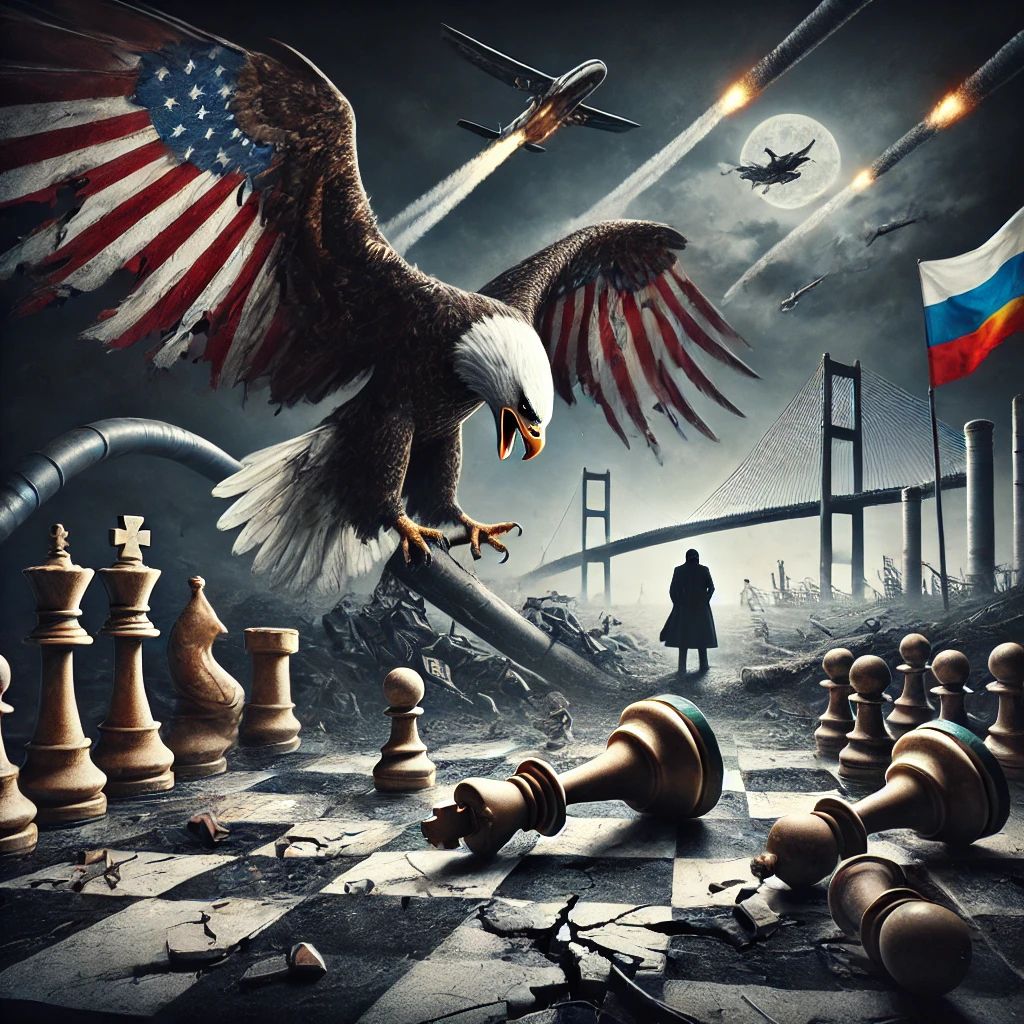
What began in Ukraine as a supposed masterstroke of geopolitical chess—arming, training, and provoking Russia into a war of attrition—has backfired spectacularly. The war didn’t weaken Russia; it strengthened it. It didn’t isolate Russia; it pushed it closer to China, Iran, and the Global South. The grand plan to turn Ukraine into “Russia’s Afghanistan” has instead turned into NATO’s slow-motion humiliation, a proxy war that exposed the declining industrial and military capacity of the West while solidifying the emergence of a multipolar world order.
But to understand how we got here, we need to rewind—to the 1990s, when U.S. capitalists swarmed over post-Soviet Russia like vultures picking apart a fresh corpse.
The Plunder of Russia: Wall Street’s Post-Soviet Feeding Frenzy
After the Soviet Union collapsed, U.S. elites assumed history had finally bent to their will. Russia was on its knees, and the empire wasted no time moving in for the kill. Harvard economists, U.S. Treasury officials, and IMF functionaries orchestrated what was called “shock therapy”—a euphemism for the wholesale robbery of an entire country. State-owned industries were privatized overnight, funneled into the hands of a few well-connected oligarchs while ordinary Russians saw their life savings wiped out. GDP collapsed, wages disappeared, and life expectancy fell as mass poverty, hunger, and organized crime took hold.
This was not some organic, market-driven transformation. It was economic warfare, imposed by the same Wall Street and Washington elites who now lecture the world about democracy and human rights. The new Russian Constitution—essentially ghostwritten by U.S. advisors—was designed to ensure the country remained weak and dependent on Western capital. It was colonialism in everything but name.
And yet, even in its weakened state, Russia was still too big for Washington’s liking. The unipolar moment had arrived, and the U.S. intended to keep it that way. The Wolfowitz Doctrine—the empire’s blueprint for the post-Cold War world—made it explicit: No power, anywhere, would be allowed to challenge U.S. supremacy. Russia had to be contained, dismantled, and reduced to a permanently subordinate status.
This is where NATO came in.
NATO’s Eastward Creep: The Long Betrayal
Back in the early 1990s, U.S. officials swore up and down to Soviet leaders that NATO would not expand “one inch eastward.” Fast forward three decades, and NATO has absorbed nearly every former Soviet ally, stationed troops right on Russia’s borders, and turned Ukraine into a de facto NATO outpost. So much for diplomacy.
Why the endless expansion? Simple. Encircling Russia was always the plan.
People like Zbigniew Brzezinski—Washington’s grand strategist for Eurasian domination—had spent decades arguing that Russia had to be carved up, broken into manageable pieces, and permanently neutralized. Ukraine was central to this vision. Brzezinski famously wrote that “without Ukraine, Russia ceases to be a Eurasian empire.” The goal, then, was to turn Ukraine into a forward operating base for the U.S., with the explicit purpose of undermining, destabilizing, and eventually “picking apart” Russia.
This was the real reason behind the 2014 Maidan coup. Under the cover of “pro-democracy” protests, the U.S. engineered the overthrow of Ukraine’s democratically elected government and installed a pro-NATO regime willing to do Washington’s bidding. The new government immediately launched a crackdown on Russian-speaking Ukrainians, outlawed opposition parties, and unleashed ultranationalist militias to terrorize the Donbas.
Russia, after years of trying to negotiate a diplomatic settlement, finally had enough. In 2022, it launched the Special Military Operation (SMO)—not to “conquer Ukraine,” as Western propaganda claims, but to stop NATO’s militarization of the country, protect Russian-speaking populations, and secure its own borders.
The U.S. War on Terror: A Smokescreen for Global Domination
To understand why Russia was never going to tolerate a NATO-backed Ukraine on its doorstep, we need to look at the broader trajectory of U.S. imperialism since 9/11.
The War on Terror was never really about fighting terrorism. It was about establishing a pretext for endless military interventions, justifying permanent occupation of resource-rich regions, and reshaping the geopolitical map to suit U.S. corporate interests. By invading Afghanistan and Iraq, destroying Libya as a nation-state, arming jihadist groups in Syria, and targeting Iran for regime change, the U.S. sought to dominate the world’s energy reserves and prevent any regional power—especially Russia and China—from emerging as a counterweight.
Russia initially played along, believing the U.S. was serious about fighting terrorism. Then the evidence started piling up:
1. The CIA was arming and funding jihadist groups in Libya and Syria—including affiliates of Al-Qaeda.
2. The U.S. was using terrorism as an excuse to intervene in the Middle East while simultaneously fueling it.
3. Chechen terrorists, responsible for massacres inside Russia, were receiving quiet support from Western intelligence agencies.
By 2015, Russia had had enough. It intervened in Syria, decisively smashing the U.S.-backed jihadist networks and preventing Syria from meeting the same fate as Libya (although the Assad government did eventually vacate power). This wasn’t just a battlefield victory—it was a major geopolitical shift. Russia had proven that U.S. hegemony was not unchallengeable.
Sanctions, Sabotage, and Economic Warfare
When brute force fails, the U.S. turns to economic strangulation. Following Crimea’s reunification with Russia in 2014, Washington unleashed a wave of sanctions designed to cripple Russia’s economy. But let’s be real—this wasn’t just about Ukraine.
– Russia crucially delayed U.S. regime change in Syria up until just recently
– Russia helped broker the Iran nuclear deal preventing the West from bombing Tehran
– Russia started challenging the dollar’s dominance in global trade
The final straw was Nord Stream. The U.S. didn’t just sanction Russian energy exports—it outright blew up Europe’s gas pipeline to make sure Germany and the EU had no choice but to buy overpriced American gas, thus rendering Europe even more dependent on, and held captive by, the Empire. Economic warfare disguised as geopolitics.
The U.S. Proxy War Has Failed
Fast forward to 2025, and it’s clear the empire’s grand strategy has flopped. The proxy war against Russia has failed.
Ukraine is a shattered state, hemorrhaging troops and territory.
NATO’s weapons stockpiles are depleted.
The Western economy is cracking under the weight of its own contradictions.
And worst of all (for Washington), the war pushed Russia and China closer together and accelerated the collapse of the U.S.-led world order.
The multipolar world is here. BRICS is expanding. The Global South is rejecting U.S. dictates. The U.S. empire, instead of adapting to the new reality, is still clinging to outdated fantasies of global supremacy.
The U.S. has two choices: accept multipolarity and recalibrate, or continue its self-destructive decline.
If history is any guide, the empire will choose the latter.
—
 Weaponized Information
Leave a comment