
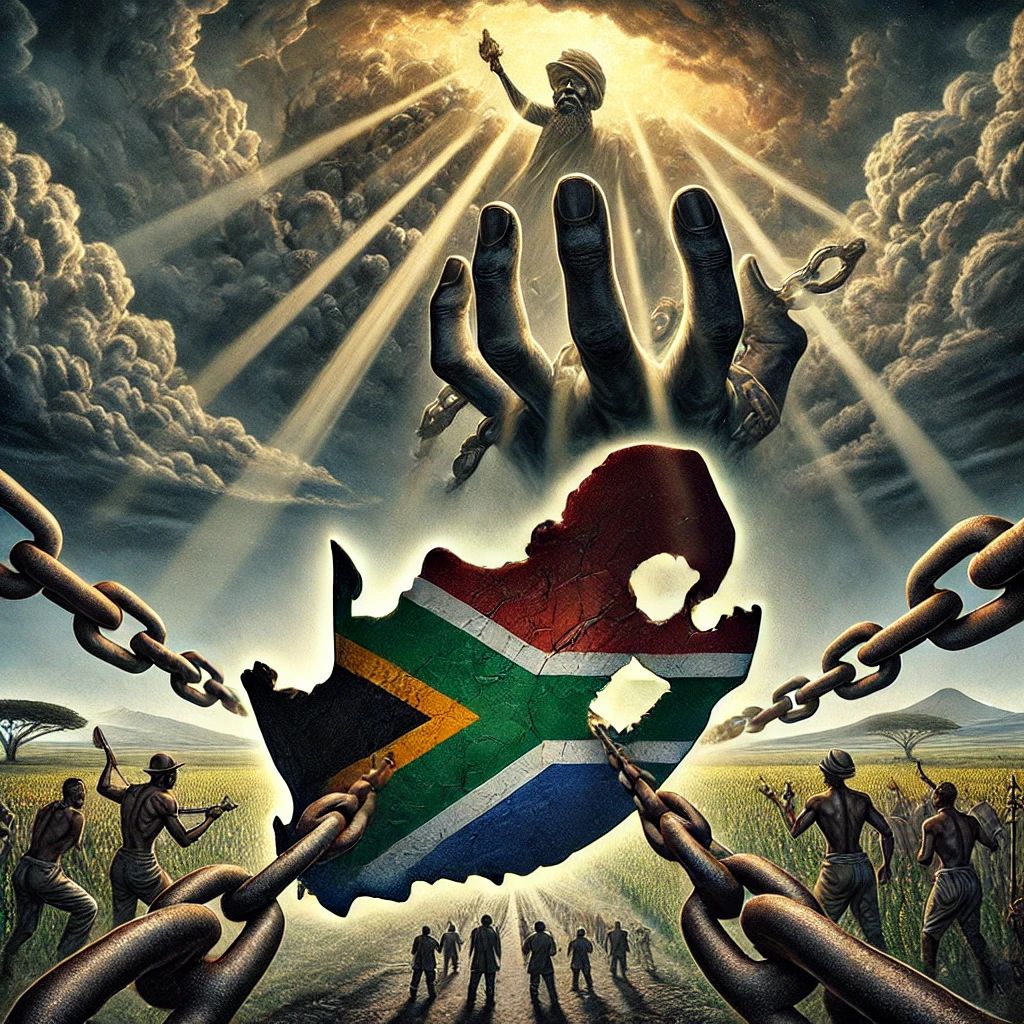
South Africa—often praised as the “gateway to Africa”—is a nation at the crossroads of imperial ambition and the people’s aspirations for dignity and self-determination. While the legacy of apartheid may have been formally dismantled, the battle for real economic and political liberation is far from over. Black South Africans are still fighting the colonial ghosts of yesterday, as the shackles of economic dependence, settler colonialism, and Western capital continue to shape the nation’s present. Yes, South Africa is now part of the BRICS bloc, but don’t be fooled—it’s hardly the shining example of post-colonial success that some might think. It’s a country where the long shadow of Western imperialism continues to loom large, and where the real power still rests in the hands of a settler elite, and, of course, multinational corporations.
The question isn’t whether South Africa’s status within BRICS offers hope—it does—but whether it can break free from the economic chains that tie it to its former colonial masters. To pretend that BRICS alone is the answer to Africa’s liberation would be to ignore the deep fractures within both the South African economy and the broader geopolitical order.
Economic Dependency: Settler Colonialism 2.0, Now with More Tech
Let’s not sugarcoat this: South Africa’s economic structure is still stuck in the colonial era. While apartheid may have ended on paper, the country’s economic engine is still fueled by the same forces that enriched the white settler class for generations. In fact, this is the ugly truth we must confront—South Africa’s economy is largely dominated by descendants of the very colonialists who once wielded their power with impunity. The wealth generated by the extraction of minerals like gold, platinum, and rare earth elements is still being funneled into the hands of a small, white minority, even as the majority of Black South Africans remain locked out of the nation’s riches.
Take a look at the reality of South Africa’s mining industry, where foreign capital—often from Western corporations—still controls much of the action. Sure, the names of these companies may have changed over the years, but their business model remains fundamentally the same: extract resources, enrich the few, and keep the masses in their place. Multinational corporations have a long history of exploiting South Africa’s natural wealth, with the white elite continuing to profit off of the labor of Black South Africans. And as South Africa finds itself drawn into the global tech race, we see the same dynamic playing out, now with the added layer of Silicon Valley’s voracious appetite for the minerals that make our modern gadgets tick.
What’s frustrating is that, despite the language of “economic independence” that we hear from political elites, the reality is much starker. South Africa’s economic sovereignty is largely an illusion—one that is tightly controlled by international financial institutions and the corporations that profit from its mineral wealth. Black South Africans, though they fought for political freedom, are still locked in an economic system that serves only to maintain the status quo for the settler elite and multinational corporations.
The BRICS Contradiction: A Beacon of Hope or Just Another Imperial Power Play?
Let’s not kid ourselves—BRICS is not a savior for the Global South. It’s not a magic bullet that will fix all of South Africa’s problems. While BRICS offers an alternative to Western hegemony, the internal contradictions within the group itself—between China, India, and South Africa—cannot be ignored. South Africa’s role within BRICS is not one of dominance; it’s one of trying to carve out space within a multipolar world order, all while still tethered to the West. The economic realities of South Africa’s dependence on Western trade and investment make it clear that the road to true independence is far from smooth.
South Africa’s role within BRICS is undoubtedly important, but to view it as the Global South’s ticket out of the stranglehold of imperialism would be a dangerous oversimplification. The country’s position in the world economy means it can play a part in challenging the existing global order, but it is still constrained by the very forces it seeks to confront. South Africa is caught between two worlds: trying to challenge imperialist structures while still deeply embedded in them. This is not an easy balancing act, and it’s one that requires more than just diplomatic rhetoric and multilateral cooperation.
Western Imperialism: South Africa’s Vulnerability in the Imperial Crosshairs
If South Africa had any illusions about escaping the Western gaze, it didn’t take long for them to be shattered. The West’s imperial interests in South Africa have never been about supporting liberation—they’re about controlling key resources and maintaining global dominance. From the Cape of Good Hope to South Africa’s vast mineral wealth, the West has long understood that this nation is a crucial chokepoint in the global trade network. South Africa’s strategic position makes it a key player in global logistics and resource extraction, which is why it remains so vulnerable to Western subversion.
In fact, let’s not forget that South Africa is a battleground for Western powers looking to maintain their grip on global capital. The Cape of Good Hope, which controls one of the world’s most important shipping routes, has been a prime target for imperialist ambitions for centuries. Today, that chokehold remains just as vital. While South Africa’s leadership talks a big game about sovereignty, the truth is that multinational corporations and international financial institutions still hold the cards. They may not be using guns and soldiers anymore, but they’re just as effective in maintaining control through economic pressure and manipulation.
The White South African Settler Class: Elon Musk and Trump’s White South African Resettlement Plan
And now, let’s talk about the real kicker—Elon Musk, the tech oligarch who has somehow managed to convince people that he’s a revolutionary force. Musk, a product of a wealthy settler family in apartheid-era South Africa, represents everything that’s wrong with the myth of meritocracy. His rise to power in the tech world is built on the same colonial structures that have kept South Africa’s economy locked in a cycle of exploitation. Musk’s fortune was made possible by a system that rewarded a small group of elites—white settlers in South Africa included—while the majority were left to toil under the boot of economic oppression.
But Musk isn’t just playing his cards in Silicon Valley—he’s also part of a disturbing trend where white South Africans are being resettled in the United States. Trump, ever the opportunist, has floated plans to resettle white South Africans in the U.S., offering them a lifeline from the ongoing struggles in their own country. In a grotesque display of imperialist continuity, the settler class—historically entrenched in both South Africa and the U.S.—is looking to relocate, as if their colonial privileges are simply a birthright that must be preserved.
It’s important to understand that this isn’t just about a couple of privileged individuals—this is about a deeper, ongoing pattern of settler colonialism and the ways in which Western powers continue to perpetuate a global hierarchy. Musk’s rise, Trump’s plans for resettling white South Africans, and the persistence of Western capital in South Africa are all part of the same imperialist project: the preservation of a system that serves the rich, white elite at the expense of the global majority.
South Africa as a Crucial Battleground for Global South Sovereignty
South Africa remains one of the most vital battlegrounds in the fight for global South sovereignty. Yes, it’s part of BRICS, but its role is not as straightforward as some might hope. While BRICS offers a platform for challenging Western imperialism, South Africa’s internal struggles—caught between settler colonialism, global capital, and the aspirations of its people—make it one of the weakest links in the chain. But that doesn’t mean it’s without potential. The struggle for land, economic equity, and sovereignty continues, driven by the resilience of the Black South African masses who have always fought to reclaim their dignity and freedom.
The West’s imperial grip on South Africa remains strong, but it is being challenged. The key to the future of South Africa—and the Global South—is in the hands of those who are willing to confront both the settler elite and the multinational forces that continue to drain the country’s wealth. The question is whether the Black South African masses will be able to break free from these historical chains, and whether South Africa can finally play the role it was always meant to: a beacon of resistance and a pillar in the fight for a multipolar world order.
 Weaponized Information
Leave a comment