
When the U.S. ruling class talks about immigration, it usually frames the conversation in one of two ways: either as a national security crisis (“hordes at the gates”) or as an economic question (“jobs for Americans”). What they never do is admit the obvious: that migration is a problem of their own making. The very people they now vilify as “illegals” are the same people displaced by U.S. economic and military policies, the same people they rely on to clean their houses, pick their crops, and build their skyscrapers.
Trump, of course, has taken this to a new level, fusing old-school xenophobia with the cold efficiency of surveillance capitalism. His administration’s approach to immigration is not just about racism (though it is certainly that), nor is it just about economic control (though that too). It’s something bigger—part of the broader shift toward technofascism, where state repression, corporate monopolies, and digital surveillance merge into a seamless machine of control. And like all things in the American empire, immigration policy follows the iron logic of imperialism: extract, exploit, and when no longer profitable, expel.
A Nation Built on Racialized Labor Control
From the beginning, U.S. immigration policy has never been about “managing” migration—it has been about controlling labor. This is a country founded on the forced migration of millions of enslaved Africans and the mass expropriation of Indigenous lands. The first real immigration restrictions, like the Chinese Exclusion Act of 1882, were not about “national security” but about disciplining the labor force—ensuring that nonwhite workers were only tolerated as long as they remained an exploitable underclass.
The 20th century followed the same script. The Bracero Program (1942–1964) brought in Mexican laborers under hyper-exploitative conditions, only for Operation Wetback (1954) to deport them en masse when they were no longer needed. The 1986 Immigration Reform and Control Act granted amnesty to some undocumented workers, but only as a prelude to expanding border enforcement and restricting future migration. The formula is simple: use foreign labor when profitable, then crack down when it threatens to disrupt the racial and economic order.
Trump’s so-called immigration crackdown is not a break from this history—it is its logical next step. What’s new is the technology. Today, immigration enforcement is less about rounding up people on street corners and more about mass digital surveillance, biometric tracking, and algorithmic policing. The goal is total control: of borders, of labor, and ultimately, of the population itself.
The CIA’s Death Squads and the Refugee Crisis of the 1980s
If we want to talk about “illegal immigration,” let’s start with the real criminals. During the 1980s, the U.S. didn’t just interfere in Central America—it waged a full-blown campaign of terror. The Reagan administration, following the proud tradition of the Yankee imperialists, armed, trained, and funded some of the most brutal death squads in history. In El Salvador, the Atlacatl Battalion (U.S.-trained, of course) massacred entire villages, while in Guatemala, the U.S.-backed military government carried out a genocide against Indigenous communities.
The result? Hundreds of thousands of refugees fleeing for their lives—many to the United States. But Reagan, ever the faithful servant of the Cowboy capitalists, refused to grant them asylum. Instead, they were classified as “economic migrants” and deported back to the slaughterhouse. The U.S. creates refugees, then criminalizes them for running. That’s the game.
NAFTA: The Corporate Takeover of Immigration Policy
Fast forward to the 1990s, and the story takes a new turn—not through military intervention (though that never stopped) but through economic warfare. Enter NAFTA.
Clinton, ever the smooth-talking Digerati politician, sold NAFTA as a grand project of economic modernization. What it really did was wipe out Mexico’s rural economy. By flooding the market with subsidized U.S. corn, NAFTA forced millions of Mexican farmers into bankruptcy. Their choices? Starve, work for slave wages in a U.S.-owned maquiladora, or cross the border. Many chose the latter, fueling a surge in undocumented migration.
But here’s the kicker: NAFTA made it easier for corporations to move across borders while making it harder for workers to do the same. This is neoliberalism in action—capital gets a first-class ticket, while labor gets barbed wire and border patrol. And when migration inevitably increased, the response wasn’t economic justice but militarization. Operation Gatekeeper (1994) didn’t stop migration—it just made it deadlier. The goal was never to prevent crossings, just to make them more dangerous, ensuring a steady supply of cheap, vulnerable labor.
Superexploitation: The Engine of the U.S. Economy
Here’s a simple truth: the U.S. economy needs undocumented labor. Agriculture, construction, domestic work—these industries don’t just use migrant labor, they depend on it. But there’s a catch: undocumented workers are ideal employees because they have no rights. They can be paid starvation wages, denied healthcare, and fired without consequence. This is imperialist superexploitation—extracting maximum profit from the most vulnerable workers.
Trump and his Cowboy allies frame immigration as a “threat to American jobs.” In reality, the ruling class uses undocumented labor to suppress wages across the board. It’s not the migrants driving down wages—it’s the capitalists using immigration status as a tool of labor discipline. The working class, divided by legal status, is easier to control.
The Militarized Border: A Playground for the Surveillance State
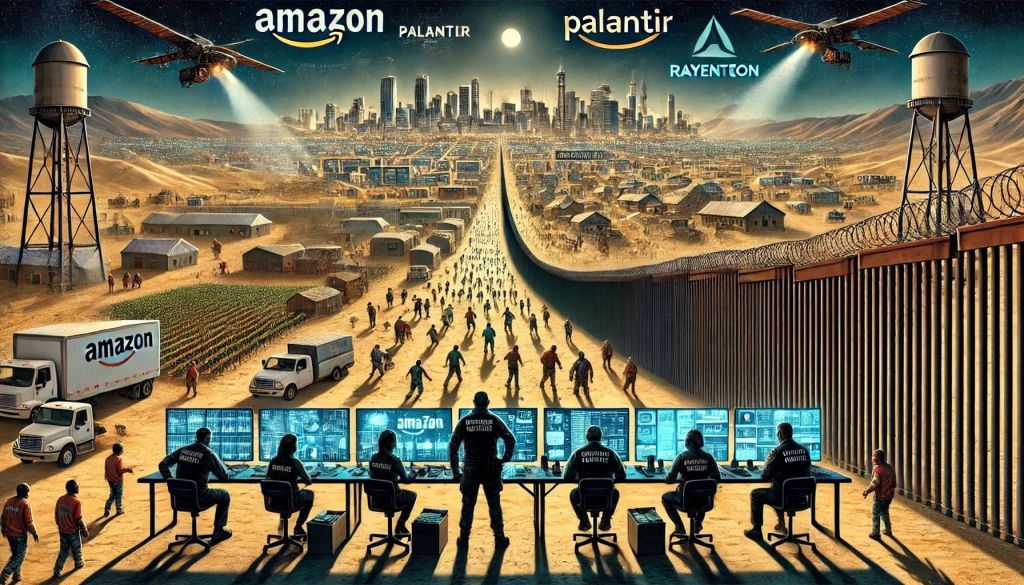
Under technofascism, the border is more than a barrier—it’s a laboratory. The high-tech surveillance systems used to track migrants today will be used to monitor everyone tomorrow. Palantir, Amazon, Raytheon—these corporations are not just building tools for ICE, they’re building the architecture of a totalitarian digital state.
Trump’s mass deportations are not just about punishing migrants—they’re about setting a precedent. Today, it’s undocumented workers. Tomorrow, it’s political dissidents, labor organizers, the poor. The border is the frontline of a new kind of authoritarianism, one where corporate power, state violence, and AI-driven surveillance combine into an all-encompassing system of control.
Mass Deportations: Protecting Stolen Wealth
Let’s talk about money. Migrants send billions of dollars in remittances back to their home countries—over $150 billion in 2022 alone. For the U.S. ruling class, this is a problem. They see it as lost wealth, money that should be circulating within the imperial core, not flowing back to the very nations the U.S. has looted.
Mass deportations serve a dual purpose: they reinforce labor discipline while ensuring that imperialist plunder remains concentrated in Euro-American hands. The Trump regime’s deportation machine isn’t just about border security—it’s about locking down the wealth stolen through centuries of colonialism and ensuring it stays within the empire.
Immigration Control as a Pillar of Technofascism
The border is not just about migration. It is about power—who gets to move, who gets to work, and who gets to live under constant surveillance. Trump’s immigration regime is a test case for a broader transformation in governance, where corporate monopolies and state repression fuse into a seamless system of digital authoritarianism.
Immigration policy in the U.S. has always been a tool of empire, a way to extract labor, suppress wages, and enforce racial hierarchy. But under technofascism, it has become something even more sinister: a mechanism for total control.
The fight against border militarization and mass deportations is not just about defending migrants—it is about resisting the consolidation of an imperial police state that will eventually turn its sights on all of us. The system is built to discipline, exploit, and discard. The question is: how long before the net closes in on the rest?
 Weaponized Information
Leave a comment