
Donald Trump wants the world to believe he’s bringing back the glory days of American industry—factories roaring, workers thriving, and foreign competitors bowing before U.S. economic might. That’s the story, at least. The reality? His tariff and trade barriers aren’t about reviving American manufacturing or protecting workers; they’re about reorganizing global capitalism to serve the interests of an increasingly desperate and authoritarian ruling class.
Protectionism, under Trump, is less about shielding the American economy and more about disciplining it—hammering the working class into submission, forcing U.S. allies into obedience, and ensuring that Big Tech and finance capital stay on top. In classic imperial fashion, this isn’t just about punishing external enemies like China—it’s about keeping supposed friends in check too. The same tariffs slapped on Beijing are also hitting Europe, Japan, and Canada, sending a clear message: loyalty isn’t enough, submission is required.
The Ruling Class Civil War: Yankees, Cowboys, and Digerati in the Age of Protectionism
Trump’s economic nationalism is best understood as an expression of a deeper fracture within the U.S. ruling class, where three factions—the old-money Yankees, the oil-and-gun-toting Cowboys, and the algorithm-worshiping Digerati—are locked in a struggle over how to manage American decline.
For decades, the Yankees—the Wall Street financiers, multinational corporations, and neoliberal technocrats—ran the show. They championed free trade, tore down economic barriers, and used institutions like the IMF and WTO to keep the Global South under control while extracting profits from every corner of the world.
The Cowboys—the oil barons, arms dealers, and industrial magnates of the American heartland—were always more skeptical of globalization, preferring the old-school imperial model: seize resources, crush competitors, and use brute force when necessary. They had been sidelined for years, but with Trump, they’ve found their way back into power, pushing for tariffs, protectionism, and raw economic coercion.
And then there’s the Digerati—the Silicon Valley overlords who don’t just want to rule the economy, they want to rule the future. Unlike the Yankees, who benefited from global free markets, or the Cowboys, who want to fortify American industry, the Digerati are in the business of monopolization. They don’t care about competition; they want absolute control over the digital economy, artificial intelligence, and global data flows.
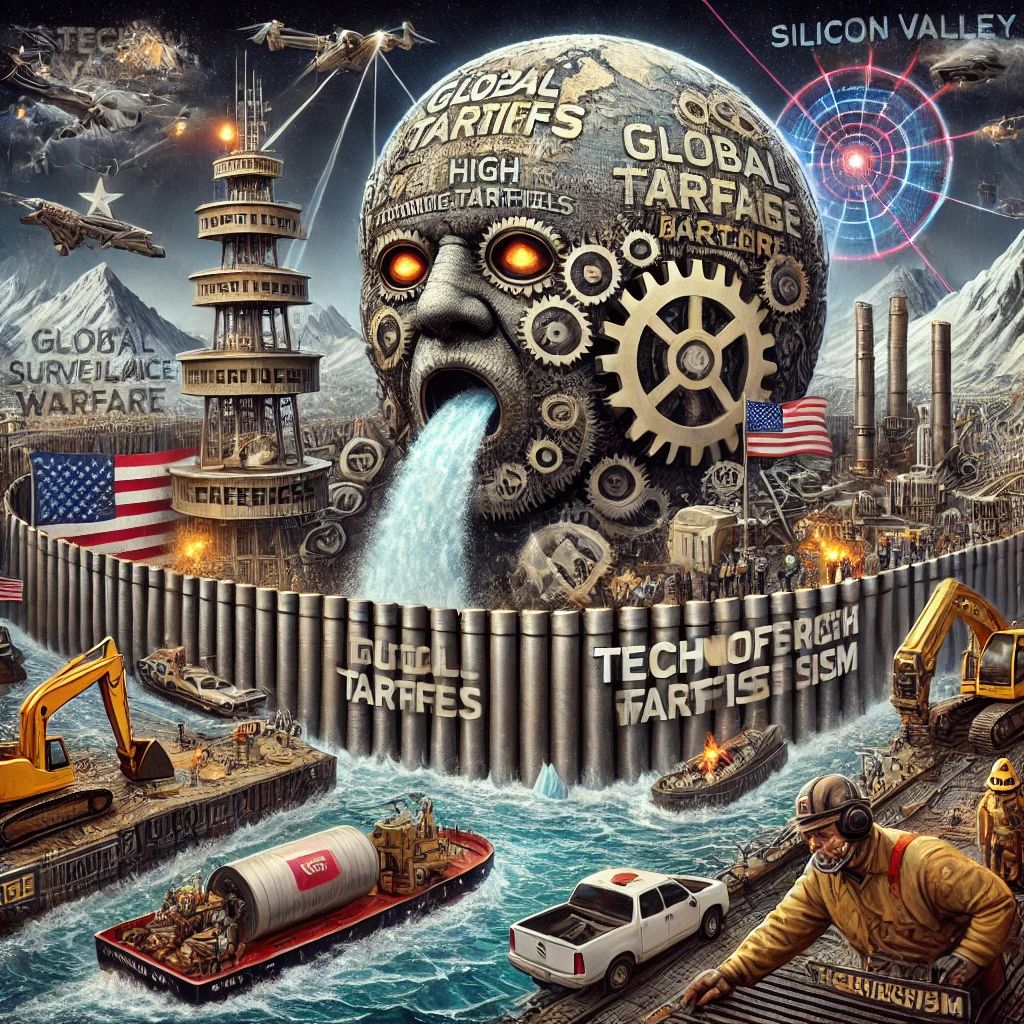
Trump’s tariffs, then, aren’t a return to economic sovereignty—they’re a tool for reorganizing the economy in favor of this emerging technofascist bloc. The working class gets austerity, while Big Tech gets trade barriers that ensure no foreign company can ever challenge their dominance. Protectionism, in this context, isn’t about rebuilding—it’s about entrenching monopoly power and using the state to crush both foreign and domestic threats to corporate supremacy.
Tariffs as a Weapon: Who’s Being Disciplined?
In the golden days of American empire, economic coercion was more subtle. The U.S. would dangle trade deals, loans, and investment as carrots, while keeping the stick of military intervention in reserve. Trump, however, has abandoned all pretense. His tariff war isn’t just targeting adversaries like China—it’s hitting allies with equal ferocity. Germany, France, Canada, Mexico—none are spared. Washington’s message is simple: the U.S. economy is no longer an open system where capital flows freely; it’s a fortress, and entry is conditional on total subordination.
For the Global South, this shift signals the end of an era. Neoliberalism offered at least the illusion of choice—submit to the free market, privatize your industries, and the empire will allow you a slice of the pie. Now, even that fig leaf is gone. Under Trump’s protectionism, trade is a weapon, and the U.S. economy is a gated community where only the most obedient are allowed inside.
Domestically, the tariffs serve another function: keeping the American working class under control. Trump’s brand of economic nationalism sells itself as a defense of American jobs, but in practice, it accelerates their destruction. Higher prices, supply chain disruptions, and corporate consolidation ensure that workers pay the price while Wall Street and Silicon Valley reap the benefits. The goal is clear: a precarious, disciplined labor force that can be squeezed at will, all in the name of “national greatness.”
The Digital Fortress: Protectionism for the Few, Austerity for the Many
One of the most underappreciated aspects of Trump’s economic war is its role in securing Silicon Valley’s dominance. The tariffs on steel, aluminum, and traditional manufacturing are sideshows compared to the real battlefield: technology. The trade war with China isn’t just about protecting American industry—it’s about ensuring that no foreign power can challenge U.S. supremacy in AI, semiconductors, and digital infrastructure.
Trump’s sanctions on Huawei, semiconductor restrictions, and efforts to strangle China’s tech sector aren’t acts of national defense—they’re part of a long-term strategy to guarantee that the world’s digital future remains under U.S. control. And it’s not just China. European tech companies, too, are being hit with tariffs and regulatory threats, because in the new imperial order, only American monopolies are allowed to thrive.
This is the essence of technofascism—protectionism as a tool not of national revival, but of corporate consolidation. The tariffs aren’t about bringing jobs back—they’re about ensuring that only a handful of U.S. corporations dictate the terms of the global economy. Workers get the short end of the stick, while the Digerati cement their stranglehold on the world’s most valuable industries.
Imperialism in Decline: The New Face of Economic War
Trump’s tariffs should not be mistaken for a revival of U.S. economic strength. They are, instead, a symptom of imperial decline—a desperate attempt to hold onto global power as the old methods of control break down. The post-World War II model, in which the U.S. used trade and financial institutions to integrate the world into its economic orbit, is collapsing. In its place, a more brutal, coercive system is emerging—one where economic war replaces diplomacy, and trade barriers replace financial hegemony.
This is what the recalibration of capitalism looks like: the illusion of free trade is being discarded, and the ruling class is embracing raw economic force. The neoliberal mask has slipped, revealing the reality underneath—an empire that can no longer rule through persuasion, only through punishment.
Who Wins, Who Loses?
Trump’s protectionism is not about national revival—it’s about managing imperial collapse. The tariffs serve a dual function: disciplining the working class at home, and punishing both allies and adversaries abroad. The U.S. is no longer interested in maintaining an open economic order—it’s building a fortress, and only the most compliant are allowed inside.
Under technofascism, protectionism is not a strategy for growth, but a weapon of control. The working class gets austerity, the Global South gets economic warfare, and the corporate elite consolidate their grip over the future. The question now is whether resistance—from workers, from the Global South, and from rival powers—can break this emerging system before it fully solidifies. Because if history has taught us anything, it’s that when an empire starts using economic violence against its own allies, it’s already on borrowed time.
 Weaponized Information
Leave a comment