
There is no grand strategy, no master plan, no genius at the helm. The United States’ Middle East policy has never been about “freedom” or “security.” It has always been about one thing: keeping the rest of the world under America’s boot. The slogans change, the presidents come and go, but the core objective remains the same—crush any potential rival before they can challenge U.S. dominance.
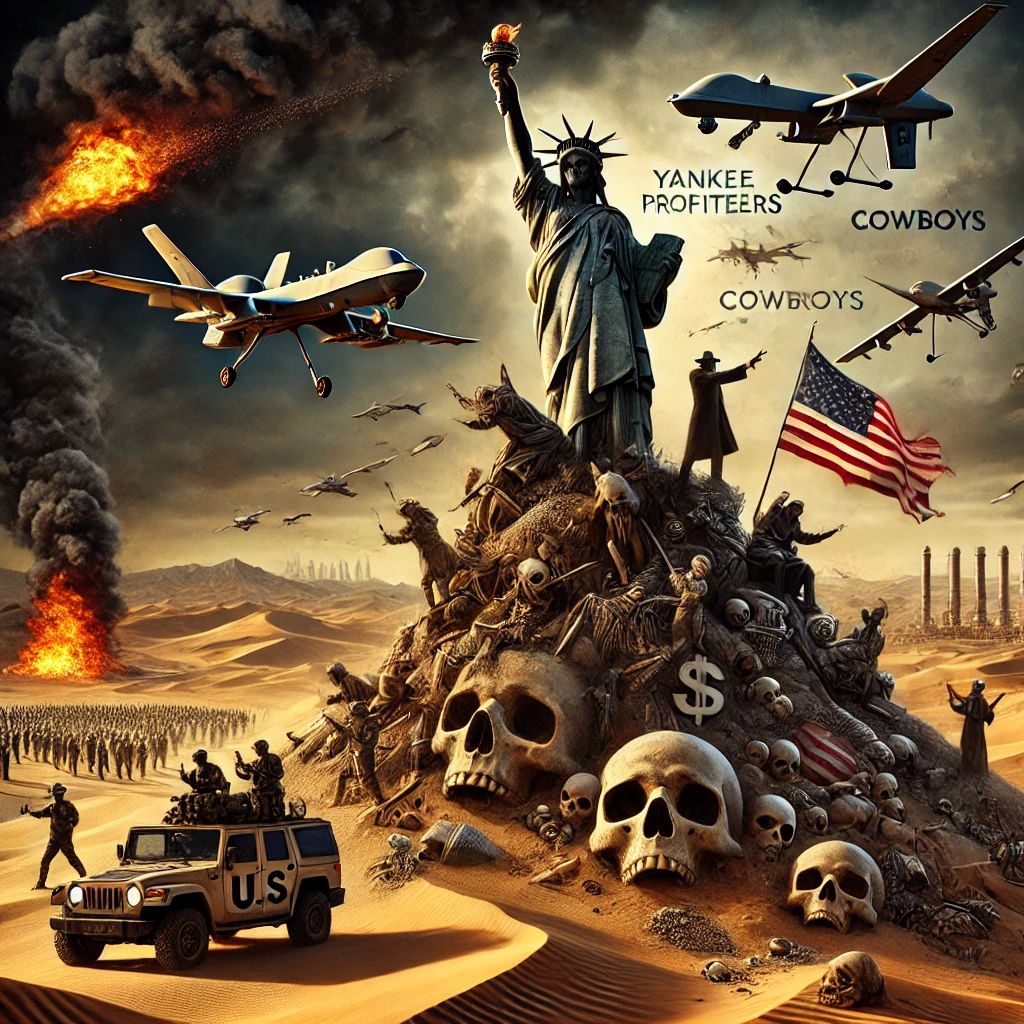
But to understand how Washington rules the Middle East, we have to start at home—because imperial policy isn’t just crafted in war rooms and think tanks. It’s the product of internal class war, of the constant knife fight between the factions that make up the U.S. ruling elite. This is not a monolith. This is an uneasy alliance of gangsters, each with their own racket.
The Yankees—the old-money East Coast financiers, the Wall Street bankers, the State Department aristocracy. Their empire is built on dollar supremacy, economic strangleholds, and financial imperialism. They don’t need to conquer you if they already own your debt.
The Cowboys—Sunbelt oil barons, defense contractors, the war-hungry factions of the military-industrial complex. For them, empire is about brute force—occupations, coups, and pipelines. Their solution to every crisis is a bomb.
The Digerati—the Silicon Valley oligarchy, the AI-finance monopolists, the surveillance-state architects. They are not interested in land or oil. They want control over data, over infrastructure, over the global flow of information. The war of the future is their kind of war—fought with algorithms, financial chokeholds, and AI-powered censorship.
For most of the 20th century, the Yankees and Cowboys fought over imperial strategy. But now, with the U.S. empire staggering under the weight of its own decline, a new system is emerging—a technofascist synthesis where Wall Street, the war machine, and Silicon Valley merge into a single ruling bloc, bound together by one overriding goal: to manage the collapse of U.S. hegemony with as much violence and surveillance as necessary.
And nowhere is this playing out more viciously than in the Middle East
I. How the Yankees Seized the Middle East and Turned It into a Gas Station
In the early days of the American empire, the Yankees were in charge. Their game was financial control, institutional imperialism. They didn’t need boots on the ground when they had coups, bribes, and CIA cutouts.
In 1953, they overthrew Mohammed Mossadegh in Iran, the crime of the century, toppling a democratic government because he had the audacity to nationalize oil. The lesson was clear: any Middle Eastern leader who put his people’s interests ahead of ExxonMobil’s would be removed—or worse, made an example of.
Then came the Carter Doctrine (1980), which formalized U.S. control over the Persian Gulf. It was a declaration of economic hostage-taking—the Yankees would not allow the world to function without American-controlled oil. But this was also where the Cowboys started muscling in. They wanted more than dollar hegemony; they wanted direct domination.
II. The Cowboys Take Over: The War on Terror as a Business Model
The Reagan years saw the Cowboys assert themselves like never before. Their style was covert wars, paramilitary death squads, and jihadist proxies. They armed the Mujahideen in Afghanistan, training the very forces that would later become Al Qaeda. They backed Saddam Hussein in Iraq, then turned on him when he outlived his usefulness. Their doctrine was simple: if a regime was too strong to be bought, it would be bombed.
By 2001, the Cowboys were fully in control. The War on Terror wasn’t a strategy—it was a business plan. Afghanistan, Iraq, Libya, Syria—the Cowboys cashed in at every stage. Weapons sales, oil deals, no-bid contracts—imperialism is the greatest racket in human history. And for a while, it worked.
Then it didn’t.
Iraq was a disaster. Afghanistan collapsed. The war machine was bleeding trillions, and the global balance of power was shifting. By 2008, the Cowboys had lost their grip. The empire needed a new approach—a pivot.
III. Enter the Digerati: The Algorithmic Empire
Obama’s Pivot to Asia (2011) wasn’t just about countering China. It was the moment when the Digerati took the reins of imperial strategy.
Unlike the Cowboys, they didn’t believe in ground invasions or trillion-dollar occupations. Why bother? Why send soldiers when you can send drones? Why seize a country when you can digitally colonize its economy? The new strategy was cyberwarfare, AI-driven financial control, and proxy wars outsourced to jihadists.
Libya was their test case. Instead of a messy invasion, they armed and funded an insurgency, turned the country into a free-market slave market, and walked away. No accountability, no body bags, just regime change by remote control. Syria followed the same model—funnel weapons to fundamentalist militias, let them burn the country down, and call it “democracy.”
But the problem was, the world was changing faster than the empire could adapt.
IV. Trump and the Birth of Technofascism: Imperialism in Freefall
Trump didn’t invent this system. He just put it on steroids. His Middle East policy isn’t about peace or withdrawal. It’s about strangulation.
Instead of endless occupations, Trump focuses on chokepoint control—crippling sanctions, economic blockades, and AI-powered financial warfare.
1. Iran – Cripple them with sanctions, cut off their economy from global markets.
2. Venezuela – Seize their assets, use economic war to starve the government out.
3. China – Ban Huawei, sever their access to advanced chips, try to kill their tech sector.
This is technofascism in action—the fusion of Yankee financial warfare, Cowboy resource extraction, and Digerati digital control into a single system of oppression. But it’s also a sign of weakness. Empires that rule by strangulation are empires in decline.
V. The Contradictions of Collapse
Here’s the problem for the U.S. ruling class: their own contradictions are tearing them apart.
The Cowboys want a new war, but they don’t have the firepower to win one.
The Yankees want to preserve the dollar, but de-dollarization is accelerating.
The Digerati want AI-powered world domination, but China is outpacing them.
So now, all they can do is lash out—more sanctions, more coups, more censorship. The desperate flailing of an empire that can no longer dictate terms.
The Long Goodbye
The Middle East was supposed to be the centerpiece of the American Century—a region controlled by puppet regimes, kept in check by U.S. military bases, feeding oil into the veins of the imperial economy. Instead, it has become the graveyard of American power.
The Yankee-Cowboy-Digerati struggle isn’t just about the Middle East. It’s about the empire itself. The war machine is eating itself alive. And as the contradictions sharpen, the real question isn’t whether U.S. hegemony will collapse.
It’s how much of the world they’ll try to burn down on the way out.
 Weaponized Information
Leave a comment