
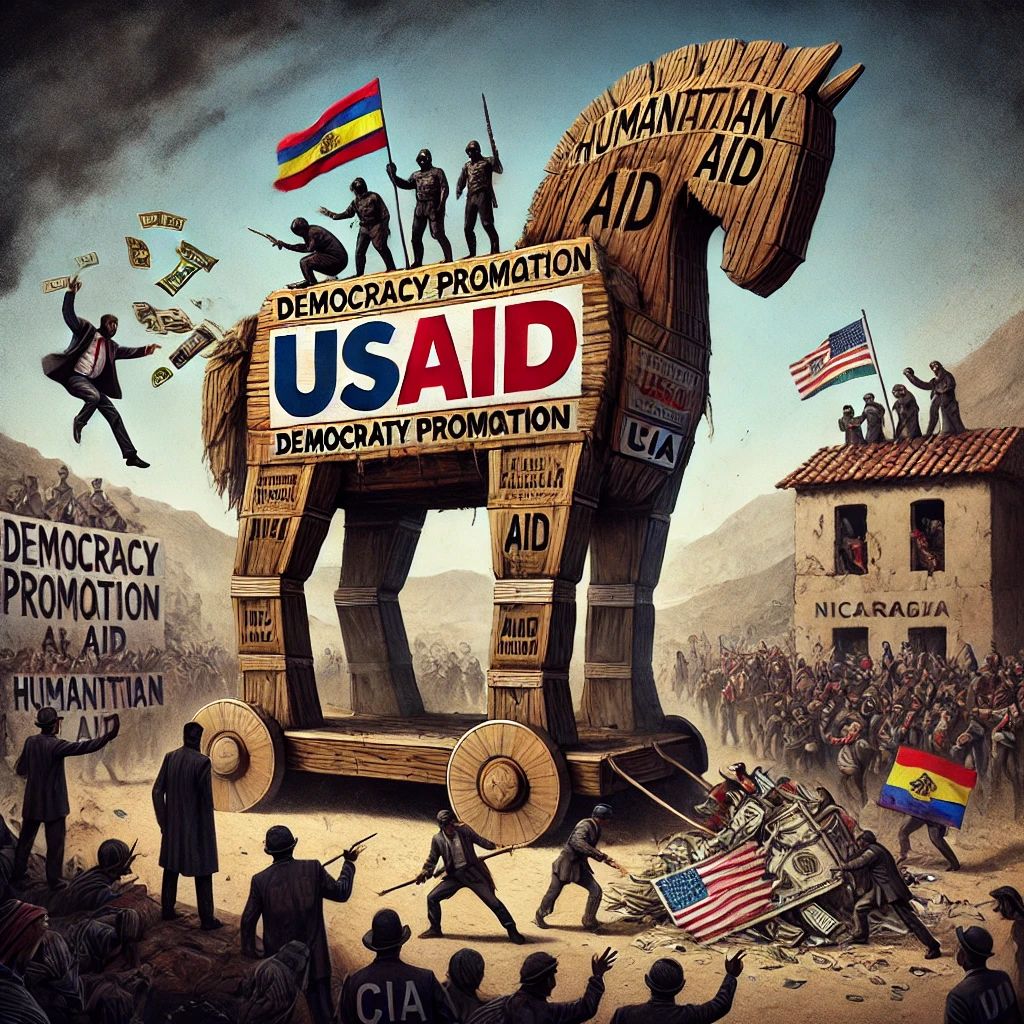
The United States has always cloaked its imperialism in the language of charity. It doesn’t invade; it “liberates.” It doesn’t interfere in sovereign nations; it “promotes democracy.” It doesn’t run an empire; it “leads the free world.” USAID was one of the slickest scams in this repertoire—a well-dressed pickpocket, wrapping its fingers around the throats of Global South nations under the pretext of helping them stand on their own two feet.
For over six decades, USAID was the friendly face of imperialism, an organization that funneled money into regime-change operations while pretending to build schools and hospitals. It was a front—a money-laundering scheme for the CIA, a paymaster for coup plotters, and a slush fund for Wall Street’s vulture capitalists. From Latin America to Africa to Eastern Europe, USAID was a wrecking ball in a three-piece suit, using “development” as a crowbar to pry open nations for American corporate plunder.
Now, Trump has unceremoniously axed it. Not because he opposes U.S. imperialism—far from it. His regime has simply decided that the soft-power approach is too slow, too bureaucratic, and too inefficient for a world in chaos. USAID is being gutted not as an act of mercy, but as an act of war—because the empire no longer has the patience to pretend. The mask is off, and the jackboot is on full display.
USAID: The CIA in a Business Suit
To understand USAID’s role, you have to go back to the early Cold War, when Washington’s imperial managers realized they needed a more sophisticated way to control the Third World. The old model of direct colonial rule had become untenable, and the CIA’s overt dirty tricks were getting exposed too often. Enter USAID: a friendlier, more respectable way to do the same thing.
As former USAID official John Gilligan admitted:
“At one time, many USAID field offices were infiltrated from top to bottom with CIA people… The idea was to plant operatives in every kind of activity we had overseas—government, volunteer, religious, every kind.”
USAID’s job was simple: grease the wheels for U.S. domination. It handed out grants to pro-American “civil society” groups, funded opposition parties, and bankrolled media outlets that parroted Washington’s line. It was a shock absorber for neoliberalism, stepping in to stabilize economies after U.S.-backed policies wrecked them.
Look at the track record:
Chile (1970s): USAID funneled millions to right-wing groups to destabilize Salvador Allende’s government before the U.S. backed Pinochet’s fascist coup.
Cuba (1960s-present): From failed coup plots to funding dissident media, USAID has been a permanent weapon in the war against the Cuban Revolution.
Post-Soviet Eastern Europe (1990s): USAID spearheaded the neoliberal looting of former socialist economies, turning them into playgrounds for Western finance.
Zimbabwe (2000s): After land reforms threatened Western corporate interests, USAID poured money into opposition groups trying to unseat Robert Mugabe.
Everywhere you look, USAID was the same thing: a velvet glove covering the iron fist of imperialism.
Kicked to the Curb: How Venezuela, Bolivia, and Nicaragua Crushed USAID’s Imperial Schemes
USAID didn’t just get expelled from Venezuela, Bolivia, and Nicaragua because it was handing out food or building roads. These governments kicked it out because it was actively working to destabilize them—funding opposition groups, bankrolling coup attempts, and undermining their sovereignty at every turn. USAID wasn’t a helping hand; it was a clenched fist, hiding behind the banner of “democracy promotion” while doing the dirty work of Washington’s regime-change machine.
Venezuela: A Coup Factory Masquerading as Aid
USAID’s role in Venezuela was never about development—it was about overthrowing the Bolivarian Revolution. Since Hugo Chávez came to power in 1999, USAID funneled millions into opposition groups, media outlets, and think tanks dedicated to toppling his government. The agency operated through the Office of Transition Initiatives (OTI), a euphemistic name that barely hides its real purpose: facilitating coups.
2002 Coup Against Chávez: USAID-funded groups played a key role in the failed U.S.-backed coup that briefly removed Chávez from power. The agency pumped money into opposition forces through its subgroups, like the National Endowment for Democracy (NED) and the International Republican Institute (IRI).
Economic Sabotage: USAID funneled money to business elites who organized lockouts in Venezuela’s oil industry, crippling the economy in an attempt to turn public opinion against Chávez.
Funding Street Violence: Throughout the 2010s, USAID bankrolled opposition groups that organized violent street protests known as guarimbas, leading to deaths and destruction in an attempt to destabilize the government.
By 2010, Chávez had had enough. He shut down USAID’s operations, exposing its role in funding right-wing groups trying to turn Venezuela into another puppet state. His successor, Nicolás Maduro, doubled down, cutting off any remaining channels USAID could use to undermine the Bolivarian project.
Bolivia: USAID’s Divide-and-Conquer Strategy Exposed
USAID was central to Washington’s attempts to break Bolivia apart. When Evo Morales, Bolivia’s first Indigenous president, took power in 2006, the agency ramped up efforts to undermine him, particularly by fueling separatist movements in the eastern lowlands, where much of the country’s wealth is concentrated.
Fomenting Secessionist Movements: USAID pumped millions into regional right-wing opposition groups in Santa Cruz, Beni, Pando, and Tarija—Bolivia’s wealthiest regions. These groups pushed for autonomy, hoping to weaken Morales’ government and carve out an elite-controlled separatist state.
Manipulating Indigenous Movements: In a classic imperial tactic, USAID attempted to co-opt and manipulate Indigenous organizations, funding factions that opposed Morales to create divisions within the Indigenous movement.
Supporting Coup Attempts: In 2008, USAID-backed opposition groups launched violent riots in an attempt to overthrow Morales. The plot failed, but it exposed USAID’s role as a key player in U.S. efforts to subvert Bolivia’s government.
By 2013, Morales had seen enough and expelled USAID from Bolivia, calling it out for “manipulating social organizations” and working against Bolivia’s sovereignty.
Nicaragua: USAID’s Role in the 2018 Coup Attempt
Nicaragua had long been in Washington’s crosshairs since the Sandinistas overthrew the U.S.-backed Somoza dictatorship in 1979. USAID played a key role in funding counter-revolutionary forces, first with the Contras in the 1980s, and later with opposition groups trying to unseat Daniel Ortega’s government.
Training and Funding Opposition Media: USAID funneled millions into opposition media outlets and NGOs that worked hand-in-hand with Washington to smear the Sandinista government and stir unrest.
2018 Coup Attempt: USAID was instrumental in bankrolling the violent 2018 coup attempt against Ortega. Under the guise of supporting “civil society,” USAID poured money into opposition groups that launched a campaign of terror—burning government buildings, assassinating Sandinista leaders, and attacking police. The goal was to create chaos, delegitimize Ortega’s government, and pave the way for U.S. intervention.
The ‘Democracy Promotion’ Racket: USAID continued to pour millions into Nicaraguan opposition forces even after the failed coup, trying to keep the destabilization campaign alive.
In 2020, Ortega shut down USAID’s operations in Nicaragua, citing its role in subversion and its direct links to U.S. efforts to overthrow his government.
A Pattern of Subversion—and a Warning to the Global South
The cases of Venezuela, Bolivia, and Nicaragua expose USAID for what it truly is: a weapon of U.S. imperialism. These nations didn’t expel USAID because they were against development—they expelled it because they understood that “aid” from Washington is just a cover for subversion.
This should serve as a warning to all nations resisting U.S. domination: Western NGO’s like USAID don’t bring prosperity; they brings coups. They don’t build democracy; they fund its destruction. And as the empire grows more desperate, its tools of intervention are evolving. The fight against imperialism is far from over, but the expulsion of USAID from these nations proves one thing: the Global South is learning, and the old tricks aren’t working anymore.
Why Trump’s Regime Hates USAID
USAID has been a useful weapon for decades, so why would Trump shut it down? The answer lies in the changing nature of U.S. imperialism and the contradictions within the ruling class.
1. USAID Was the Tool of the Old Yankee Elite
USAID was an artifact of the Cold War, a pet project of the East Coast financial elites who ran the empire through multilateral institutions like the IMF and World Bank. This was the “Yankee” faction—the globalists who believed in patient, long-term economic and institutional control. Their strategy was to infiltrate governments, groom opposition movements, and use economic leverage to bend countries to Washington’s will.
But Trump doesn’t come from that world. His faction—the Cowboys (extractive capitalists, military-industrial hawks) and the Digerati (Silicon Valley oligarchs, techno-authoritarians)—has no interest in slow-burn imperialism. They prefer brute force.
2. The Technofascist Model: From Soft Power to Digital and Financial Warfare
USAID was too slow, too bureaucratic, too dependent on outdated methods of infiltration. In today’s imperial playbook, why bother funding NGOs when you can:
Use AI-driven propaganda to control narratives instantly?
Employ economic sanctions and financial warfare to cripple nations overnight?
Leverage surveillance technology and cyber operations to directly interfere in elections?
Trump’s regime sees USAID as an unnecessary middleman. The new imperial model is more direct—why fund local opposition groups when you can just use sanctions to starve a country into submission? Why pay journalists to spread propaganda when you can manipulate social media algorithms to shape public perception? The new strategy is raw, high-tech coercion.
3. The Militarization of Foreign Policy
USAID was always a hybrid tool—part intelligence front, part development agency. But in Trump’s America, there’s no need for that balancing act anymore. The empire is done pretending to care.
Rather than bankrolling opposition movements through USAID, the U.S. now just arms them directly (see Ukraine). Rather than using aid as leverage, it just imposes brutal sanctions (see Venezuela, Iran, Cuba). The message is clear: if you’re not playing by Washington’s rules, you’ll be cut off, crushed, or invaded.
The End of USAID—and the Future of U.S. Imperialism
Trump’s shutdown of USAID isn’t a retreat—it’s a transformation. The U.S. is shedding the last remnants of its humanitarian mask. In its place, we get the next phase of empire: a digital-financial-military complex that doesn’t even bother with the illusion of “helping” the world.
For the Global South, this means the fight against imperialism is changing. The battlefield is shifting from NGOs and foreign aid programs to cyberwarfare, financial blockades, and AI-driven propaganda. The tactics are evolving, but the objective remains the same: the domination of the world for the benefit of U.S. capital.
But if USAID’s demise shows us anything, it’s that the empire is getting desperate. The tools of soft power are being abandoned because they no longer work. The people of the world are waking up, and the empire is running out of tricks.
The fight is far from over. But one thing is clear: the age of American imperialism wearing a humanitarian disguise is ending. The mask has slipped. Now we see the beast for what it really is.
 Weaponized Information
Leave a comment