
Weaponized Information – This article is Part 2 of a Series on the Trump Regime’s Foreign Policy.
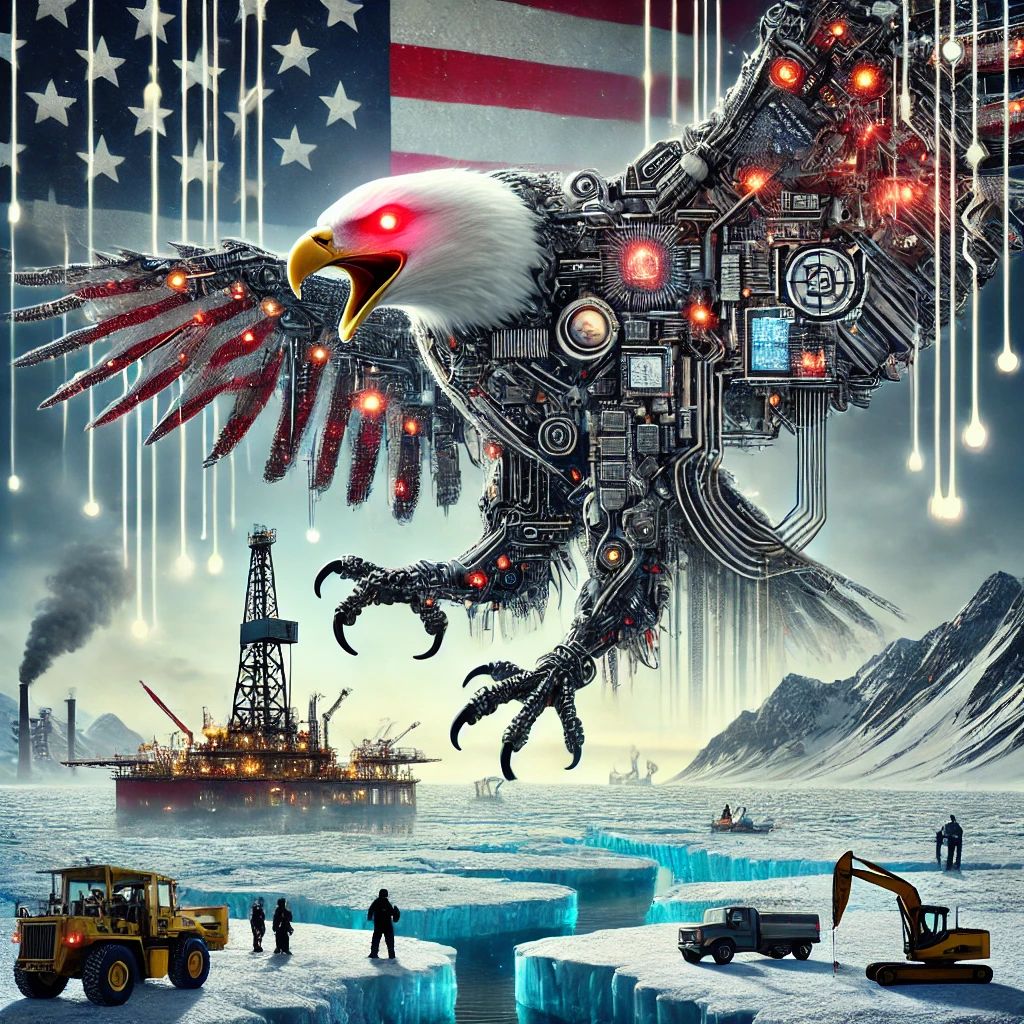
The Arctic is melting, and with it, the last excuses for leaving vast reserves of oil, gas, and minerals untapped. Naturally, the U.S. ruling class, never one to let a crisis go to waste, is scheming to grab a piece of the action. The problem? Unlike Russia, which has an actual Arctic coastline, or China, which has been making strategic moves in the region, the U.S. doesn’t have much of a claim to the frozen north. Trump, with the geopolitical finesse of a real estate developer on a bender, had a simple solution: just take Canada and buy Greenland.
Of course, the idea was met with widespread ridicule—because what kind of madman thinks you can just buy a country? But beneath the absurdity lies a cold imperial calculus. The United States, long accustomed to shaping the world order to its liking, understands that Arctic dominance is key to maintaining hegemony. If it can’t naturally stake a claim, it will have to acquire one—by hook, crook, or the well-worn art of imperial arm-twisting.
The U.S. Empire: Real Estate and Conquest, LLC
Trump’s Arctic gambit isn’t some new aberration. It’s just another chapter in the U.S. tradition of expansion by any means necessary. As Daniel Immerwahr details in How to Hide an Empire, America has always been in the business of grabbing land—whether through outright conquest (the seizure of Indigenous nations, the annexation of half of Mexico), diplomatic fraud (Hawaii), or pseudo-benevolent paternalism (Puerto Rico, Guam, the Philippines). The genius of the U.S. model is that it does all this while insisting that it’s not an empire—just a freedom-loving republic that keeps ending up with other people’s land, resources, and labor under its control.
Trump’s proposal to annex Canada and buy Greenland follows this long tradition, though with his usual lack of subtlety. Unlike his predecessors, who at least bothered with coups, treaties, and corporate-backed skullduggery, Trump seemed to think he could just write a check. But make no mistake—if the U.S. ruling class sees Arctic expansion as necessary for empire, it won’t be abandoned just because Trump made it sound like a bad real estate deal.
Why the Arctic? Follow the Money (and the Missiles)
The Arctic isn’t just a frozen wasteland—it’s a treasure trove of untapped wealth. Scientists estimate it holds about 13% of the world’s undiscovered oil, 30% of its natural gas, and a huge cache of rare earth minerals crucial for modern industry, from semiconductors to military tech. The ice melt, hastened by the same fossil fuel capitalism that created the climate crisis, is turning the Arctic into a geopolitical jackpot.
But it’s not just about resources. The Arctic is also home to emerging trade routes that could challenge Western shipping dominance. The Northern Sea Route, which hugs Russia’s coastline, could cut shipping times between Europe and Asia, giving Moscow and Beijing an alternative to U.S.-controlled chokepoints like the Panama Canal. For Washington, which has spent the last century making sure global trade moves on its terms, this is unacceptable. The solution? Secure its own foothold in the Arctic—by any means necessary.
Trump’s Expansionism: The Cowboys, the Digerati, and the Arctic Gold Rush
This is where Trump’s impulsive land-grab fits into the larger picture of American ruling-class politics. The U.S. empire isn’t a monolith—it’s a contested space where different factions struggle for control. The Cowboys (oil barons, the military-industrial complex, the old-school extractive capitalists) have a clear interest in Arctic expansion. The Digerati (Big Tech, Silicon Valley billionaires, the AI and data barons) see the Arctic as the next frontier for logistics, automation, and surveillance.
Meanwhile, the Yankee establishment—the traditional bureaucrats, financiers, and foreign policy wonks—prefer a more subtle approach. They’d rather maintain imperial dominance through economic coercion and legal maneuvering than outright annexation. Trump, a creature of both Cowboy bravado and Digerati transactionalism, didn’t bother with the finesse. Why play geopolitical chess when you can just bulldoze the board and offer to buy the pieces?
Resistance and Reality: Not Everyone Is for Sale
But while Trump may have thought Canada and Greenland were prime for the taking, reality had other plans. Canada, while deeply enmeshed in the U.S. economic and security structure, still retains enough national identity to resist outright annexation. Greenland, long seeking independence from Denmark, saw Trump’s “offer” as a slap in the face, strengthening local movements that want to sever ties with the West altogether.
Meanwhile, China and Russia have their own Arctic strategies, and they’re not about to let the U.S. waltz in unchallenged. Russia has spent decades building Arctic infrastructure, while China has declared itself a “near-Arctic state” and is investing heavily in the region. Washington’s usual playbook—sanctions, diplomatic pressure, and military posturing—won’t be enough to counter these moves.
Conclusion: The Empire’s Arctic Reckoning
Trump’s proposal to annex Canada and buy Greenland may have been laughed off, but the forces driving it are very real. The Arctic is the last great territorial frontier, and as climate change accelerates, its strategic and economic importance will only grow. The United States, facing the decline of its unipolar dominance, is desperate to secure its share of this frozen goldmine. Whether through territorial annexation, economic coercion, or military expansion, the empire will continue seeking a foothold.
But history has a funny way of ruining imperial dreams. The same arrogance that led Trump to believe he could buy a country is the same arrogance that leads empires to overreach. The Arctic’s fate will not be determined by Washington alone—resistance, both local and global, will shape the outcome. And if history is any guide, empire, no matter how powerful, is never invincible.
 Weaponized Information
Leave a comment