
Weaponized Information – This article is Part 3 of a Series on the Trump Regime’s Foreign Policy.
Empire breathes through its choke points. The U.S. doesn’t rule the world through sheer military dominance anymore—that era ended in the sands of Iraq and the mountains of Afghanistan. Now, it tightens its grip at strategic bottlenecks, using a mix of brute force, economic strangulation, and high-tech surveillance to control the flow of trade, finance, and resistance. But there’s one region where every attempt to tighten the noose has only led to the empire’s hands being bitten—the Middle East.
Unlike the Arctic, where Trump dreams of annexing new territory for resource extraction, or the Panama Canal, where he plans to weaponize trade routes against China and Russia, the Middle East refuses to be choked into submission. This is the graveyard of imperial hubris. Here, every empire has tried and failed to impose order, only to drown in its own blood and oil.
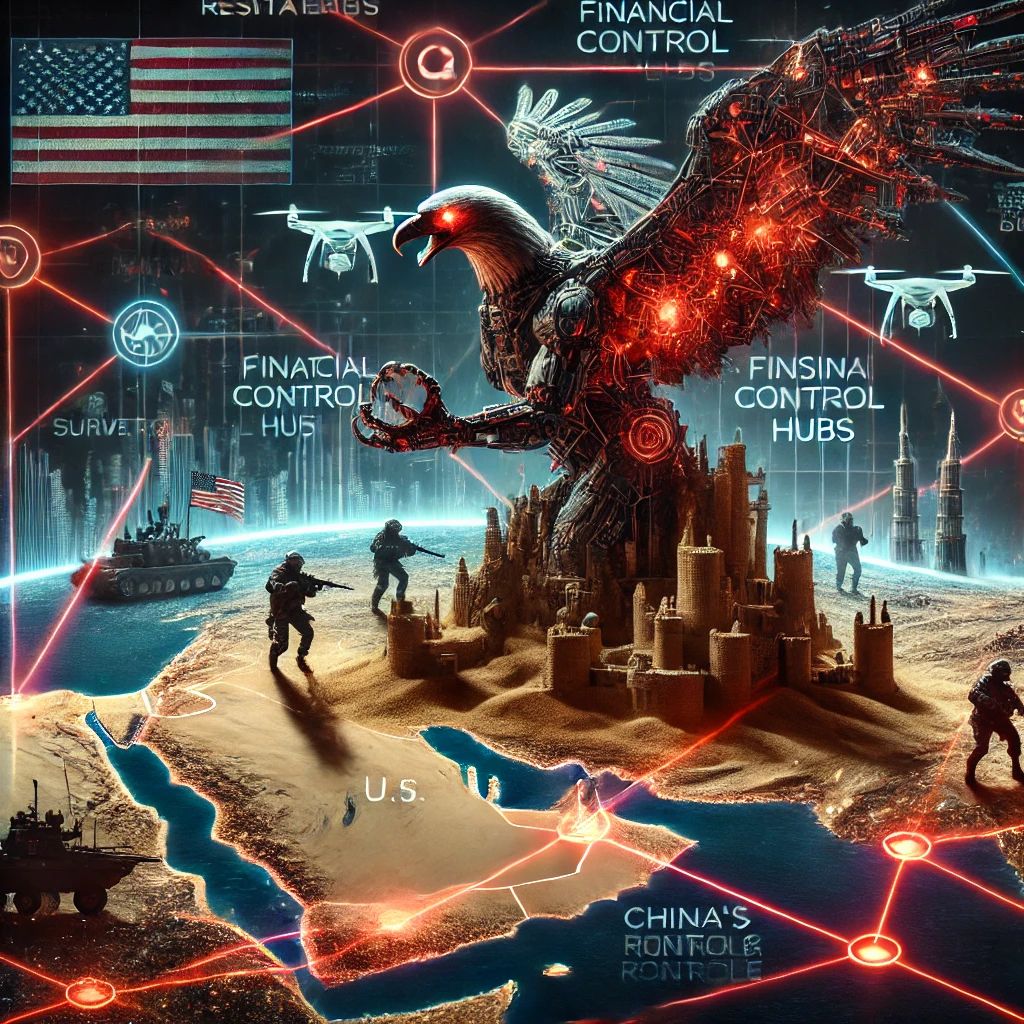
Trump understands this, but like his predecessors, he believes the right mix of brutality and technology will finally break the cycle. His administration’s strategy in the region fuses three key elements of the modern imperial project:
Technofascism – The use of AI-driven surveillance, drone warfare, and financial control as weapons of war.
The Yankee-Cowboy-Digerati Paradigm – A synthesis of Wall Street’s financial muscle, the military-industrial complex’s raw violence, and Silicon Valley’s totalitarian control over information and capital.
The Crisis of Imperialism – The irreversible decline of U.S. hegemony, forcing increasingly desperate and self-destructive measures to maintain control.
The Middle East is the hardest choke point because it contains the empire’s greatest contradictions—the struggle between U.S. settler-colonialism (embodied in Israel), the rise of a multipolar world order (led by Iran, China, and Russia), and the empire’s own inability to win wars anymore. The noose tightens, but the resistance only grows.
I. From Bush’s Cowboys to Trump’s Technofascists: The Evolution of Imperial Chokeholds
The U.S. has been recalibrating its Middle East strategy for decades, moving through three distinct phases as its power wanes:
Phase 1: The Cowboy Era (2001–2009) – Full-Spectrum Military Domination
The neocons believed they could conquer and reshape the Middle East through sheer force. Afghanistan and Iraq were supposed to be stepping stones to Iran, part of a grand strategy to turn the region into a U.S. protectorate.
Instead, they got counterinsurgency hellscapes—perpetual war, an empowered Iran, and a burned-out military.
Phase 2: The Yankee Technocrat Pivot (2009–2017) – Proxy Wars and Economic Siege
Obama’s strategy reflected the Yankee managerial class—smarter, more calculating, but still deeply imperial. The U.S. moved from direct occupation to proxy wars (Syria, Libya) and economic strangulation (Iran sanctions).
The Arab Spring was hijacked and turned into a tool for regime change. Syria was plunged into chaos, but Assad survived, thanks to Iran and Russian intervention.
The JCPOA (Iran nuclear deal) was a temporary retreat, a recognition that the U.S. could not fight everyone at once.
Phase 3: The Digerati-Technofascist Turn (2017–Present) – AI-Driven Warfare and Digital Chokepoints
Trump combines the brute force of the Cowboy right (assassination campaigns, maximum settler violence in Palestine) with the Digerati’s obsession with total information control—financial sanctions backed by AI-driven enforcement, digital blacklists, and precision drone warfare.
The logic is simple: You don’t need to control the entire region if you can suffocate the key arteries—choke Iran economically, bomb Gaza into the Stone Age, cut off Syria from reconstruction, and use Israel as an armed settler outpost to keep the region in permanent crisis.
But here’s the problem: this strategy is failing, just like the others before it. The U.S. is out of tricks, and the multipolar world is learning to live without it.
II. The Three Contradictions of Trump’s Chokepoint Strategy
1. Military Overstretch vs. Asymmetric Resistance
The U.S. can’t invade countries anymore, but it still tries to control them through drone strikes, targeted assassinations, and special forces raids. This is a contradiction—imperial control without imperial occupation.
The assassination of Qassem Soleimani was supposed to break Iran’s regional influence. Instead, it solidified the Axis of Resistance, turning Iran, Hezbollah, and even Iraq’s militias into an even more tightly integrated force.
The total war on Gaza is meant to “solve” the Palestinian problem through sheer extermination, but it has instead triggered a wider regional revolt, from Hezbollah in Lebanon to the Houthis in Yemen.
The empire now exists in a permanent state of crisis management—fighting brushfire wars on multiple fronts with no ability to win decisively.
The U.S. thinks technofascism can compensate for this weakness—AI surveillance, predictive policing, and biometric tracking are being used to pacify Palestinian resistance. But these same tools failed in Afghanistan and are failing again. No amount of software can subdue a people who refuse to be erased.
2. Economic Warfare vs. Multipolar Subversion
Trump’s main playbook is weaponizing the global economy, using the dollar, banking infrastructure, and trade chokepoints as instruments of economic strangulation. But the world is learning to bypass the U.S. financial system:
Iran is integrating into China’s Belt and Road Initiative, creating new trade routes that undermine U.S. control over global finance.
BRICS+ is creating alternatives to SWIFT, reducing the U.S. ability to freeze assets and impose financial blockades.
Trump’s economic chokepoints are crumbling, and the harder the U.S. squeezes, the faster the world moves to de-dollarization.
3. Settler-Colonial “Stability” vs. Imperial Fragility
Israel has always been the U.S.’s forward operating base in the Middle East, a settler-colonial project designed to stabilize imperial rule. But the truth is, Israel has become a liability—a rogue client state whose actions are accelerating the unraveling of U.S. hegemony.
The Gaza genocide is not a show of strength—it is an act of settler-colonial panic, a desperate attempt to erase the Palestinian question through mass murder.
The unstoppable return of Gazans to a pile of rubble is not a reconstruction effort—it is a strategy of perpetual imprisonment under digital surveillance.
Just today, President Trump announced his belief and desire that the entire population of Gaza be completely resettled through forced migration into a neighboring Arab nation. It appears that Trump, ever the real estate mogul, wants to redevelop Gaza without the inconvenience of the Gazan people. These moves only make the United States and Israel more isolated on the world stage.
Instead of securing U.S. control, Israel’s excesses are radicalizing the entire region, forcing Washington into a permanent cycle of military intervention to cover for Tel Aviv’s crimes.
The contradiction is clear: The U.S. needs Israel to be a stabilizing force, but it is now the biggest source of instability, pulling the empire deeper into conflicts it can’t win.
The Noose Tightens, But the Empire Chokes Itself
Trump’s Middle East strategy is not about winning—it’s about buying time before the empire collapses further. The technofascist model—AI-driven warfare, digital economic strangulation, settler-colonial mass slaughter—isn’t a strategy for hegemony. It’s a strategy for managing imperial decline.
But here’s the reality: the harder the U.S. chokes the Middle East, the more it strangles itself. Iran, Hezbollah, and Hamas are more resilient than ever. China and Russia are building the infrastructure of the post-American world. The empire is dying in slow motion, and the whole world is watching.
 Weaponized Information
Leave a comment