
Weaponized Information – This article is Part 1 of a Series on the Trump Regime’s Foreign Policy.
For an empire in decline, nostalgia can be a dangerous thing. The United States, once the undisputed master of global trade and finance, now finds itself fumbling for ways to maintain relevance in a world that is—rather rudely—moving on. And like all aging hegemons who refuse to accept reality, the U.S. is turning to what it knows best: brute force, economic blackmail, and the fantasy that if it just grips the steering wheel a little tighter, it can still drive the global economy off a cliff.
Enter Donald Trump, a man who seems to believe that history began when he was born and that American greatness can be restored by simply repossessing old imperial trophies. Among his latest obsessions: the Panama Canal.
Now, for those who don’t recall, the U.S. built the canal after helping Panama “gain independence” from Colombia in 1903—a process that involved the usual hallmarks of American diplomacy: gunboats, bribes, and the enthusiastic rejection of Latin American sovereignty. The canal was run as a de facto U.S. colony until 1999, when, in a rare moment of adherence to international agreements, the U.S. handed it over to Panama.
But according to Trump, this was a mistake—a grand betrayal, another example of weak American leadership. Why? Because China, of course.
The New Imperial Playbook: Controlling Chokepoints, Not Countries
Trump’s rhetoric around the canal is not just the standard chest-thumping nationalism that plays well with his base. It reflects a broader shift in U.S. imperial strategy: as full-spectrum dominance becomes impossible, Washington is recalibrating empire around key logistical chokepoints.
The problem facing U.S. policymakers is clear: sanctions don’t work like they used to. China, Russia, and a growing number of Global South nations have found ways to circumvent Washington’s economic punishments—through alternative financial networks, direct trade agreements, and sheer defiance. The U.S. can blacklist Venezuela, Cuba, and Nicaragua all it wants, but as long as Chinese and Russian goods can move freely through the hemisphere, sanctions remain more of a nuisance than a death sentence.
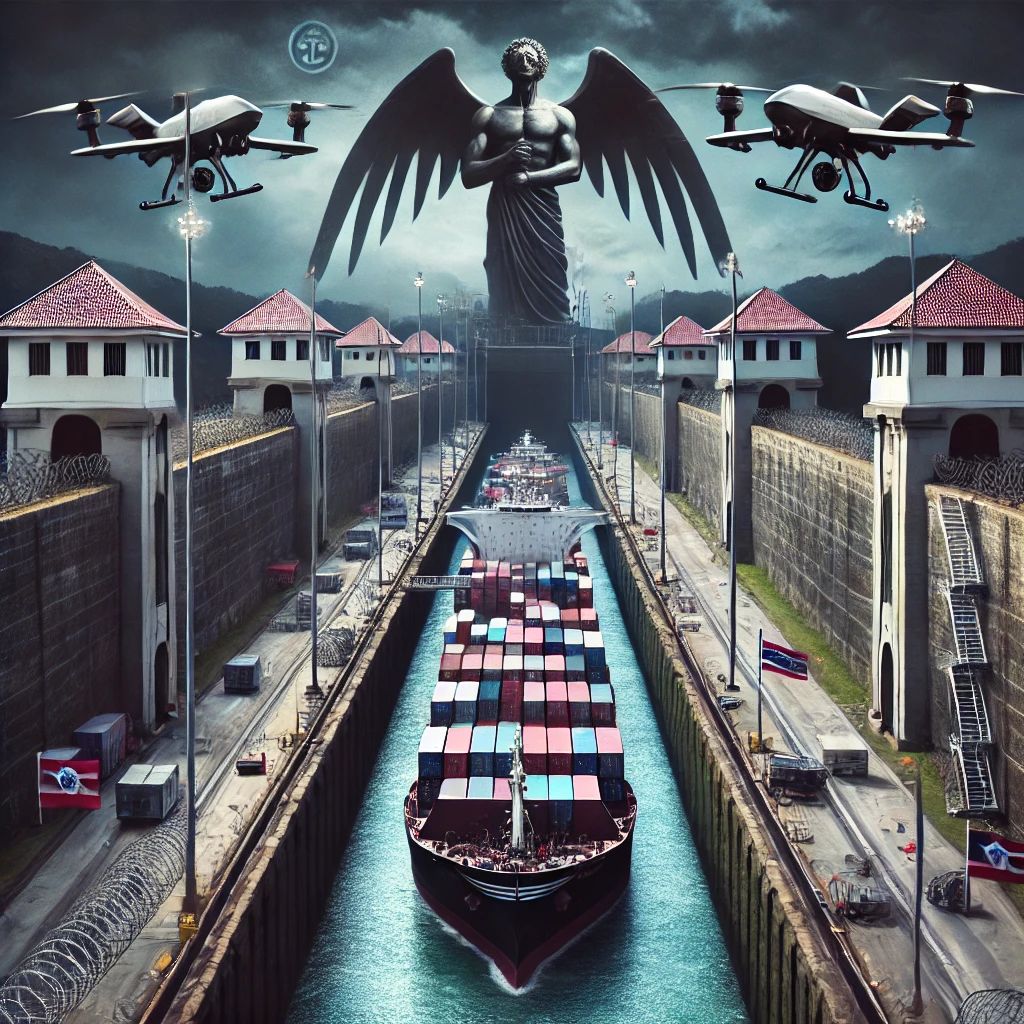
And this is where the Panama Canal comes in. If the U.S. could regain control, it could do what its financial tools increasingly fail to do: physically obstruct trade. The canal would become a disciplinary tool, a way to punish defiant nations by disrupting their supply chains.
Under this model:
China’s growing economic ties in Latin America could be sabotaged. If Washington doesn’t like a deal between China and Brazil, it could simply delay Chinese shipments. Logistics, after all, is the art of making someone’s life just difficult enough to reconsider their choices.
Russia’s ability to support allies like Venezuela and Nicaragua could be choked off. Forget sanctions—just make sure their shipments get mysteriously “lost” in transit.
Regional governments would face a choice: fall in line with Washington or risk economic strangulation. Sovereignty is a wonderful idea, but only when the empire allows it.
This is not a return to old-fashioned imperial conquest. There are no U.S. Marines storming Panama City (yet). Instead, this is logistical imperialism—controlling the lifelines of global trade, so that even in decline, the U.S. remains the gatekeeper of economic survival.
The Problem With Imperial Nostalgia
The irony, of course, is that Trump’s vision of American power isn’t just reactionary—it’s outdated. The U.S. isn’t the only game in town anymore. China, Russia, and even middle powers like Brazil and India are building alternative networks, bypassing traditional U.S. choke points.
And Panama itself? It has little interest in becoming an American protectorate again. The canal generates billions for the Panamanian economy, and the last thing its government wants is another round of U.S. occupation—whether military or economic. Trump’s vision assumes that history stopped in 1950 and that all it takes to restore U.S. dominance is a few executive orders and a sufficiently aggressive posture.
Unfortunately for him (and the empire he represents), history is moving forward, with or without the United States. And for Washington, the real danger isn’t losing control over the Panama Canal—it’s losing the illusion that it was ever entitled to it in the first place.
 Weaponized Information
Leave a comment