
The United States, ever the benevolent custodian of global “free markets,” has spent the past two decades flailing against the inevitable: its Big Tech monopolies have lost their grip. The once-unshakable empire of Silicon Valley—the cowboy capitalists in their Patagonia vests, the Yankee financiers keeping the venture capital spigots open, and the digerati priesthood coding their way to world domination—has found itself staring into the abyss of its own making.
The goal of Washington’s tech war against China was simple enough: stall China’s rise, preserve U.S. digital hegemony, and, most importantly, sabotage the example of an alternative development model that integrates state-led planning with technological innovation. But, as history so often shows, when an empire starts playing with economic warfare, it tends to burn its own house down.
1. America’s Brilliant Plan to Kneecap China—And How It Backfired
The United States, in a fit of imperial hubris, decided that the best way to maintain its dominance was to cripple China’s tech industry. Washington’s strategists—those same visionaries who turned Afghanistan into a 20-year money pit—convinced themselves that by cutting off China’s access to semiconductors, AI models, and advanced chip-making equipment, they could halt its progress.
The reality? China adapted, innovated, and left the U.S. in the dust.
The much-hyped Huawei ban? It forced China to develop its own 7nm chips without American technology. Now Huawei is back, and stronger than before.
The semiconductor blockade? China ramped up its domestic chip production, bypassing U.S. suppliers and investing in homegrown alternatives.
The AI war? While the U.S. obsessed over content moderation and the political correctness of its chatbots, China was busy building AI models like DeepSeek that actually work.
If anything, the trade war accelerated China’s rise. The U.S., in its quest to keep China permanently dependent on Western supply chains, ended up giving Beijing the strongest incentive imaginable to achieve technological sovereignty.
2. The Self-Destruction of Silicon Valley’s Tech Monopoly
As China was busy securing its digital future, Silicon Valley was busy strangling itself with a different kind of rope: monopoly capitalism.
Let’s take stock of the U.S. tech sector:
Google and Microsoft are locked in a cage match over AI, neither of them innovating so much as desperately trying to out-monetize each other’s half-baked chatbots.
Apple, once the darling of American ingenuity, is now little more than a glorified luxury brand that slaps a fresh coat of paint on last year’s iPhone and calls it “revolutionary.”
Meta, the poster child of American tech excess, is busy sinking billions into a metaverse no one asked for while hemorrhaging talent to more promising industries.
And then, there’s the technofascist trifecta—the unholy alliance of Big Tech, Big Banks, and Big Brother—trying to consolidate control over the digital economy even as its foundation crumbles. The U.S. is no longer exporting innovation; it’s exporting financialized digital feudalism, where a handful of monopolists control the infrastructure of modern life while convincing the public that they’re “disruptors.”
In the meantime, China has been methodically building an alternative system—one that does not depend on speculative finance or Silicon Valley’s corporate overlords, but on state planning, industrial policy, and long-term strategic investment.
3. Socialism with High-Tech Characteristics: The China Model
Here’s the part that keeps Washington’s foreign policy wonks awake at night: China isn’t just catching up—it’s offering a better model. One that integrates technological innovation with an actual vision for the future.
While the U.S. treats AI as a way to sell more ads and replace human workers, China treats AI as a tool for:
Public infrastructure: AI-driven traffic management systems, AI-powered healthcare diagnostics, and industrial automation that actually improves efficiency rather than just increasing shareholder value.
Sustainability: China leads the world in green tech—not as a branding exercise, but as a core industrial strategy. The U.S., meanwhile, still lets Exxon and Chevron dictate climate policy.
National sovereignty: China is ensuring that its AI, semiconductor, and telecom industries aren’t reliant on the whims of U.S. trade sanctions. The U.S., by contrast, is too busy handing over control of its digital economy to a handful of billionaires.
This is why the U.S. doesn’t just want to “compete” with China—it wants to destroy the credibility of the Chinese model altogether. The greatest threat China poses to the U.S. isn’t military—it’s ideological. The mere fact that a state-led model can produce better economic outcomes than Wall Street’s casino capitalism is an unthinkable heresy to the free-market evangelists in Washington.
4. The Global South Picks a Side
Here’s another harsh reality for Washington: most of the world isn’t buying the U.S. narrative anymore.
When the U.S. tried to force its allies to ditch Huawei’s 5G, most of the Global South ignored them.
When the U.S. tried to block China’s access to semiconductor markets, Taiwan’s own chipmakers started hedging their bets, realizing that a full-on decoupling from China would be suicidal.
When the U.S. tried to sanction China’s AI firms, countries across Africa, Latin America, and Southeast Asia deepened their partnerships with Beijing instead.
For decades, Washington assumed that economic coercion would always work. But as the U.S. loses its grip on global trade, its economic sanctions are beginning to look more like temper tantrums than effective policy.
The Empire’s Last Gasp
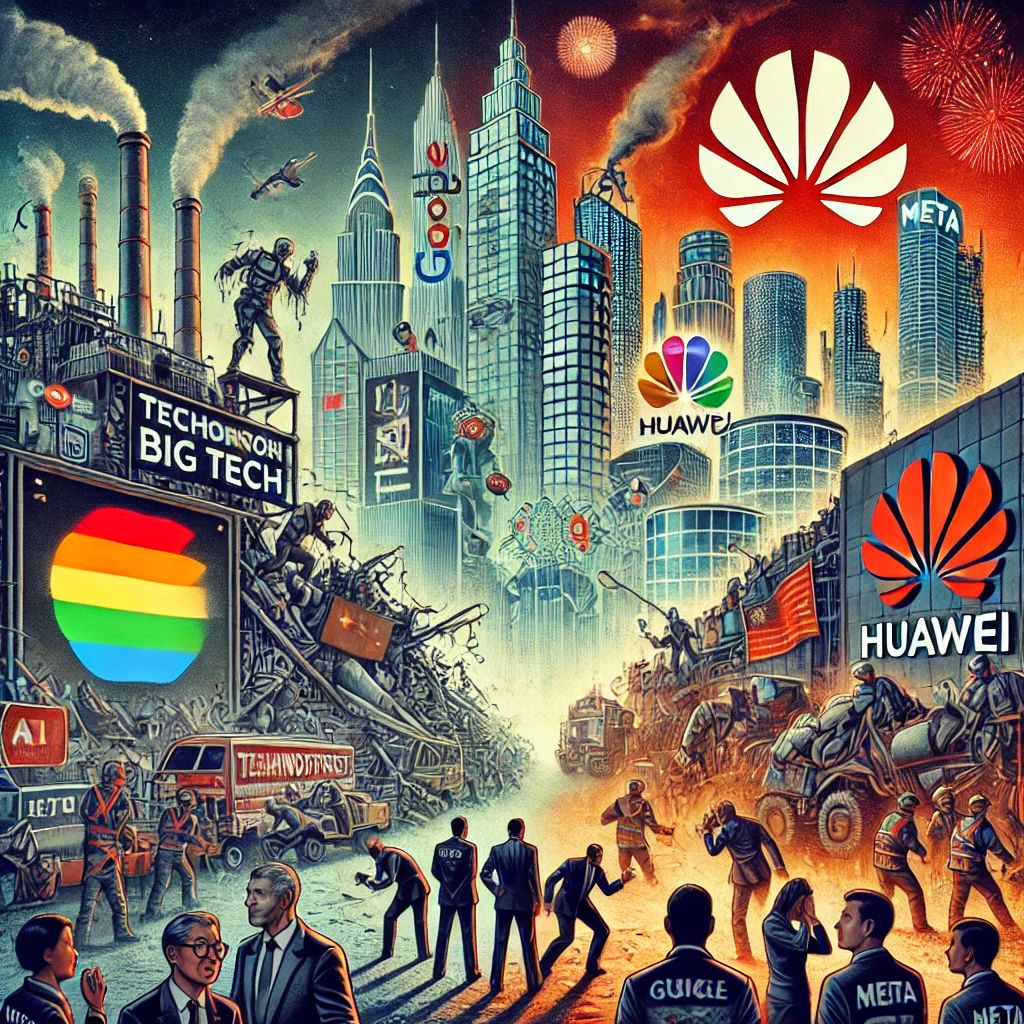
The U.S. tech monopoly is finished. What was once a hegemonic force of economic coercion has become a protectionist mess, more concerned with stifling competition than fostering innovation.
China, by contrast, is moving forward—developing AI, expanding its semiconductor industry, and leading the global transition toward a more sustainable, state-directed technological future.
The U.S. technofascist elite—the cowboy venture capitalists, the Yankee financiers, and the digerati ideologues—bet everything on their ability to strangle China’s rise. Instead, they handed China the ultimate incentive to build a fully independent, globally dominant tech ecosystem.
The end result? A world where the U.S. tech industry is mired in self-imposed stagnation, while China is setting the course for the 21st century’s technological revolution.
 Weaponized Information
Leave a comment