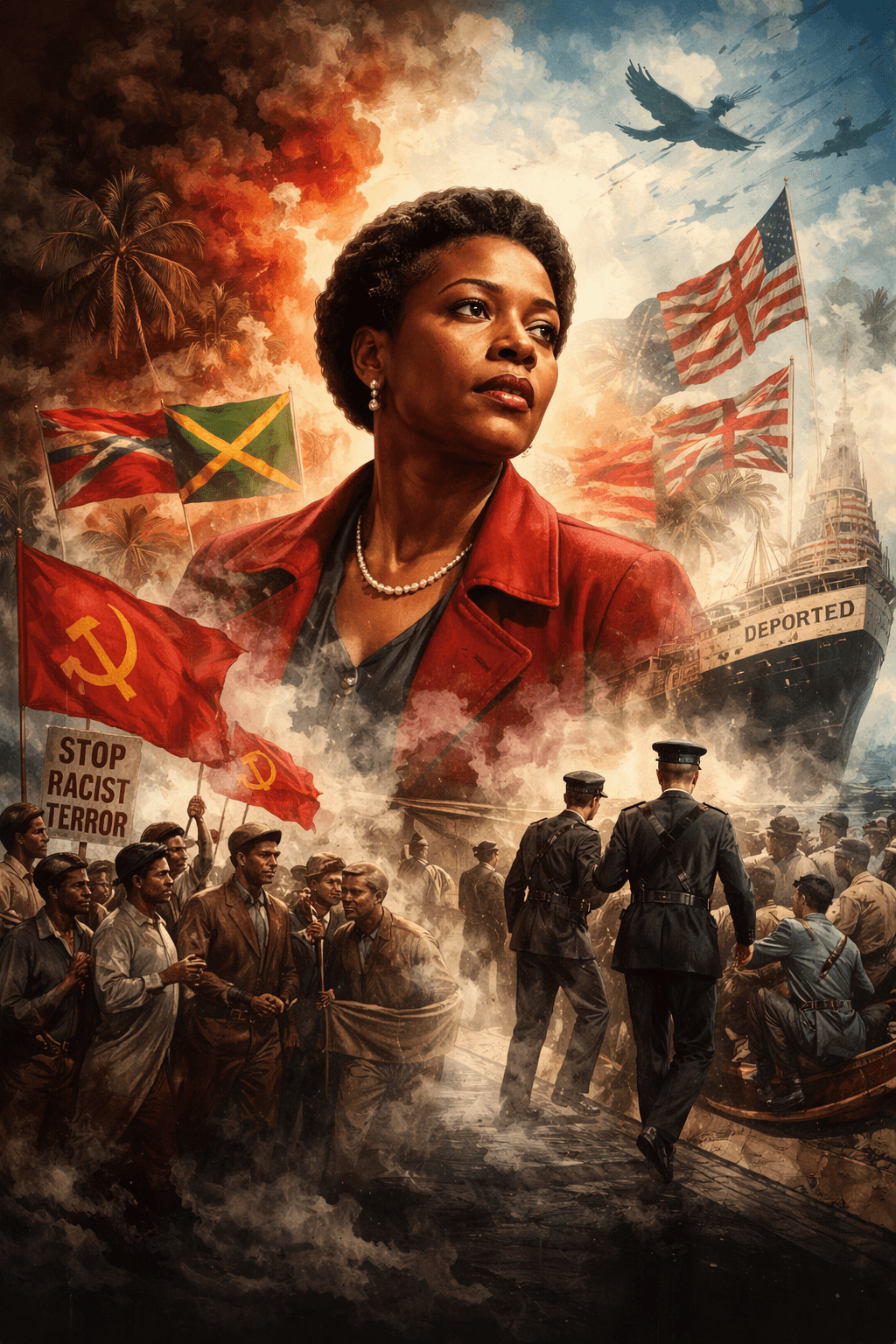
The daughter of Caribbean labor radicalism enters the furnace of U.S. racial capitalism. The Communist Party becomes a battlefield over race, class, and the super-exploitation of Black women. McCarthyism criminalizes Black internationalism and deports a revolutionary. Exile in Britain transforms repression into new insurgent possibility.
By Prince Kapone | Weaponized Information | Black History Matters Series | Weaponized Information | February 13, 2026
I. When Empire Meets a Black Woman With a Theory
Claudia Jones does not fit comfortably inside the museum of “firsts,” nor inside the polite liberal script that turns Black revolutionaries into motivational posters. The empire tried to file her away as an immigrant troublemaker, a communist agitator, a woman who spoke too sharply and organized too well. But Jones was something far more threatening than any of those labels: she was a strategist of liberation who treated race, gender, and class not as separate “issues,” but as the interlocking machinery of imperial capitalism. She refused the comforting lie that oppression is accidental. She insisted it is engineered.
That insistence matters because the ruling order survives by keeping our analyses fragmented. It will gladly allow “diversity” in the workplace, so long as the workplace remains a plantation with better lighting. It will celebrate Black history as long as it is drained of politics, and celebrate women’s history as long as it is drained of class. Claudia Jones shattered that arrangement. She wrote and organized from the standpoint of the people who carry the heaviest load and receive the smallest wage — and she argued, with the cold clarity of a materialist, that this was not marginal. It was central. Not charity. Not symbolism. Power.
Her life is a map of what happens when a Black woman refuses to be managed. She becomes a communist cadre in the United States at precisely the moment the state begins to treat anti-imperialism as a criminal category. She fights inside organizations that, like much of the left, sometimes needed to be dragged toward the truth with both hands: that the struggle of Black people — and especially Black working women — is not a “special question,” not a side campaign to be handled after the “real” battle. It is one of the decisive fronts where the whole system reproduces itself. And when the U.S. state finally decides it cannot cage her with intimidation, it reaches for another weapon: deportation — counterinsurgency in administrative clothing.
But the story does not end with removal. Empire has always imagined that distance equals defeat: break the network, isolate the organizer, and the contradiction dissolves. Claudia Jones made a mockery of that assumption. Pushed out of the United States, she carried her line into the heart of the British metropole, into the Caribbean and African diaspora working-class neighborhoods of London, where racism wore a policeman’s uniform and exploitation hid behind “respectability.” There, she did what revolutionaries do when the conditions are hostile: she built infrastructure — press, organization, solidarity, community defense — and helped transform culture itself into a mass assertion of life against a system designed to ration dignity.
This is the Claudia Jones we have to recover: not the sanitized symbol, but the living weapon. Her legacy forces a question that the white left and the liberal establishment would rather avoid without ever naming them as our center of gravity: if a Black communist woman could see that the system is one structure with many faces, why do so many who claim to oppose capitalism still treat the colonial contradiction as an afterthought? Jones did not have the luxury of such abstraction. She lived where the system shows its teeth. And because she was precise about what she saw, the state recognized her correctly — as an enemy.
II. Born in the Caribbean, Formed in the Belly of the Beast
Claudia Jones was born Claudia Vera Cumberbatch in 1915 in Trinidad, then a British colony stitched into the imperial economy as a site of extraction and discipline. Sugar plantations, colonial administration, racial hierarchy — this was the architecture of her first world. When her family migrated to Harlem in the 1920s, they were not “seeking opportunity” in some abstract sense. They were moving along the circuits of empire, from one node of colonial exploitation to another. The metropole feeds on the periphery and then imports its labor. That was the material background of her childhood.
Harlem during the Depression was not the romanticized renaissance of coffeehouses and poetry readings; it was overcrowded tenements, precarious work, tuberculosis, and police surveillance. Jones’s mother died when Claudia was still a teenager, worn down by the brutal arithmetic of poverty. Claudia herself battled illness for much of her life. The state did not protect this family. The market did not reward their labor. The school system did not prepare them for power. These were not personal misfortunes. They were structural outcomes.
In this environment, politics was not an extracurricular hobby; it was survival. The Great Depression made visible what polite society tries to conceal: capitalism does not malfunction when it produces misery; it functions exactly as designed. It is no accident that Harlem in the 1930s became fertile ground for radical thought — Garveyism, socialism, communism, labor militancy. Young Claudia absorbed this ferment. She read. She listened. She observed how unemployment and hunger were distributed along racial lines with mechanical precision.
By the mid-1930s, she joined the Young Communist League and soon the Communist Party USA. This decision is often narrated as ideological conversion, as if she were seduced by foreign doctrine. That framing misses the point. For a young Black working-class woman in Harlem, communism did not appear as an imported abstraction; it appeared as one of the few organized forces naming racism as structural and linking it to the global crisis of capitalism. The party was not flawless — no organization operating inside empire ever is — but it offered analysis and collective discipline in a moment when liberal reform seemed painfully insufficient.
Jones quickly distinguished herself not as a mere follower but as a theoretician in motion. She wrote for party publications, organized among youth and women, and sharpened her understanding of how race, class, and gender intersected not in theory alone but in the lived experience of Black communities. Her early writings show a mind already refusing fragmentation. She saw that Black workers were super-exploited, that Black women bore a triple burden, and that imperialism abroad reinforced racial domination at home. The logic was not rhetorical. It was empirical.
What is important here is continuity. The girl who watched her family strained by colonial poverty becomes the young organizer who recognizes that migration did not end empire — it relocated it. Harlem was not separate from Trinidad. The plantation logic had simply modernized. And so her political formation did not arise from sentiment but from synthesis: colonial birth, metropolitan exploitation, Depression-era collapse, and exposure to internationalist currents. The conditions educated her as surely as any classroom.
III. Naming the Triple Oppression: Black Women at the Center of the Struggle
By the 1940s, Claudia Jones was no longer simply a committed cadre; she was becoming one of the sharpest Marxist minds grappling with the specific condition of Black women in the United States. Where many on the white left treated race as secondary and many nationalist currents treated gender as incidental, Jones insisted that neither shortcut would survive contact with reality. In her landmark 1949 essay, often remembered by the phrase “An End to the Neglect of the Problems of the Negro Woman,” she articulated what she described as the “super-exploitation” and “triple oppression” of Black women — as workers, as Black people, and as women. This was not rhetorical layering. It was structural analysis.
She argued that Black women occupied a decisive position in the working class because they were concentrated in the lowest-paid sectors, particularly domestic labor and service work, and were subjected to both racial terror and patriarchal subordination. To ignore their condition, she warned, was not merely a moral failure; it was a strategic one. A movement that marginalizes the most oppressed will reproduce the hierarchies it claims to oppose. In that sense, Jones was not adding an “identity” category to Marxism. She was deepening its materialist method.
The timing of this intervention matters. Postwar America was reorganizing itself as global hegemon, presenting liberal democracy as the antidote to fascism and communism alike. Yet at home, segregation, police violence, and economic apartheid remained intact. Abroad, the United States moved aggressively to secure markets and suppress decolonization. Jones connected these terrains. She saw that the degradation of Black women workers in Harlem was tied to a world system that relied on cheap labor and racial division. The empire abroad required racial order at home.
It is here that her theoretical originality becomes unmistakable. Long before the vocabulary of “intersectionality” entered academic fashion, Jones was mapping how multiple structures of domination converge materially. She rejected any sentimental celebration of Black womanhood divorced from class struggle, just as she rejected any class analysis that treated race and gender as distractions. The Black woman worker, she argued, stood at a crossroads of exploitation — and therefore at a strategic crossroads of resistance.
This was not comfortable reading for many in the Communist Party, where white male leadership often reproduced the very blind spots Jones criticized. Nor was it easily absorbed by male-dominated nationalist circles. But Jones did not write for comfort. She wrote to sharpen. She insisted that if socialism was to mean anything in the United States, it had to grapple concretely with the specificities of Black life, and especially with the conditions of Black women whose labor sustained families and movements alike.
In placing Black women at the analytical center, Jones shifted the terrain. She demonstrated that the fight against racism could not be separated from the fight against capitalism, and that neither could be separated from the fight against patriarchy. The movement, she implied, would either be reconstructed from its most oppressed foundations or it would remain stunted. That insistence — uncompromising, grounded, dialectical — would follow her into the next phase of confrontation with the American state.
IV. McCarthyism, Smith Act, and the Criminalization of Thought
By the early 1950s, Claudia Jones was no longer simply a theorist inside a party; she had become a target inside a state apparatus recalibrating itself for global empire. The Cold War was not only a geopolitical contest abroad. It was a domestic purge. Under the Smith Act, the United States government criminalized membership in organizations deemed subversive. In practice, this meant that communists — particularly Black communists who linked racism to imperialism — were placed under surveillance, indicted, and imprisoned. The crime was not violence. The crime was analysis.
Jones was arrested in 1951 along with other Communist Party leaders. The charges alleged conspiracy to teach and advocate the overthrow of the government. No armed uprising existed. No operational plot was presented. What the prosecution offered instead were speeches, articles, and theoretical texts — including the kind of Marxist writing that had made Jones a respected figure among Black workers and international comrades. In other words, the state moved not against an act, but against an ideology.
Her trial unfolded in the shadow of hysteria. The press painted communists as foreign agents; the courts treated dissent as treason. Jones defended herself not as an abstract citizen but as a Black woman whose commitment to socialism arose from lived experience of exploitation and racial terror. She did not deny her political convictions. She insisted on them. In 1955, she was sentenced to prison and served time at Alderson Federal Reformatory for Women — the same institution that held other women deemed politically dangerous.
Here the dialectic becomes sharp. The United States claimed to be the global defender of freedom against totalitarianism, yet it imprisoned a Caribbean-born Black intellectual for arguing that capitalism and racism were structurally linked. The empire could tolerate liberal protest so long as it did not expose the foundations of property and power. But a Marxist who connected Harlem to colonial Africa, who linked Black women’s exploitation to Wall Street expansion — that figure required neutralization.
Even prison did not silence her. Jones wrote, organized, and corresponded. She emerged physically weakened but politically unbroken. The repression clarified rather than softened her analysis. The American state had demonstrated, with bureaucratic precision, that anti-imperialist internationalism was incompatible with its self-image. And if the cost of clarity was imprisonment, Jones was prepared to pay it.
When she was released in 1955, the government made its final move: deportation. Declared an “undesirable alien,” stripped of any remaining foothold in the country where she had built her political life, Claudia Jones was expelled from the United States. The empire that had extracted her labor and imprisoned her thought now exiled her body. But exile, as history would show, did not mean erasure. It meant relocation of the struggle to a new terrain.
V. Exile as Repositioning: London, Diaspora, and the Rebuilding of a Revolutionary Platform
Deportation in 1955 was meant to be an ending. For the U.S. state, Claudia Jones had been removed from the terrain of struggle. But history rarely obeys administrative intent. Exile did not silence her; it repositioned her. Arriving in London as a political deportee, Jones entered a Britain still clinging to imperial prestige while presiding over a rapidly changing Caribbean and African diaspora. The empire that expelled her had sent her to the heart of another.
Britain in the mid-1950s was no refuge for Black migrants. Caribbean workers were arriving in increasing numbers, recruited to rebuild the postwar economy, only to encounter housing discrimination, employment exclusion, and open street racism. The Notting Hill attacks of 1958 would later make this contradiction visible to the world. Jones quickly recognized the structural similarity between U.S. racial capitalism and British colonial labor management. The flag changed. The logic did not.
Within months of her arrival, she founded the West Indian Gazette, one of Britain’s first major Black newspapers. This was not a cultural newsletter; it was a political organ. The Gazette linked Caribbean workers in London to anti-colonial struggles in Africa, labor battles in the United States, and socialist movements worldwide. Jones insisted that diaspora was not fragmentation but connection. Migration did not sever struggle; it internationalized it.
Her journalism sharpened rather than softened. She analyzed British racism not as prejudice but as imperial afterlife. The same empire that had ruled the Caribbean now sought to discipline its former colonial subjects inside the metropole. Jones exposed how labor exploitation, housing segregation, and police harassment were instruments of racialized class control. In doing so, she translated her earlier analyses of U.S. capitalism into a British context without losing theoretical coherence.
Yet exile also demanded tactical creativity. In response to the violence and demoralization following racist attacks, Jones helped organize what became the precursor to the Notting Hill Carnival. Popular memory often strips Carnival of its political meaning, reducing it to music and color. But Jones conceived it as cultural resistance — a public assertion of Caribbean dignity in the face of white hostility. Celebration, here, was insurgent affirmation. It declared: we are not temporary labor; we are a people.
The dialectic deepened. In the United States, she had been a Black communist confronting racial capitalism at its core. In Britain, she became a diasporic revolutionary confronting the imperial periphery from within the metropole. Her exile expanded her field of struggle from national terrain to transnational movement. It demonstrated a truth she had long argued: that capitalism and colonialism were not separate systems but interconnected circuits of power.
London did not dilute Claudia Jones. It internationalized her. What the U.S. state intended as banishment became strategic relocation. From Harlem to Brixton, from Party cadre to diaspora organizer, she continued to build what empire most feared — a consciousness that saw race, class, gender, and imperialism as one structure. And structures, once understood, can be dismantled.
VI. Beyond the Triple Oppression Thesis: Toward a Revolutionary Theory of Black Women’s Leadership
If exile repositioned Claudia Jones geographically, it did not dilute the theoretical clarity she had forged in struggle. In Britain, as in the United States, she continued refining what would become one of the most important conceptual interventions in Black Marxist thought: the centrality of Black women to revolutionary transformation. Her earlier formulation of “triple oppression” was not a slogan; it was a structural analysis. It identified Black women as positioned at the intersection of racial domination, economic exploitation, and patriarchal control — not as victims alone, but as strategic actors within each contradiction.
Jones rejected the assumption that the liberation of Black women would follow automatically from either national or class struggle. She insisted that revolutionary movements that ignored gender reproduced the very hierarchies they claimed to oppose. Yet she did not retreat into abstract feminism severed from class struggle. For Jones, the oppression of Black women was inseparable from wage labor, colonial plunder, and domestic servitude. She analyzed Black women as workers, organizers, mothers, migrants — the backbone of both community survival and industrial production.
In London, this theory became practical. Caribbean women were entering British hospitals, transport systems, and domestic labor markets in large numbers. They carried the burdens of low wages and racial hostility while sustaining families and communities fractured by migration. Jones argued that any anti-racist politics that sidelined these women would fail at its roots. She understood something many European Marxists ignored: the proletariat was not abstract. It was racialized, feminized, and shaped by empire.
Her critique also extended inward, toward the left itself. Jones did not hesitate to challenge male chauvinism within communist ranks or nationalist circles. She understood that revolutionary rhetoric could coexist with patriarchal practice. But her approach was not moral denunciation; it was political discipline. She demanded that organizations align their internal culture with their stated commitments. Liberation required coherence.
What distinguished Jones from liberal reformers was her refusal to separate identity from material structure. She did not frame Black women’s oppression as a plea for recognition within capitalism. She framed it as evidence of capitalism’s architecture. The labor of Black women — underpaid, undervalued, yet indispensable — revealed the mechanics of racial capitalism in its clearest form. To uplift Black women, therefore, required dismantling the system that profited from their marginalization.
In this way, Claudia Jones anticipated later developments in Black feminist and revolutionary thought without retreating into fragmentation. She did not carve out a niche politics. She widened the revolutionary horizon. Her analysis insisted that movements capable of confronting empire must understand the layered nature of domination. And those positioned at the deepest intersections often possess the sharpest clarity.
Jones’s life demonstrates that theory is not written in isolation from struggle. It is tested in the factory, the courtroom, the migrant neighborhood, the prison cell. Her insistence on Black women’s leadership was not an auxiliary concern; it was a strategic conclusion drawn from history itself. Where exploitation converges most intensely, revolutionary potential concentrates.
VII. Carnival as Counterpower: Culture, Community, and the Architecture of Survival
If Claudia Jones’s theoretical intervention clarified the structural position of Black women under racial capitalism, her political practice in Britain demonstrated how culture itself could become an instrument of counterpower. After the 1958 Notting Hill racist attacks, when white mobs targeted Caribbean migrants and the British press flirted with narratives of “immigrant provocation,” Jones recognized that survival required more than defensive protest. It required institution-building. It required psychological sovereignty. It required space.
In 1959, she helped organize what would become the precursor to the Notting Hill Carnival — at first an indoor Caribbean Carnival staged as a response to racist violence. This was not entertainment as distraction. It was political choreography. It asserted that Black migrants were not temporary labor inputs in Britain’s postwar economy but a people with history, rhythm, dignity, and collective memory. In a country that preferred their invisibility, Jones foregrounded their presence.
The British state had invited Caribbean labor to rebuild the metropole after World War II, yet it refused to extend full belonging. Housing discrimination, police harassment, and employment barriers structured daily life. Jones understood that communities under siege require institutions that nourish confidence and cohesion. Carnival, in her hands, became a form of anti-colonial pedagogy — a public declaration that the children of empire would not be reduced to silence in the imperial center.
This intervention cannot be separated from her Marxism. Jones did not romanticize culture as folklore detached from material struggle. She saw that migrant workers faced not only economic exploitation but social fragmentation. Racism isolates. It atomizes. By constructing communal spaces — newspapers, meetings, festivals — Jones helped consolidate a political constituency capable of self-recognition. Culture became a staging ground for consciousness.
At the same time, she never reduced politics to cultural affirmation alone. The West Indian Gazette continued reporting on labor struggles, colonial independence movements, and police brutality. Carnival and journalism functioned together: one fortified morale; the other sharpened analysis. This dialectic between celebration and critique marked Jones’s method. Resistance required joy, but joy required clarity.
In this period, Jones was operating within the contradictions of British social democracy. The welfare state promised inclusion while empire frayed at the edges. Anti-colonial uprisings were dismantling British authority abroad even as racial hierarchies persisted at home. Jones positioned Caribbean migrants not as guests within Britain but as historical agents within a collapsing imperial order. Their labor had built the metropole; their presence exposed its contradictions.
The Carnival would grow far beyond its origins, but its political DNA remains traceable to Jones’s intervention. She demonstrated that revolutionary work is not confined to party meetings or courtroom defenses. It extends into the streets, into music, into the reclaiming of public space. When the oppressed gather without apology, they alter the balance of power.
In this sense, Carnival was not a retreat from Marxist struggle; it was an expansion of it. Jones grasped that empire seeks not only to extract labor but to discipline imagination. By organizing joy under conditions of hostility, she affirmed that the colonized carry within them the capacity to remake the social terrain. And that capacity, once recognized, cannot easily be contained.
VIII. Illness, Isolation, and Unbroken Internationalism
By the early 1960s, Claudia Jones’s body bore the accumulated cost of struggle. Years of imprisonment in the United States had damaged her health. Exile in Britain meant rebuilding life without the infrastructure of comrades she had known in the CPUSA. Surveillance followed her across the Atlantic. British intelligence monitored her political activities, just as the FBI had done before. Empire does not easily forget those who expose its foundations.
And yet, if the state hoped isolation would produce quiet retreat, it miscalculated. Jones did not moderate. She internationalized further. From London she spoke and wrote about the Cuban Revolution, African independence movements, and the global struggle against colonial domination. Ghana’s independence in 1957, the Algerian war, the rising tides across the Caribbean — she interpreted each as confirmation that history was bending toward the dismantling of empire.
The Cold War context sharpened her analysis. She understood that Britain’s postwar decline did not signal humanitarian reform but imperial restructuring. Colonial authority abroad was being replaced by neocolonial arrangements — economic dependence without formal occupation. Jones warned that without structural transformation, political independence would remain fragile. Her vantage point from the imperial center gave her a clear view of how finance, trade, and diplomacy preserved hierarchy after the flag was lowered.
At the same time, the Black migrant community in Britain was confronting new forms of racial management: immigration controls, policing, employment discrimination. Jones linked these developments to Britain’s attempt to renegotiate its imperial identity. The metropole sought to absorb labor while maintaining racial stratification. She refused that compromise. Her insistence that Caribbean migrants were historical subjects — not economic appendages — remained constant.
Ill health increasingly confined her physical movement, but it did not dull her intellectual sharpness. Even as hospital visits became more frequent, she continued to write, organize, and speak where she could. There is something historically instructive in this image: a revolutionary operating under material constraint yet refusing ideological surrender. The state can restrict mobility; it cannot extinguish clarity.
When Claudia Jones died in 1964 at the age of forty-nine, she was buried in Highgate Cemetery, not far from Karl Marx. The symbolism is almost too neat. A Black Caribbean communist woman, expelled by the United States and surveilled in Britain, laid to rest near the theorist whose framework she had expanded and concretized through lived struggle. Yet even here the dialectic holds: she did not merely inherit Marxism; she reshaped it by forcing it to confront race, gender, and colonialism as structural, not peripheral, realities.
Her final years were not a coda. They were proof of continuity. Through repression, exile, illness, and marginalization, her political line did not fracture. It clarified. And in that persistence lies the measure of her significance.
IX. The Afterlife of a Revolutionary: From Claudia Jones to Black Internationalism
Claudia Jones did not leave behind a mass organization bearing her name, nor a single text canonized by liberal academia. What she left was more dangerous: a political method. Her analysis of race, gender, and class as structurally fused within imperial capitalism would echo long after her death — often without citation, sometimes without acknowledgment, but unmistakably present in the revolutionary grammar of the late 1960s and beyond.
The Black Power era did not emerge from nowhere. When organizations such as the Black Panther Party began articulating the idea of an internal colony, when they insisted that Black women were central to revolutionary struggle, when they linked urban policing to global counterinsurgency — they were walking terrain that Jones had already mapped. She had argued decades earlier that Black oppression in the United States was inseparable from colonial domination abroad, and that working-class Black women occupied a strategic position in that structure. What appeared in the 1970s as new synthesis had, in crucial respects, already been theorized in her writings.
Internationally, her influence ran through Caribbean radicalism and British Black politics. The networks formed through The West Indian Gazette and Carnival would nourish a generation confronting police brutality and immigration repression in Britain. Across the Atlantic, anti-colonial movements in Africa and the Caribbean advanced along the very lines she had insisted were historically inevitable: empire would not dissolve voluntarily; it would be dismantled through organized struggle.
Yet there is also an absence to confront. Claudia Jones was marginalized not only by the state but by segments of the left itself. Her insistence that race and gender were not secondary contradictions challenged orthodoxies that preferred a narrower economic reductionism. She refused that comfort. She understood that any socialism that failed to address racial and patriarchal domination would reproduce hierarchy under a different banner. In this sense, her critique was not divisive; it was prophylactic.
What survives, then, is not nostalgia but instruction. Jones demonstrates that revolutionary politics must be international or it will collapse into reformism; must be feminist or it will calcify into patriarchy; must be anti-racist at its core or it will mirror the very order it claims to oppose. Her life insists that theory and organization are inseparable from lived struggle — that the deported woman in London, the imprisoned communist in New York, and the Caribbean migrant organizing Carnival are part of the same historical arc.
Empire sought to isolate her, to render her marginal. History has done the opposite. Claudia Jones stands as a bridge — between Harlem and Port of Spain, between Moscow and Accra, between Marx and the Black working-class woman in Brixton. Her afterlife is not in statues or slogans. It is in every movement that refuses to treat race, class, and gender as separate lanes and instead confronts them as one structure demanding dismantling.
X. The Long Arc of Revolutionary Womanhood
Claudia Jones’s life does not resolve neatly. It does not end in victory, nor in institutional recognition, nor in the polite embrace of the nation that expelled her. It ends in exile and early death, worn down by prison, deportation, and relentless organizing. But to measure her life by bourgeois standards of success would be to misunderstand the terrain on which she fought. Her significance lies not in tenure or office, but in trajectory — in the way her political line sharpened as historical contradictions sharpened around her.
She began as a Caribbean migrant navigating Harlem in the Depression, witnessing the convergence of racial terror and economic collapse. She matured into a communist organizer confronting fascism abroad and segregation at home. She endured prison not as martyrdom, but as confirmation that the state recognized the threat of her analysis. And in exile, she rebuilt — proving that deportation could not sever internationalist commitment. Each stage of her life corresponds to a widening of political clarity: from national struggle to imperial critique; from party organizer to diasporic strategist; from militant to theoretician of intersectional exploitation before the term existed.
If we follow the arc dialectically, we see that Jones’s central contribution was not a single formulation but a method: begin from the most oppressed, analyze the totality, and organize accordingly. She refused both liberal feminism that ignored class and race, and narrow class reductionism that dismissed the specific oppression of Black women. She understood that the so-called “triple oppression” of race, gender, and class was not additive but structural — the very architecture of imperial capitalism.
In this sense, Claudia Jones stands within a lineage that includes Ida B. Wells, Amy Ashwood Garvey, Louise Thompson Patterson, and extends forward to the radical women of the Black Power era and beyond. She is not an isolated figure but a node in a historical current: revolutionary Black womanhood as strategic center rather than peripheral support. Empire perceived this clearly enough. That is why it moved to silence her.
To study Claudia Jones today is not an act of recovery alone. It is an act of orientation. Her life teaches that internationalism is not optional; that solidarity must cross borders; that repression is confirmation of impact; and that revolutionary clarity often emerges from those positioned furthest from institutional power. She reminds us that theory is forged in struggle, and that struggle, if it is to endure, must be rooted in the lived realities of those most exploited.
Claudia Jones did not ask history for permission. She intervened in it. And though empire attempted to write her out, the record remains: a Caribbean migrant who became a communist strategist, a deported woman who seeded Black British resistance, a prisoner who deepened theory under confinement. Her life affirms a simple but dangerous truth — that when the most oppressed organize consciously, the foundations of empire begin to tremble.
XI. Exile as Continuation: The Afterlife of a Revolutionary Line
Claudia Jones did not live to see the uprisings of the late 1960s. She died in London in 1964, only fifty-nine years old, her body weakened by tuberculosis, overwork, and the cumulative violence of imprisonment and deportation. But history does not measure revolutionaries by lifespan. It measures them by the lines they set in motion. And in that sense, Jones did not conclude in exile — she multiplied.
The Caribbean Carnival she helped establish in London would become Notting Hill Carnival, now one of the largest cultural festivals in Europe — not a spectacle of integration, but a living assertion of diasporic presence against white nationalist hostility. The Black British movements that emerged in the 1970s and 1980s — from the Race Today collective to radical anti-fascist organizing — operated in terrain she had helped prepare. Her insistence that Black migrants in Britain were not guests but subjects of empire foreshadowed the language of internal colony and metropolitan colonialism that later organizers would deploy more explicitly.
Across the Atlantic, her theoretical contributions continued to reverberate. When Black radical women in the United States articulated the interlocking nature of race, class, and gender oppression, they were not inventing a new grammar from nothing. They were extending a line Jones had already carved. When revolutionary nationalists centered Black women as strategic leaders rather than auxiliary support, they were walking a path she had cleared under far harsher conditions.
The state attempted to reduce her to a deported communist footnote. But repression often functions as historical annotation. By targeting her, the U.S. government revealed what liberal historians later obscured: that Claudia Jones was not marginal. She was dangerous. She linked Harlem to the Caribbean, the Caribbean to Africa, and all of it to a systemic critique of imperial capitalism. She refused the fragmentation that empire depends upon.
To conclude this study is not to close a biography, but to recognize a continuity. Jones’s life demonstrates that revolutionary thought does not emerge in abstraction, nor does it remain static. It evolves under pressure, sharpens under repression, and migrates across borders when forced. Her exile did not mark defeat; it marked relocation of struggle. The line endured.
And that is the lesson for our moment. Empire still disciplines dissidents, still polices borders, still isolates radical women in particular. But the method Jones modeled remains intact: begin from the most oppressed, think internationally, organize relentlessly, and refuse containment. The revolutionary woman in exile is not an ending. She is a signal that the struggle has moved to another front.
 Weaponized Information
Leave a comment