Phillips & Kovalik name the empire’s balance sheet—our task is to weaponize it | Weaponized Intellects Book Review
By Prince Kapone | Weaponized Information | September 22, 2025
Naming the Titans, Naming the Enemy
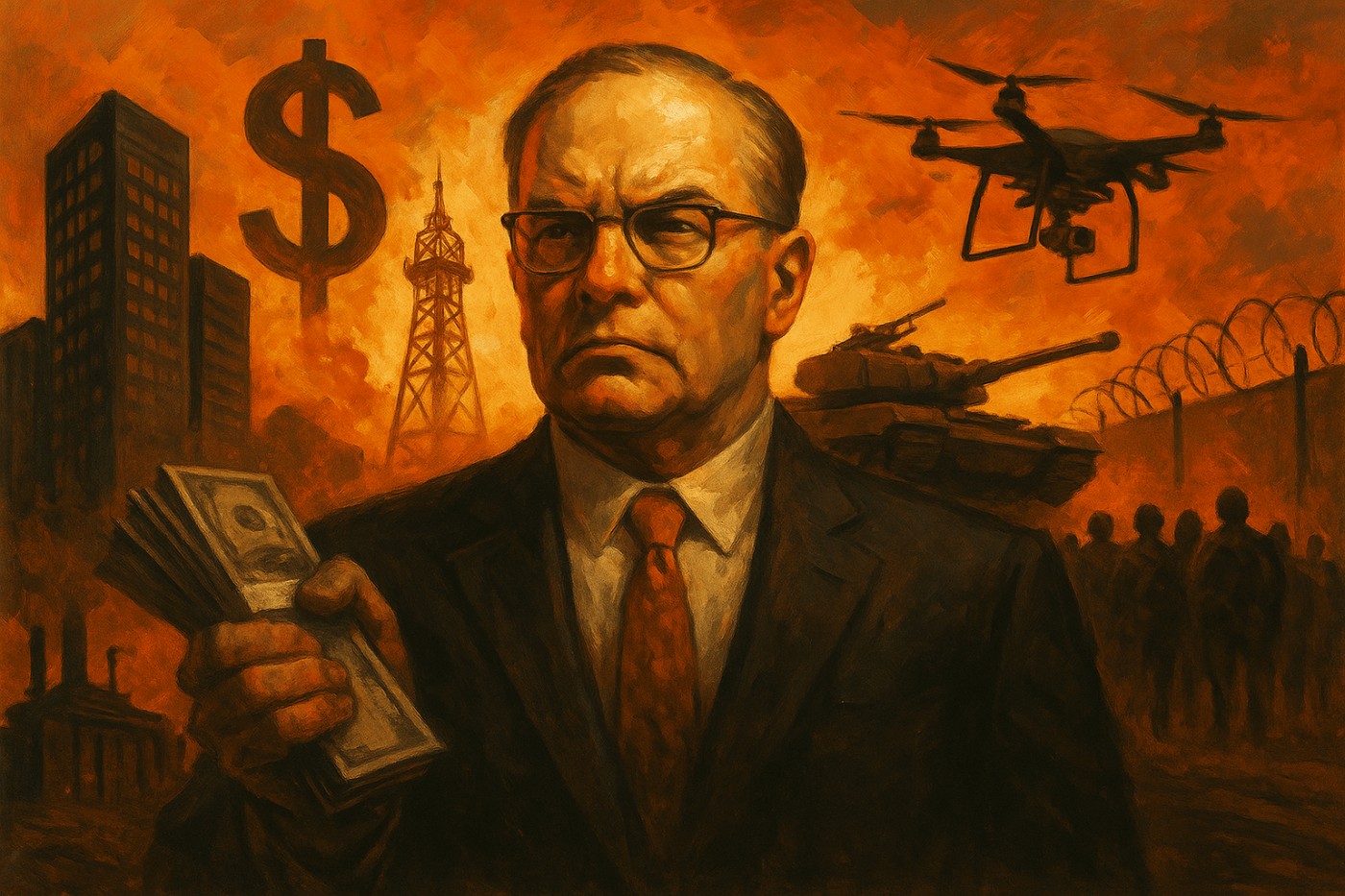
Peter Phillips and Dan Kovalik’s Titans of Capital doesn’t bother with fairy tales. They go straight for the jugular: the world’s wealth and power are locked up in the fists of a tiny handful of capitalists who sit on top of everything like bloated spiders on a web. They put the names on the page—BlackRock, Vanguard, State Street—the quiet giants who own pieces of every oil well, every weapons factory, every tech platform you’ve ever touched. Forget the bedtime stories about competition. The same firms that bankroll Exxon bankroll Apple, the same money behind Boeing props up Google. It’s not rivalry—it’s a racket, and they’re all cashing out.
The strength of Phillips and Kovalik’s book is that it makes the invisible visible. They hand us the receipts, the charts, the tangled lines of ownership that most of the press pretends don’t exist. They take the mask off capitalism and show us the mugshot: the titans are not geniuses, not innovators, but landlords of the whole planet. Their balance sheets decide whether you drink clean water, whether a country gets bombed, whether your rent doubles. That’s the raw truth the book lays bare.
But here’s the thing: the authors often stop at outrage. They say the problem is that “too much wealth” has landed in “too few hands.” Sure. But that’s like saying slavery was unfair because some men had too many slaves. The problem isn’t just inequality—it’s theft. The wealth these titans shuffle around was built on stolen land, stolen labor, genocide, and war. Every dollar in their accounts drips with blood—from the slave ships and cotton fields, from the reservations and prisons, from Iraq and Honduras and Palestine. Phillips and Kovalik show us who holds the money; we have to say what that money really is: accumulated plunder.
That’s why we read Titans of Capital not as a finished story but as a tool. We take their hard evidence and plug it into the revolutionary lineage of thinkers who explained how capital really works—Baran and Sweezy on monopoly capital, Magdoff on empire, Foster on financialization. And we stretch it further, grounding it where the authors hesitate: in the colonial contradiction that has defined the United States from day one. Because when you connect their data to our lived reality—Trump 2.0 snarling in Washington, climate chaos burning the world, a multipolar South refusing to bow—you see the shape of something new. The ruling class is welding its assets, its tech platforms, its cops and soldiers into one fused machine. That machine has a name: technofascism.
So yes, Titans of Capital is useful. It tells us who the enemy is and where they hide. But if they are naming their stakes, we must name ours. The point is not just to count the titans, but to fight them. Phillips and Kovalik handed us the map. Our job is to turn it into a weapon.
Mapping the Web of Empire
Phillips and Kovalik’s greatest service in Titans of Capital is their relentless accounting. They don’t just talk about power in the abstract—they follow the money. They map out who owns what, how BlackRock and Vanguard show up again and again across the boardrooms of Exxon, Microsoft, Lockheed Martin, JPMorgan Chase, and Amazon. They reveal how Berkshire Hathaway, Fidelity, Capital Group, and Blackstone tie together the commanding heights of the global economy. The picture that emerges is not one of healthy competition but of incestuous interlocks. Coke or Pepsi? Either way, the same investors get paid. Boeing or Lockheed? The dividends end up in the same portfolios. The free market, it turns out, is just a Monopoly board, and the same families already own Park Place and Boardwalk.
This empirical work is not glamorous, but it is essential. The ruling class prefers to stay in the shadows, hiding behind the language of “innovation” and “consumer choice.” Phillips and Kovalik rip off the mask. They show us that beneath the glossy ads and political speeches, the economy is run like an old boys’ club where the same suits sit on each other’s boards, shuffle each other’s money, and cash each other’s bonuses. They prove that ownership itself is a weapon—that the very structure of capital ties together firms we’re taught to think of as rivals.
But here’s the limit: the authors sometimes slip into the language of moralism. They stress that too much wealth is concentrated in too few hands, as if the real crime were bad manners or poor distribution. But capitalism’s problem isn’t just that it piles riches at the top—it’s that those riches were built on robbery. The hands that hold them are soaked in blood. The plantations, the reservations, the sweatshops, the prisons—those are the foundations of the balance sheets. Phillips and Kovalik show us the fortress walls but not the slave labor that built them. They reveal the financial plumbing but don’t fully explore the colonial basement where the pipes begin.
That is why we have to take their maps further. It’s not enough to know that BlackRock owns chunks of Exxon and Microsoft. We have to ask what that ownership means: how it binds together oil and tech, finance and war, into a single structure of rule. We have to connect their charts to the political form it produces in crisis—an order where capital converges not out of harmony but out of fear. Titans of Capital gives us the blueprints. Our task is to read those blueprints not like accountants but like guerrillas—looking for the weak points, the cracks, the lines where the whole structure can come crashing down.
From Monopoly to Convergence
To really understand what Phillips and Kovalik put on the table, we have to place their work in the longer history of Marxist analysis of capitalism. In the 1960s, Paul Baran and Paul Sweezy wrote Monopoly Capital, showing how the old “free market” myth had already collapsed into domination by giant corporations. By the 1970s, Harry Magdoff and Sweezy were charting how finance was taking over, not as a sideshow but as the main act—what John Bellamy Foster would later call the era of financialization. Their point was clear: when capitalism can’t expand smoothly through production, it turns to speculation, debt, and financial engineering to keep the profits rolling in.
Phillips and Kovalik carry this story into our moment, though they don’t always say it outright. What they document is not just monopoly, and not just financialization, but a deeper kind of fusion we can call asset convergence. The same handful of firms now hold the strings across every sector—oil and tech, weapons and food, healthcare and housing. This is more than market power. It is structural convergence: the binding together of formerly separate capitalist factions into one nervous system, one bloodstream, one survival strategy.
There has been debate about what this actually means. Paul Sweezy himself warned back in 1971 in his essay “Fact or Fancy” that just because a firm owns shares doesn’t mean it directly controls management. More recently, Marshall Steinbaum and Nathan Tankus argue that index funds are mostly passive; they don’t storm into boardrooms. On the other side, Eileen Appelbaum and Rosemary Batt show how private equity is brutally active, gutting companies, laying off workers, and restructuring industries to squeeze out every last dollar. Both are right in their way. Some capital sits quietly collecting dividends, some capital ransacks everything in sight—but either way, the end result is convergence. The same investors ride both horses, and their portfolios pull in the same direction.
This is where Titans of Capital matters most. It gives us the receipts. It names the firms and maps the overlaps, making clear that rival companies are often bound to the same investors. And when you put that together with the historical lineage of monopoly and financialization, the picture comes into focus: we are looking at the knitting together of the capitalist class itself. Not harmony, not consensus, but enforced unity through shared ownership and shared crisis. This is not just economic bookkeeping. It is the groundwork for a political form. When capital converges at this level, the ruling class converges too—and the system it produces has a name. We call it technofascism.
When Finance Arms the State
Phillips and Kovalik give us a clear picture of who holds the purse strings, but what those strings are tied to is just as important. The titans of capital don’t only shuffle money between corporations; they plug directly into the machinery of repression and war. Look at Amazon’s AWS and Microsoft’s Azure—the same cloud platforms that host your email are under billion-dollar contracts with the Pentagon. Google runs data projects for the military while its shareholders pocket dividends from both fossil fuels and “green” energy. Palantir builds the digital backbone of ICE raids, turning migrant communities into open-air databases. Private equity outfits bankroll prisons and detention centers, where profit literally depends on filling cages. Phillips and Kovalik lay out the financial web, and when you follow the threads, they all run into the state’s iron fist.
This is not new—Brecht already warned us about the “apparatus of communication,” and Foster and McChesney showed how monopoly capital fused with mass media to produce ideology. What’s different today is the scale and intimacy. Finance and technology have converged so completely that the same firms who own the factories also own the algorithms, the pipelines, the satellites, and the drones. The so-called free market and the so-called free press are chained together in service of empire. The titans don’t just write balance sheets; they write the code, fund the surveillance, and bankroll the bombs. It’s one integrated system of extraction and control.
This is what we mean when we speak of technofascism. Not some cartoon dictatorship, but a state form born out of convergence: finance capital fused with digital repression, militarized borders, and permanent counterinsurgency. Phillips and Kovalik’s data gives us the anatomy of ownership; we extend it to show the anatomy of power. The titans sit at the center of this convergence—not as neutral investors, but as engineers of a new authoritarian order. Their portfolios are battle plans. Their spreadsheets are maps of empire. And the political form that emerges from their convergence has only one name: technofascism.
Blueprints and Blind Spots
Here’s where the strength of Titans of Capital runs into its own limits. Phillips and Kovalik hand us an arsenal of facts—ownership tables, corporate interlocks, balance sheets that make clear just how concentrated power really is. They give us the enemy’s blueprint. But too often they frame this concentration as a moral problem, as if the issue were simply that too few people control too much wealth. That’s true, but it doesn’t cut deep enough. Capitalism was never about fair play; it was always about robbery. The titans aren’t just greedy—they’re inheritors of a system built on the plantation, the reservation, and the prison. Every dollar they shuffle has been wrung from colonized labor and stolen land. To treat the problem as one of “inequality” alone is to mistake the symptom for the disease.
This is why we have to put their work in dialogue with the revolutionary tradition. W.E.B. Du Bois showed how the wealth of the United States was inseparable from slavery and Reconstruction. Gerald Horne has mapped the settler-colonial roots of American capitalism. John Henrik Clarke explained how Columbus and the slave trade laid the foundation for Europe’s world system. Their insights remind us that concentration of wealth is not a recent accident—it is the logical outcome of centuries of plunder. Phillips and Kovalik describe the fortress, but these thinkers show us the blood and bones it was built on.
What also goes underdeveloped is the political form that all this convergence produces. The authors show us the fortress walls but don’t tell us who guards the gates. They prove that ownership has converged but leave unanswered what kind of regime emerges from that fact. We argue it takes the form of technofascism: a system where concentrated wealth fuses with digital surveillance, militarized borders, and endless counterinsurgency to maintain control. The balance sheets are not just records of ownership; they are the scaffolding of an authoritarian order in crisis.
So our task is to extend Titans of Capital. To take their empirical clarity and drive it into the political heart of the system. To show that what they’ve charted is not only oligarchy but the very architecture of technofascism. The book gives us the facts; our theory must give those facts teeth. Because blueprints alone don’t topple fortresses—but they can tell us where to place the dynamite.
Turning the Map into a Weapon
So what do we do with a book like Titans of Capital? Phillips and Kovalik have done the hard, unglamorous work of digging through the filings, the shareholder reports, the corporate directories, and they’ve shown us the enemy’s infrastructure. They prove that the same handful of firms own the pipelines, the data centers, the war factories, and the housing stock. They’ve made it impossible to pretend the system is a free market of plucky entrepreneurs. It’s a cartel at a planetary scale, guarded by cops and soldiers, justified by media myths, and powered by blood. That alone makes the book worth reading.
But if we stop there—if we treat their facts as the end of the story—we miss the point. The titans don’t simply hoard wealth. They organize society through that wealth, fusing finance with digital platforms, with prisons, with borders, with war. That is the leap we make when we embed their data in the Marxist tradition—from Baran and Sweezy’s Monopoly Capital, to Magdoff’s work on imperialism, to Foster’s theory of financialization—and when we root it in the colonial contradiction that Du Bois, Clarke, and Horne insist is the foundation of U.S. power. Through that lens, the spreadsheets in Titans of Capital stop being mere statistics and become coordinates on the battlefield of technofascism.
The conclusion is as urgent as it is obvious: the empire is converging to survive, and it is converging in the form of technofascism. Concentrated wealth, digital repression, and racial-colonial domination are not three separate crises—they are one system with many faces. Trump 2.0 is not the aberration but the expression of that system. And the lesson of Titans of Capital, sharpened through revolutionary theory, is that exposure alone will not topple the titans. We need more than outrage, more than statistics. We need organization, clarity, and a will to fight.
Phillips and Kovalik drew the map. Our job is to turn that map into a weapon. The fortress has been named. The only question left is how long we will wait before we lay siege.
 Weaponized Information
Leave a comment