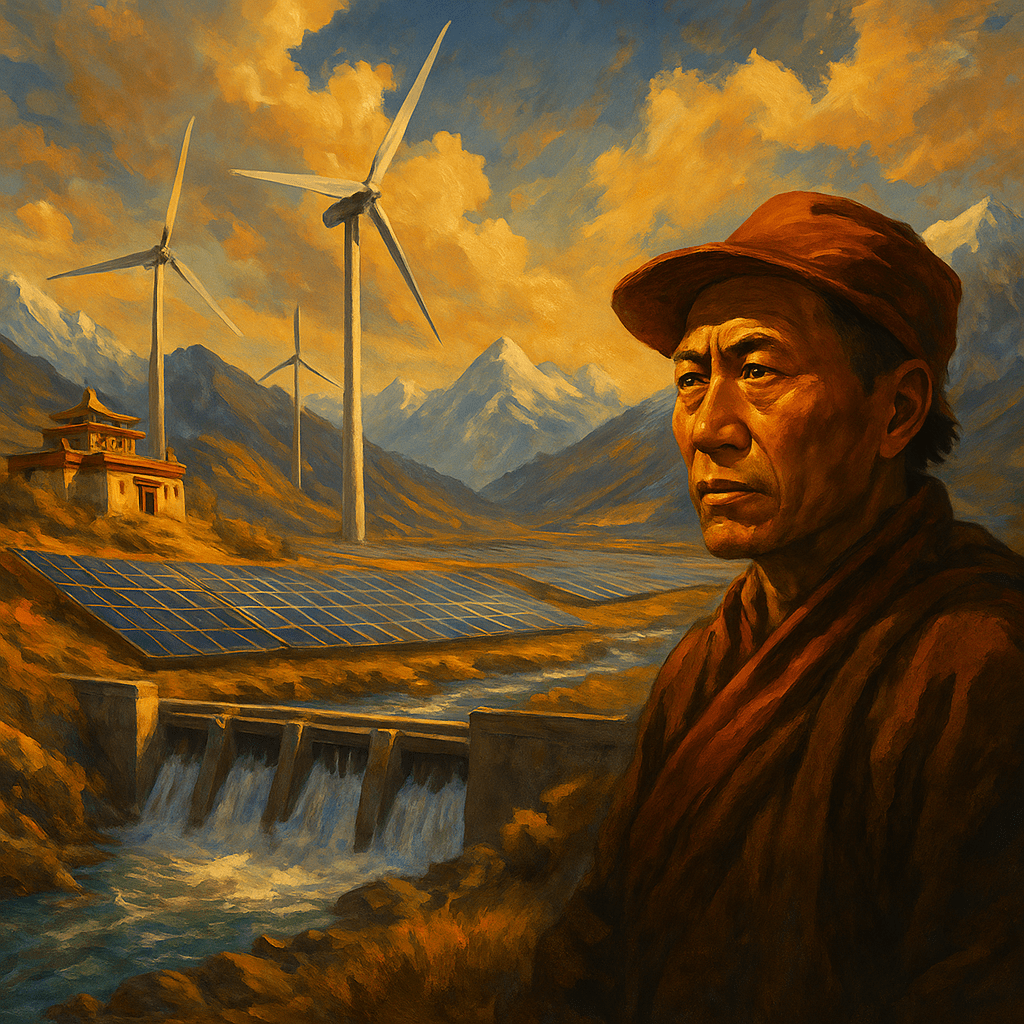
El Diario 24 dresses up an energy story as a morality play, turning turbines and panels into weapons of empire. The facts reveal a different picture: massive renewables, ecological migration policies, and multipolar energy links. Imperial dread is reframed as fear of losing fossil monopolies, exposing the necrotic logic of Western capitalism. Mobilization means aligning the global working class with multipolar sovereignty, ecological justice, and political education.
By Prince Kapone | Weaponized Information | September 4, 2025
The Roof of the World as a Battleground of Narratives
On August 29, 2025, El Diario 24 published an article titled “China charges the roof of the world with energy — A project designed to dominate the planet”, penned by one Fridas S. It tells us a simple story dressed up as an epic: China has turned the Tibetan Plateau into a colossal energy platform, a renewable empire in the making, a threat to the balance of the world. At first glance, it seems like another report on technology and climate. But read closer and you’ll see something else at work: the familiar hum of propaganda, where every solar panel becomes a weapon, every turbine a declaration of war, every dam a symbol of domination. This is not journalism—it is theater, with the reader cast as a passive audience member in the empire’s morality play.
Who is Fridas S.? A pen-for-hire, producing consumable copy for digital syndication markets, their class position anchored in the petty bourgeois strata of freelancers who orbit Western editorial platforms. The work depends on translating the ideological anxieties of imperial centers into “digestible narratives” for global audiences. The reward is survival in a precarious gig economy, but the cost is subservience to the ideological apparatus of the West. The result is articles like this one, where China’s concrete advances in renewable power must always be reframed as dangerous ambition, as if energy itself carries Chinese characteristics of menace.
And then there is the outlet. El Diario 24 looks like a newspaper but functions like an ad farm. Its lifeblood is not subscription or investigative independence, but the algorithmic churn of clicks, fed by sponsored junk promising “cheap Viagra at CVS” or “the three foods doctors forbid.” This is no accident. The same structure that fills the margins with snake oil also fills the center with anti-China dread. Both are symptoms of dependence on Western advertising networks, where survival means producing content that flatters the ideological needs of imperial capital while luring eyeballs for ad revenue. The form is infotainment, the substance is subordination.
The article’s narrative does not emerge in a vacuum. It draws oxygen from a network of amplifiers—energy think tanks tied to NATO strategy, the Atlantic Council’s policy mills, the International Energy Agency’s white papers—all of them translating the geopolitical nervous system of the West into talking points for a mass audience. Their fingerprints are on the framing: China as overreacher, Tibet as victim, the planet as captive. This is the script written in Washington and Brussels, rehearsed in corporate media studios, and performed here in Spanish for global consumption.
The propaganda mechanics are not subtle. The project is framed not as energy security or ecological transition but as “empire-building.” Omission works like a scalpel: the Hoover Dam, the Tennessee Valley Authority, America’s own green megaprojects vanish, leaving China as the only nation guilty of audacity. Emotional manipulation is deployed in poetic descriptions of the Plateau—“roof of the world,” “untouchable terrain”—now supposedly defiled by turbines and panels. Cognitive warfare reframes renewable energy as a zero-sum conflict, forcing readers to choose sides in a new Cold War disguised as a green one. False equivalence is slipped in: the displacement of Tibetan communities is made to stand in for the entire renewable program, while the global displacement caused by Western oil corporations never merits a headline. And hovering over all of this is the Orientalist trope: Tibet as a sacred Shangri-La, corrupted by Chinese ambition, a familiar fantasy of empire in monk’s robes.
This is what it means to excavate propaganda. You peel back the layers of myth, you watch how words are arranged to discipline thought, you see how omission becomes weapon, how poetry becomes camouflage, how every image is wired to a geopolitical agenda. What we find in this excavation is not a neutral report on solar panels at high altitude. It is the imperial gaze, staring out from behind a byline, projecting its fears onto a plateau that, for the first time in history, may generate power not just for villages but for an entire multipolar future. And that is the real scandal for the West—that someone else might define the terms of survival in the age of energy transition.
From Omission to Context: Building the Factual Baseline
The article in El Diario 24 sprinkles facts like seasoning but never serves the full meal. Yes, it mentions solar panels on high-altitude plateaus, turbines harnessing Himalayan winds, and hydropower fed by glacial rivers. It acknowledges Beijing’s talk of domestic security and surplus export through ultra-high-voltage lines. It admits that Indigenous Tibetans are displaced and ecosystems unsettled. And it warns us that China seeks “global energy dominance.” But what it delivers is a skeleton, stripped of flesh, history, and contradictions. Our task here is to recover the facts in their fullness, not the curated fragments designed to fit a geopolitical script.
Begin with what the article won’t tell you: scale. China’s renewable energy targets are staggering. By 2030, the government plans to install 1,200 gigawatts of solar and wind capacity, more than the combined output of the U.S. and EU today. The Tibetan Plateau is not a fanciful outpost but a linchpin in this strategy: it contributes roughly 62% of China’s annual hydropower generation, underscoring its central role in the country’s renewable future. Beyond China’s borders, energy connections are taking shape through planned infrastructure rather than a single multilateral web. In Laos, China General Nuclear signed agreements in 2024 to develop a 1,000 MW renewable power base intended to feed electricity into China’s Yunnan grid.
Meanwhile, Nepal and China have agreed to build a 220 kV cross-border transmission line from Jilong/Kerung through Rasuwagadhi to Chilime, with earlier plans for a larger 400 kV line scaled back, though feasibility studies have been completed and both sides reaffirmed their commitment to start construction “at an early date.”
As for Pakistan, CPEC projects have expanded generation capacity significantly, creating domestic surpluses, and analysts note the potential for future regional energy flows into Xinjiang, though no formal cross-border power purchase agreement has yet been signed. These arrangements point less to domination than to regional interdependence, built through surplus energy flows and infrastructure linkages.
Equally absent is the reminder that mega-projects are hardly a Chinese invention. The Hoover Dam, the Tennessee Valley Authority, and Canada’s James Bay Project are remembered in the West as triumphs of modern engineering and state-led development. But when China builds dams or solar farms on the Tibetan Plateau, it is branded as conquest. This double standard, baked into the imperial imagination, is a propaganda tactic as old as empire itself. Scholars have shown how New Deal hydro projects like the TVA were celebrated as models of modernity and government-led progress—the TVA was widely hailed as a symbol of infrastructural salvation—while global coverage of China’s Three Gorges Dam has skewed negative, especially highlighting environmental and social risks—a longitudinal study reveals predominantly negative tone in global media reporting.
The ecological ledger is also skewed. The article laments Indigenous dislocation and fragile biodiversity—but ignores what’s being displaced: coal. A 2025 analysis by Carbon Brief found that clean-energy expansion—especially from solar, wind, and nuclear—has begun to push down China’s power-sector carbon dioxide emissions, even as electricity demand rises. Yet this dynamic disappears from the narrative, because recognizing it would depict China not as a destroyer, but as a vital lifeline for a world suffocating under Western fossil dependence.
This brings us to the matter of Tibetan relocation. The article invokes it as proof of domination, but leaves the question hanging without context. Officially, Beijing frames these moves under “ecological migration” and “poverty alleviation relocation,” backed by laws like the Qinghai–Tibet Plateau Ecological Conservation Law and State Council resettlement regulations. Official documents emphasize that relocation under the Ecological Migration and Poverty Alleviation Resettlement frameworks is intended to be voluntary and to provide comprehensive support. In the Three-River Headwaters (Sanjiangyuan) region, national park and related programs are designed to conserve fragile ecosystems through coordinated measures that include ecological resettlement; official guidance also mandates new housing standards and livelihood arrangements (employment, services, and follow-up assistance) so relocation is tied to actual well-being. Meanwhile, the “Comfortable Housing Project” in the Tibet Autonomous Region—advanced as a pillar of the “New Socialist Countryside”—has delivered modern homes with electricity and running water and expanded access to schooling; official summaries note that by the mid-2010s around 2.3 million rural residents in Tibet were living in new, safe housing. Chinese scholars have documented real gains—poverty incidence falling, new schools and clinics appearing—but also stress contradictions: employment is often precarious, cultural adaptation difficult, and income growth uneven.
Set in historical relief, the story sharpens further. Tibet has long been targeted in Western geopolitical strategy, from the CIA’s Tibet Project in the 1950s to today’s green-washed narratives. Relocation policies are now reframed as evidence of totalitarian cruelty, while Western states quietly expand fossil displacement at home—from Navajo uranium mines to Canadian tar sands—without drawing equal outrage. The double standard is not incidental. It is structural.
We also need to situate the timing. China’s pivot to massive renewables is not just ecological virtue but geopolitical necessity. The sanctions regime unleashed in 2014 and escalated after the Ukraine crisis accelerated Beijing’s determination to secure energy independence and weave Eurasian partners into an alternative grid. This is the contradiction the West cannot accept: a world where the dollar and oil no longer dictate survival. In this light, “energy dominance” means something very different: not Beijing imposing its will, but Beijing refusing to bow to Washington’s.
What emerges, once the omissions are filled, is a landscape of contradictions. Geopolitically, China’s renewables threaten fossil monopolies, so they are painted as aggression. Economically, the surplus power that could electrify South Asia is cast as “imperialism,” while Western oil giants flooding the Global South with pipelines are normalized. Socially, Tibetan relocation contains both evidence of state investment and reports of coercion, revealing an uneven and contested process that neither the West’s demonization nor Beijing’s triumphalism can fully capture. This asymmetry—highlighting Tibetan dislocation while erasing Indigenous displacement in the West—is not accidental. It is propaganda by omission, a technique as powerful as outright lies.
By extracting the facts, by situating them in their historical and geopolitical context, we see clearly what the article tried to obscure. The Tibetan Plateau is not simply a stage for Chinese ambition; it is a battlefield where narratives are fought over, where fossil empires defend their turf by portraying every alternative as dangerous, and where the future of global energy hangs in the balance. This is not a debate about turbines and solar cells—it is a struggle over who will control the terms of survival in the twenty-first century.
Reframing the Plateau: From Imperial Dread to Multipolar Power
Once the omissions are stripped away, we can see how the facts point in a very different direction from the story spun by El Diario 24. What lies on the Tibetan Plateau is not simply a pile of solar panels, turbines, and dams. It is a material rupture in the world system, a break with the fossil order that has yoked the planet to death for a century. Western media call it “domination” because they cannot admit the truth: if China succeeds, the monopoly on energy—once enforced through oil cartels, military bases, and sanctions—will slip out of imperial hands.
This is where the propaganda must be inverted. When the article says “empire,” what it really signals is fear: fear of losing control over the arteries of global accumulation. The real empires of energy have never been on the Plateau—they sit in Exxon boardrooms, NATO pipelines, and Wall Street trading floors. Yet the narrative flips the script, painting China’s renewable surge as the threat while hiding the fact that Western fossil capitalism is a textbook case of Necro-Extractivism—an economy that feeds itself on destruction, from oil wars in Iraq to poisoned water in Niger Delta villages. By contrast, the Plateau’s turbines and solar fields represent a path to break with this death logic.
The ideological trick at work is what we call Green Imperialism: the West reserves the language of “sustainability” for itself while weaponizing it against others. When California builds solar deserts, it is innovation; when Beijing builds them on the Plateau, it is conquest. When European firms export wind technology, it is progress; when China exports surplus power to Nepal or Pakistan, it is domination. The discourse is not about ecology at all. It is about protecting the market share of Western capital in a world where multipolar energy threatens to render them irrelevant.
This is also a war of ideas, an Information War fought with ecological vocabulary as the arsenal. Every paragraph about dislocated Tibetans is not simply concern—it is counterinsurgency, the repurposing of real suffering into ammunition against multipolar sovereignty. Notice what is absent: no mention of Navajo uranium miners who died in silence, no memorial for Indigenous families displaced by Canadian hydroelectric giants, no word of the African villages torched to secure oil pipelines. The suffering counts only when it can be wielded against China. That is not solidarity—it is instrumentalization.
Looked at dialectically, the contradictions sharpen. “Instability” in the Western frame is not about the Plateau at all but about a system whose own legitimacy is collapsing. The fossil empire is not threatened by China’s authoritarianism but by China’s capacity to electrify without Exxon, to warm homes without Chevron, to sell surplus without OPEC. The crisis belongs not to the Plateau but to imperialism itself. The Plateau merely reveals it by existing as an alternative.
From the standpoint of the global proletariat and peasantry, this shift matters. Workers in Pakistan’s textile mills and farmers in Nepal’s valleys do not see turbines as domination—they see cheaper, more stable electricity, freedom from rolling blackouts, a chance to live without the permanent chokehold of IMF fuel conditionalities. For them, multipolar energy sovereignty is not a menace but a reprieve. The question, then, is not whether the Plateau is “too ambitious” but whether the rest of the world is prepared to stand with those who build outside the fossil order.
That is the real reframing: to understand that the Himalayan winds, the Tibetan sun, and the glacier-fed rivers are not just “natural resources” but weapons in a struggle against an imperialism in crisis. The choice is not between domination and purity, as the Western myth suggests. It is between clinging to a necrotic fossil empire or aligning with a multipolar project that, however contradictory, cracks open the possibility of an ecological future. The Plateau does not symbolize China’s hunger for empire. It symbolizes empire’s fear of losing its monopoly. And that fear is precisely why this project is so viciously maligned.
From Propaganda to Praxis: Mobilizing for Ecological Sovereignty
The contradictions we have unearthed do not end on the Tibetan Plateau. They spill outward into every factory, every farm, every street where the global working class and peasantry live under the shadow of fossil imperialism. Western media tells us that Tibet is a land occupied and oppressed, that every protest is a cry for liberation. But what they hide is their own hand: the long history of U.S. and CIA manipulation of Tibetan separatism, the money funneled through NGOs, the weaponization of culture as a wedge against China’s sovereignty. A revolutionary analysis cannot fall into that trap. Tibet is part of China and has been for generations. Its contradictions are not a colonial border dispute but the real tensions of modernization, ecological protection, and socialist development on difficult terrain.
This means our solidarity cannot be a blanket endorsement of every outcry, especially when imperialist actors amplify those voices to delegitimize China. Yes, relocation has brought grievances, monasteries face risks from dam projects, and people demand to be heard. But those grievances exist inside the Chinese polity, and the responses must be measured against China’s own policies: programs that emphasize voluntariness, compensation, new housing, job training, and ecological conservation. Revolutionary solidarity here does not mean cheering on imperialist-scripted uprisings. It means holding Beijing to the standards it has set for itself, amplifying internal progressive struggles like Friends of Nature’s legal battle to save the green peafowl and its precedent-setting public interest litigation, or the long campaigns of Green Earth Volunteers and the Nu River defense, which prove that ecology can be defended from within China’s system.
For the working class and peasantry in the Global North, mobilization begins by dismantling the propaganda machine. The same governments and corporations that frack Indigenous lands in North America, poison Niger Delta rivers, and tear apart the Amazon dare to speak of Tibet as a moral cause. We must turn that hypocrisy against them, exposing how “green imperialism” works: condemning China’s renewable projects while continuing to bankroll Exxon, BP, and Chevron. Campaigns like those led by International Rivers and the International Tibet Network can be spaces of struggle if we insert class clarity—demanding consistency, linking Tibetan relocation to Standing Rock, Navajo uranium mines, and every Indigenous struggle erased by Western media. The task is to redirect energy from demonization of China toward a global offensive against fossil capital itself.
In the Global South and multipolar world, mobilization means building solidarity on two fronts. First, with China’s effort to break the fossil monopoly through massive renewable expansion—because if Beijing succeeds, the chokehold of Western oil and finance weakens. Second, with communities affected by relocation and ecological disruption, insisting that their rights and livelihoods are safeguarded. Movements in Africa, Latin America, and South Asia can demand that multipolarity be more than a slogan—that it integrates ecological justice and popular participation into its fabric. This is not a contradiction to be feared; it is the dialectic of socialist development in practice.
Above all, mobilization requires political education. We must train cadres to know China’s policies in detail, to study the relocation frameworks, the poverty alleviation data, the emissions reductions achieved by Plateau solar and hydro—not the Western caricature. We must read the empirical research, not the propaganda, and arm ourselves with facts that can cut through the fog of imperial narrative. Study circles, workers’ schools, peasant assemblies—these are the spaces where propaganda is smashed and solidarity is forged. To fight for Tibet’s people is to fight for a multipolar, socialist future where no empire dictates the terms of survival. That is the task before us.
 Weaponized Information
Leave a comment