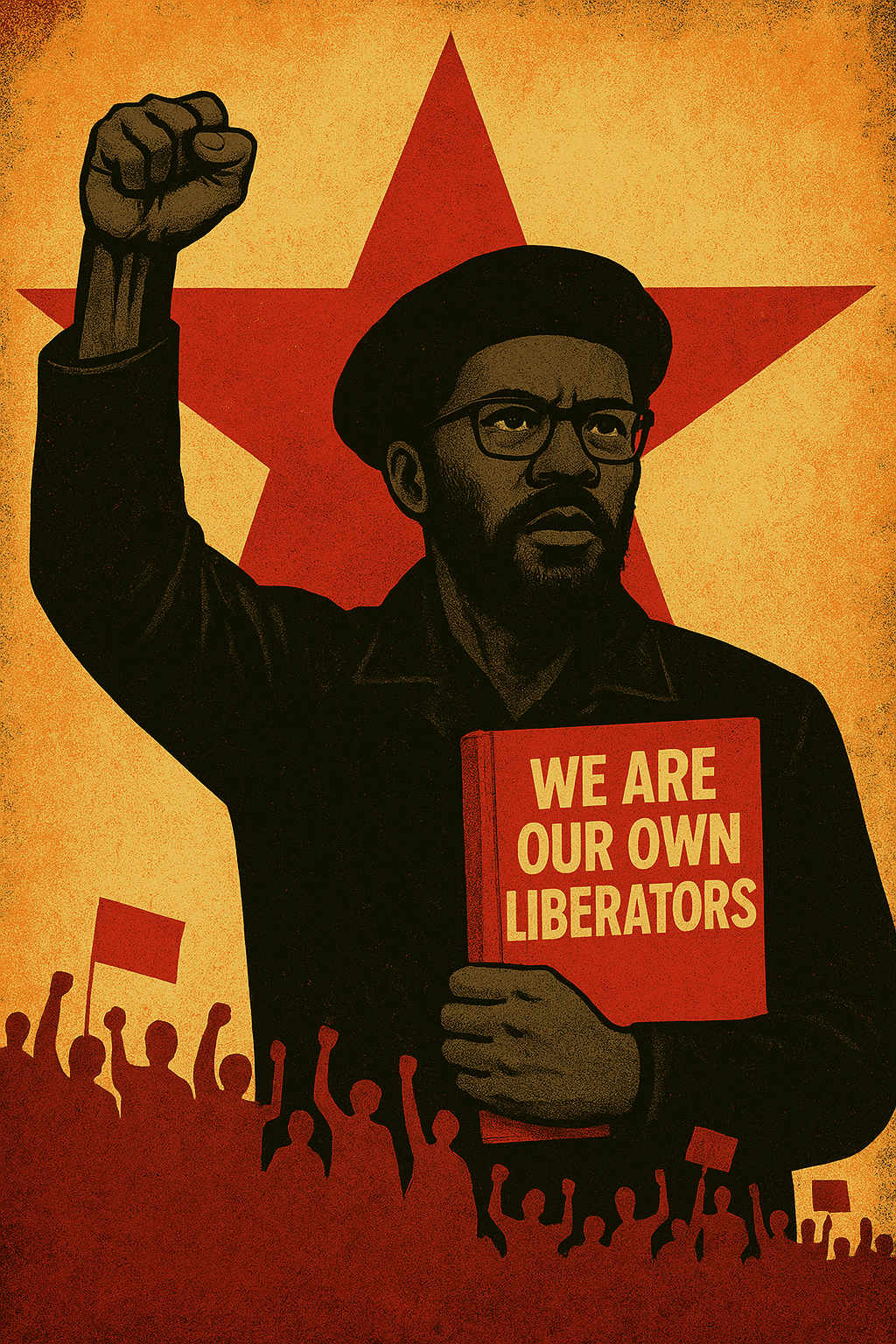
A Weaponized Intellects book review of We Are Our Own Liberators by revolutionary soldier Jalil Muntaqim, who spent 49 years captive in the belly of the beast as a prisoner of war.
By Prince Kapone | Weaponized Information | August 20, 2025
The Man, the Movement, the Sentence
Jalil Muntaqim wasn’t born with that name. The settler state knew him first as Anthony Bottom. But it was as Jalil that he chose to stand against empire—as a soldier of the Black Liberation Army, a political theorist forged in struggle, and eventually, a prisoner of war buried alive by the same government that claimed to uphold freedom and democracy. He was just 19 years old when he was arrested in 1971 and charged in the death of two NYPD officers—a trial saturated with COINTELPRO infiltration, surveillance, and strategic deception. But this was never about justice. It was about war. And Jalil Muntaqim was captured on the battlefield.
He spent the next 49 years behind bars—four times the length of the U.S. Civil War. He was finally released in October 2020, at the age of 69. But his liberation was never just about parole or clemency. It was ideological. Muntaqim survived half a century inside the most advanced system of mass political containment on earth. And what did he do with that time? He wrote. He organized. He studied. He sharpened his theory. He refused to die. He turned his cage into a command post.
We Are Our Own Liberators is not a memoir. It is not written to gain sympathy or sell redemption narratives. It is not the literature of a victim. It is a manual of counter-counterinsurgency, written by a revolutionary captured in action and still committed to victory. Every page is soaked in historical memory, political strategy, and a clarity of purpose that puts the entire left to shame. Jalil doesn’t write to be understood—he writes to be obeyed. Because what he’s saying isn’t new. It’s what the Panthers said. What Assata said. What George said. But what the white left has never wanted to hear: that the United States is a settler-colonial empire, not a flawed democracy. That Black people in America are not a marginalized group—they are a colonized nation. And that liberation is not a matter of dialogue. It is a matter of war.
This book exists because the Black Revolution was betrayed—by the state, of course, but also by the white left. While the Panthers were being hunted, the so-called Marxists were writing papers about Eurocommunism. While BLA soldiers were being captured, the professors were debating Trotsky. While Muntaqim sat in a cell, the NGOs perfected the art of selling Black pain for white grants. Western Marxism did not lose the war—it refused to fight it. It substituted “critique” for confrontation. It made defeatism into a discipline. And it has spent the last 50 years burying the Black revolution beneath layers of poststructuralist jargon, nonprofit politics, and sanitized syllabi.
But Jalil didn’t forget. His work tears through the polite silences of the academic left like a prison shank. He names the contradiction: between reform and revolution, between performative allyship and material solidarity, between being a radical and being a soldier. And that is why this book cannot be read like theory. It must be read like a set of orders. Because Jalil Muntaqim is not just a former political prisoner. He is a surviving officer of the last revolutionary army this country produced. And he wrote this not to be admired—but to be followed.
Prison Writings Are War Writings
Western Marxism treats prison literature like it treats revolution itself—as a dead artifact, to be studied from a distance, stripped of its urgency, and embalmed in theory. It fetishizes Fanon while forgetting the gun. It quotes George Jackson but ignores his actual politics. And when it confronts Jalil Muntaqim, it recoils. Because this is not literature—it is live ammunition.
We Are Our Own Liberators does not traffic in metaphor. When Muntaqim says he’s a prisoner of war, he means it. When he says the U.S. prison system is a counterinsurgency weapon, he’s speaking from behind enemy lines, not behind a podium. His analysis of incarceration is not abstract—it’s experiential, theoretical, and strategic all at once. This book is not about prison—it is from prison, and that changes everything. Because the prison, for Muntaqim, is not the exception to empire. It is its continuation. It is the re-segregated plantation. The post-civil rights slave ship. The containment unit for revolutionaries whose only crime was refusing to kneel.
In the imperial core, where white radicals debate abolition over coffee, Jalil writes under lockdown. His words aren’t catharsis—they are reconnaissance. Every essay is a dispatch from the front, tracking the psychological, ideological, and spatial warfare of the carceral state. He names it plainly: this is not rehabilitation—it is domesticated war. Every new jail built is a trench dug. Every sentence passed is a bullet fired. Every silence from the white left is collaboration. And every time a revolutionary like Jalil puts pen to paper, it’s a counterattack.
That’s what separates this work from the prison genre as imagined by academics. It’s not asking for understanding. It’s not auditioning for redemption. It’s not meant to inspire sympathy or institutional reform. It’s meant to organize. This book is what George Jackson called “armed propaganda.” It is theory under occupation. And that makes it radioactive to Western Marxists, because it doesn’t ask for analysis—it demands action. It exposes the myth that the U.S. ever left its counterinsurgency phase. It proves that what happened to the Black revolutionaries of the 60s and 70s was not a crackdown—it was a long-term strategy of decapitation. And it indicts those who let it happen without consequence.
Jalil names this process with precision. He maps the psychological warfare, the sensory deprivation, the political censorship, the structural gaslighting. But he never centers himself as a victim. His method is dialectical. He sees prison as both repression and opportunity—as both enclosure and revolutionary school. He builds theory through experience, not in spite of it. And in doing so, he revives what Western Marxism abandoned decades ago: the primacy of revolutionary practice. The idea that knowledge is not for debate, but for struggle. That the point is not to interpret the world, but to change it—even from a cage.
The Internal Colony and the White Left Lie
There’s a reason Western Marxists hate the term “internal colony.” It collapses their entire fiction in a single phrase. It declares that Black people in the U.S. are not a racial minority seeking equality—they are a colonized nation trapped inside a white settler empire. It exposes that this so-called democracy is maintained by force, not consent. It demands not rights, but sovereignty. And it makes clear that the only path to freedom is the destruction of the state that holds them captive.
Jalil Muntaqim doesn’t theorize this as an abstraction—he writes it as a lived reality. He’s not borrowing from Lenin or Mao to sound militant. He’s drawing from the actual experience of a people whose labor, land, lives, and future have been systematically stolen and policed by a settler regime since day one. His analysis of internal colonialism isn’t academic. It’s geographic, economic, military. It defines the ghetto as a containment zone. The police as an occupying army. The courts as instruments of war. And it reorients the struggle from civil rights to anti-colonial resistance.
This is where the white left always flinches. Because if Black people are a nation, not a class fragment, then white radicals can’t lead. They can’t speak for. They can’t subsume. They have to support from behind. Worse, they have to confront their own material stake in the system. Muntaqim forces that confrontation. He exposes how the white working class has historically sided with the oppressor, not the oppressed. How the labor aristocracy cashed in on colonial plunder. How “class unity” became a euphemism for Black subordination. And how Western Marxism, for all its talk of revolution, has served as the ideological cover for betrayal.
This isn’t a moral critique. It’s a material one. Muntaqim isn’t asking for guilt or virtue-signaling. He’s exposing the class and colonial alignment of the Western left itself. Its refusal to engage revolutionary nationalism isn’t an accident—it’s a defense of settler unity. That’s why they erase the history of Black struggle. That’s why they downplay the Panthers, discredit the BLA, and ignore the political prisoners still rotting in U.S. gulags. Because if they acknowledged the truth, they’d have to admit they’re not in a revolutionary alliance—they’re in a comprador one.
But Jalil refuses to let them off the hook. He brings the national question to the center. He weaponizes it. He treats it not as a topic for debate, but as a foundation for strategy. Because without national liberation, there is no socialism in the U.S.—only settler social democracy in disguise. And without confronting the white left lie, the revolutionary project is already lost.
Western Marxism = Counterinsurgency by Other Means
The pigs weren’t the only ones who came for the Panthers. The white left did too—just slower, softer, and armed with critique instead of cuffs. Jalil Muntaqim names this betrayal for what it was: ideological pacification. When the state rolled out COINTELPRO to dismantle the Black Liberation Army and cage its members as prisoners of war, the Western Marxists rolled out conferences, journals, and seminars—designed not to defend the movement, but to dissect and defang it. This was counterrevolution disguised as critique, and it became the dominant political grammar of the left in the imperial core.
From behind bars, Muntaqim watched as former allies sanitized the very history they had once celebrated. Black revolution was reframed as sectarianism. Armed self-defense became “adventurism.” National liberation was rewritten as a distraction from “real” class struggle. The outcome? A settler socialism that props up the very empire it claims to oppose. A “radical” tradition so committed to maintaining white political coherence that it rebrands the colonial contradiction as an unfortunate misunderstanding. Muntaqim sees it plainly: this isn’t revolutionary failure—it’s socialist white chauvinism.
And that chauvinism isn’t just theoretical—it’s strategic. The Western left has always tried to collapse the national question into the class question, as if centuries of racialized colonial domination can be abstracted into labor categories. Muntaqim rejects this co-optation. He understands that the internal colony of Black people in the U.S. has its own class structure, forged in struggle and shaped by its position as a colonized nation, not a demographic fragment. Any analysis that ignores this is not just mistaken—it’s part of the ideological warfare being waged against Black self-determination.
He reserves particular fire for the bourgeois left—those NGO-trained, credential-chasing, protest-fetishizing forces who parade as radicals while acting as servants of empire. He calls out their petty bourgeois paternalism, their unshakable fear of losing control, and their habit of demanding unity only on settler terms. These are the same forces that claim to support Black liberation, so long as it doesn’t threaten their nonprofit funding, tenured positions, or movement brand. They fear armed struggle more than they fear the police. And they loathe revolutionary nationalism because it can’t be co-managed through consensus meetings and think pieces.
Muntaqim never pleads for inclusion in their politics. He indicts it outright. He exposes that the refusal to support revolutionary Black nationalism was never a theoretical disagreement—it was a political decision rooted in material interests. Because to support that struggle would mean confronting settler privilege, not just state repression. It would mean revolutionary solidarity must be anti-imperialist in practice—not in rhetoric, not in reading groups, but in line, structure, and risk. And that is where the white left historically folds.
For those of us trained in that tradition, Muntaqim’s clarity is a rupture. It doesn’t just critique our politics—it burns the foundation. It leaves no room for neutrality, for abstraction, for soft betrayal dressed up as nuance. His words demand realignment—not through guilt, but through rupture. To walk away from the reformist charades and petty critiques. To take a side. And to finally understand that the most dangerous counterinsurgency wasn’t in the prisons or the streets—it was in our heads.
Revolution is International or It is Nothing
Jalil Muntaqim doesn’t write like an American. He writes like a soldier in the world revolution. And that’s exactly what he is. We Are Our Own Liberators is saturated with an internationalist consciousness that blows past the borders of the U.S. settler state and calls into question every project that claims to be socialist but refuses to be anti-imperialist. In Muntaqim’s world, solidarity isn’t symbolic. It’s strategic. The fate of the Black Liberation Army is tied to Palestine, to Puerto Rico, to the Philippines, to Vietnam, to the long march of colonized peoples fighting to claw back history from those who stole it.
His analysis tears through the arrogant fiction that revolution can be contained within national lines—or worse, within the “first world” imagination of what struggle looks like. He rejects the idea that the U.S. is a site of internal class contradiction detached from global plunder. He knows better. The prisons are not anomalies—they’re nodes in an international counterinsurgency apparatus. What they do to Black and Brown bodies in Attica, they do in Gaza, in Guantánamo, in Haiti, in the Sahel. Muntaqim doesn’t theorize this—he names it, weaponizes it, and draws the frontlines accordingly.
The internationalism he practices is not just a politics of alignment—it’s a politics of strategy. He draws from Cabral, from Fanon, from Nkrumah, from Mao—not for posturing, but because these were men who understood war. Not just military war, but ideological war. Cultural war. Class war as national liberation. They knew that the greatest threat to empire wasn’t civil rights—it was self-determination. Not inclusion—but rupture. That’s why the BLA aligned itself not with white-led socialist parties, but with armed national movements struggling across the Third World. Because those movements were fighting the same enemy: U.S. imperialism.
This is the terrain Muntaqim calls us to. Not the terrain of coalition meetings and electoral strategies, but of political warfare. He sees no contradiction between building underground formations in U.S. prisons and declaring solidarity with Sandinistas, FMLN guerrillas, or Palestinian fedayeen. For him, these are not acts of charity—they are acts of survival. Because if empire is global, then liberation must be too. And any politics that doesn’t reflect this is not just flawed—it’s a dead end.
For those of us emerging from the wreckage of Western Marxism, Muntaqim’s internationalism is not a side note—it’s a lifeline. It reminds us that the center of revolutionary gravity has always been in the Global South, in the anti-colonial trenches, in the occupied zones. That theory without this orientation is just settler noise. That solidarity without this clarity is just settler guilt. Muntaqim shows us what it means to be loyal—not to a flag, or a party, or a tradition—but to a people. To a planet. To a war still underway.
Culture is Ammunition, Not Ornament
Jalil Muntaqim never mistakes culture for a side project of the revolution. He knows it is one of the sharpest weapons we have. For him, culture is not an echo of struggle, nor is it the indulgent theater of self-expression. It is preparation. It is discipline. It is morale for the trenches. In his writings, culture is not a mirror of society, as the Western Marxists love to repeat, but a forge—where new men and women are hammered into being. Culture is not the soul of the nation; it is the armory of the people.
Western Marxism turns culture into a seminar topic. It makes murals into metaphors, songs into commodities, and education into liberal therapy. Art becomes a market, literature becomes a career, and “political education” becomes a ritual of discussion groups with no conclusions. Jalil smashes this charade. He insists that culture without purpose is counterrevolutionary. If it does not steel the oppressed for combat, if it does not clarify the enemy, if it does not prepare the people to seize history, then it is not culture at all. It is propaganda for defeat.
That is why he elevates the importance of revolutionary propaganda and political education. In the belly of empire, where every image and every word is weaponized to demoralize the colonized, Jalil reminds us that counter-propaganda is not optional—it is survival. Stories of resistance must be told not to impress the academy but to immunize the people against despair. Education is not an abstract right but a battlefield necessity. It builds cadres, not critics. It sharpens lines instead of blurring them. It arms the oppressed with analysis, not platitudes.
Think of how the Western left treats culture—as if quoting Gramsci absolves them of the duty to fight like him. They make “hegemony” into an essay prompt while Jalil makes it into a combat strategy. They speak of “contesting ideology” in the abstract while he uses poetry, study groups, and revolutionary memory to harden men and women caged by the empire’s most sophisticated counterinsurgency apparatus. He does not separate the pen from the gun, the classroom from the street, the song from the struggle. For him, all culture is military culture. All art is armed art. All pedagogy is training.
This is what frightens the Western Marxists most. Because if culture is not an open canvas but a battlefield, then their entire profession collapses. The journals, the panels, the careers—they all become what they truly are: noise. Distractions. At best, indulgence; at worst, collaboration. Jalil’s writings strip away the illusion. He does not ask whether culture can be radical. He tells us it already is—but the question is, on whose side? In his framework, culture is not neutral ground. It either fortifies the oppressed or furnishes the oppressor. There is no third option.
That is why We Are Our Own Liberators is so dangerous. It does not permit us to read and walk away the same. It calls us to make a choice: to wield culture as ammunition or to waste it as ornament. Muntaqim’s verdict is mercilessly clear: in war, every word, every song, every lesson, every symbol must serve liberation—or it serves the enemy. And if Western Marxism still insists that art is self-expression, Jalil answers with the only truth that matters: self-expression without revolution is just self-deception.
Prisoner of War, Soldier of Liberation
Jalil Muntaqim spent nearly five decades in the empire’s cages, and yet he never accepted the identity of “inmate.” He insisted on the truth: he was a prisoner of war. That distinction matters. To call him an inmate is to criminalize him. To call him a prisoner of war is to criminalize the empire. Western Marxists never make this leap. They prefer the language of reform—“political prisoner,” “unjust sentence,” “prison abolition.” All useful perhaps, but all inadequate. Jalil refused every euphemism. He was captured in battle, not caught in crime. His comrades were soldiers, not convicts. The walls around him were not a social failing, but a military front. He never forgot it. He never let us forget it either.
The strength of his example is not martyrdom. It is clarity. He understood that to be a revolutionary in the United States was to accept two possible fates: the grave or the cage. And if captured, the struggle does not end—it mutates. Prison becomes another theater of war. Every letter smuggled out, every study circle organized, every refusal to break under isolation is a skirmish in the long war of liberation. Jalil made prison a command post, not a coffin. He lived as proof that repression does not end resistance; it merely changes its form.
Western Marxism cannot metabolize this kind of discipline. Its theorists imagine revolution as a horizon to be endlessly discussed, not a trench to be occupied. For them, a half-century in prison represents failure, futility, a tragedy. For Jalil, it was training. He entered as a soldier; he emerged as a general, carrying with him decades of reflection, analysis, and sharpened commitment. His life rebukes the entire logic of Eurocentric leftism, which recoils from sacrifice and romanticizes defeat. Muntaqim proves that revolution is not an idea one holds but a position one defends—sometimes literally against iron bars and steel doors.
That is why Jalil’s writings remain intolerable to the soft left. He exposes every contradiction they try to paper over. He shows that liberation is not compatible with comfort, that solidarity is not a slogan but a discipline, and that captivity is not the end of struggle but a continuation by other means. He names himself a soldier of liberation, and in doing so, condemns all who chose to surrender instead of fight. Where Western Marxism rationalized retreat, Jalil modeled endurance. Where they institutionalized defeat, he kept victory alive as a living possibility.
To read him now is not to mourn a lost battle but to inherit unfinished orders. His half-century in the empire’s dungeons is not a warning against militancy—it is an instruction manual on how to endure repression without surrendering principle. He leaves us no middle ground. Either we take up the struggle with the same tenacity, or we accept collaboration with the very system he spent his life fighting. In the final analysis, Jalil Muntaqim does not ask to be remembered. He demands to be joined. For he was never just a prisoner. He was, and remains, a soldier of liberation.
The Final Verdict
Jalil Muntaqim’s We Are Our Own Liberators is not a book to be admired—it is a verdict to be delivered. Against empire, against the white left, against the liberalism that gutted Marxism of its teeth, Jalil writes as judge, jury, and still a combatant in the dock. His words leave no space for neutrality. Either you side with liberation or you side with empire. Either you pick up the orders he lays down, or you admit to your own collaboration. The text does not flatter, it indicts. And the sentence it hands down to Western Marxism is death. Not metaphorical death, but irrelevance, liquidation, and exposure as counterinsurgency in intellectual form.
For fifty years, the Western left has busied itself with debates, careers, and carefully curated dissent, while Jalil Muntaqim carried the banner of a revolution the state tried to bury alive. The difference could not be starker. He survived cages; they survived conferences. He sharpened a people’s strategy; they sharpened résumés. He called for war; they called for civility. In that contrast lies the truth of our present: the empire still stands, not because it is strong, but because its enemies in the heart of the beast chose retreat. Jalil proves that the choice was never inevitable. It was betrayal.
The final lesson of this book is mercilessly simple: there is no reforming a settler colony. There is no sneaking socialism in through the back door of a police state. There is no dialogue with empire. Liberation is war, and war demands soldiers. That is why Jalil’s words still sting fifty years later—they remind us that nothing has changed except the excuses. The empire still cages, still bombs, still occupies. And the Western left still dithers, still theorizes, still explains away its own paralysis. Jalil offers no sympathy for this condition. He offers a weapon.
If you are looking for hope, go read Baldwin. If you are looking for permission, go read Zizek. But if you are looking for orders from a captured general in the revolutionary war—read Jalil Muntaqim. And follow them. Because the truth is as sharp now as it was in 1971: we are our own liberators. No one is coming to save us. Not the state, not the white left, not the professors, not the philanthropists. Only the oppressed, organized and disciplined, can make history move again. And Jalil Muntaqim, soldier of liberation, still points the way.
 Weaponized Information
Leave a comment