By Prince Kapone, Weaponized Information
The Strangulation of Food
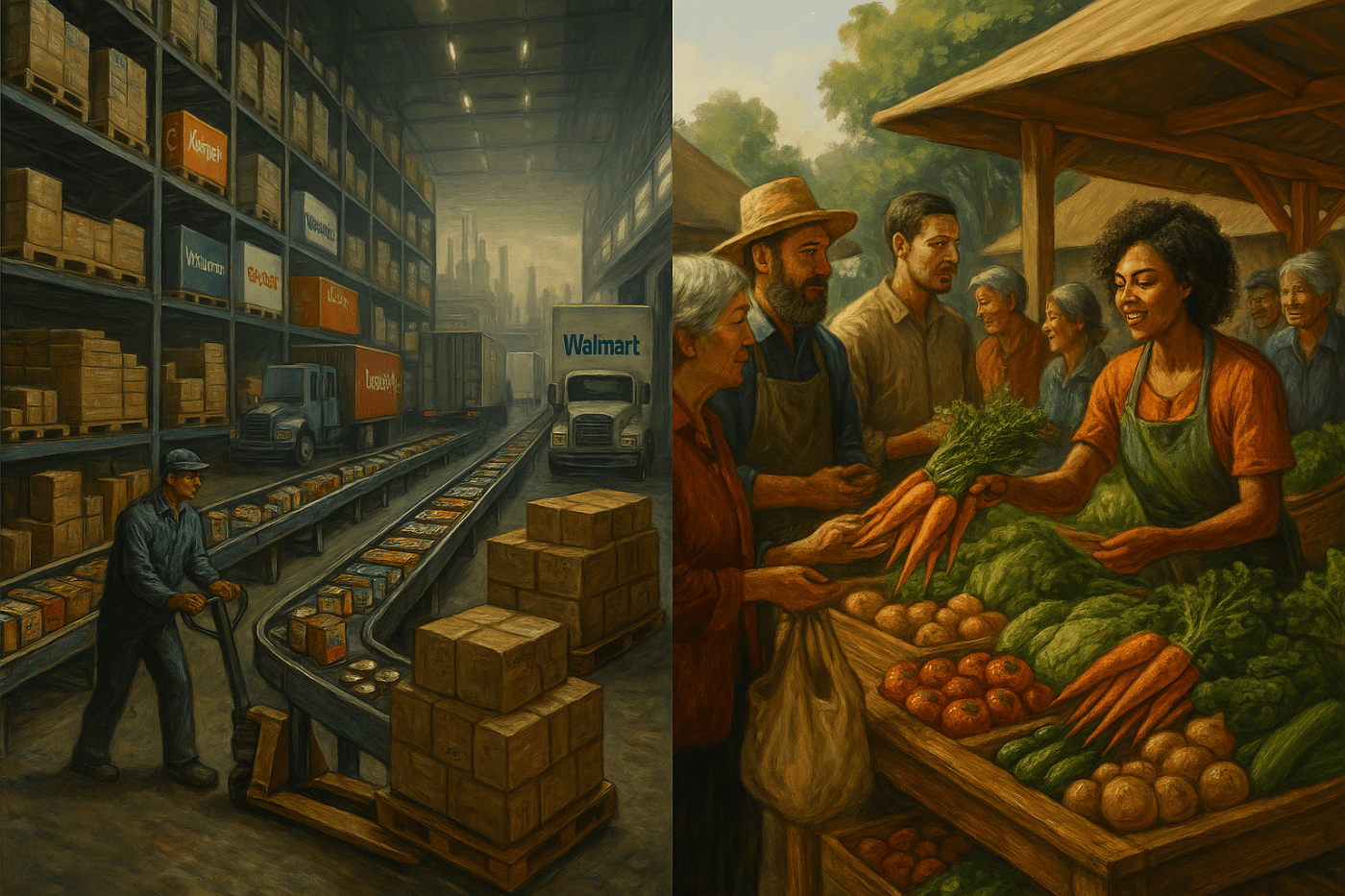
Food is grown by many—but captured, commodified, and profited from by the few. The moment food leaves the field, it enters a machinery not of nourishment, but of accumulation. From packaging and processing to shipping, marketing, and retail, capitalist agriculture doesn’t just produce food—it alienates it. It transforms nourishment into branded product, surplus into scarcity, and labor into market dependency.
In this installment, we analyze the circulation phase of agriculture: how food moves through the global capitalist system, who controls it, and what is destroyed along the way. If production is where life begins, circulation is where it is priced, partitioned, and often wasted. This is not logistics—it is domination by design.
The Imperial Food Circuit
Most agricultural goods do not move locally. They are harvested in the Global South, processed in export zones, packaged in shipping hubs, and distributed to retail centers in the imperial core. This system is defined by:
- Disarticulation: Production is separated from consumption by thousands of miles and dozens of intermediaries.
- Monopoly control: 10 corporations dominate global grain trade, meat processing, and retail logistics (e.g., Cargill, Nestlé, Walmart).
- Rentier infrastructure: Every stage is governed by tolls, packaging contracts, certifications, insurance premiums, and IP rents.
This is not the “free market”—it is a tightly controlled circuit of appropriation and profit extraction. The food is not just moved—it is captured.
Processing: Commodifying the Edible
Before food reaches the plate, it is “value-added” by processing: bleached, cut, injected, preserved, and packaged. This serves several purposes:
- Extends shelf life—necessary for long-distance trade, not nutrition.
- Increases consumer dependency—processed foods require fewer skills and tools to prepare.
- Generates IP and branding potential—turning grains into logos, meals into trademarks.
The result is ultra-processed food: stripped of nutrients, soaked in preservatives, and marketed through psychological warfare. This “food” maximizes profit, not health. It is the dietary wing of technofascism—designed to addict, pacify, and extract.
Packaging and Waste: Labor for the Landfill
Much of the labor poured into food ends in waste:
- Over 30% of all food globally is discarded—often because packaging, shelf aesthetics, or surplus volumes render it unsellable.
- Packaging materials (plastic, cardboard, foil) outnumber edible contents in many processed foods.
- Corporate liability systems prevent surplus food redistribution to hungry populations due to profit and legal concerns.
Meanwhile, 828 million people go hungry each year (FAO, 2023), and billions more suffer malnutrition—not because of scarcity, but because of **capitalist overproduction and market prioritization**. Waste is not accidental. It is built into the system.
Retail: Where Surplus Meets Scarcity
The final stage of circulation is retail—supermarkets, fast food chains, and delivery platforms. Here, the price of food is determined not by its nutritional value or ecological footprint, but by logistics, rent, and speculation.
Supermarkets are not neutral providers. They are **gatekeepers** of food access—selling what is profitable, not what is nourishing. In urban food deserts, especially in the U.S. and parts of the Global South, communities have no access to fresh produce but are surrounded by processed, commodified calories.
Gig-based delivery services (e.g., Instacart, DoorDash) further alienate food by replacing community with convenience, while exploiting riders and undermining local economies.
Finance, Futures, and Hunger as Business
Behind the scenes, the entire circulation system is tied to speculative markets:
- Futures contracts determine global grain prices, often manipulated by hedge funds and agribusiness cartels.
- Commodity indexes allow investors to bet on hunger, scarcity, and droughts—extracting profit from disaster.
- Food crises are used as pretexts for land grabs, humanitarian aid monopolies, and militarized logistics interventions.
Finance capital has turned food into a battlefield. Hunger is not a failure of production—it is the success of capitalist circulation.
The Logistics of Domination
Technofascism expresses itself in logistics:
- QR-coded harvests tracked from seed to shelf by corporate platforms
- Supply chain “optimization” that eliminates informal markets, street vendors, and peasant exchange
- AI-driven pricing and distribution systems that extract rent from every unit of caloric movement
The result is not a more efficient system—it is a more enclosed one. One where food becomes a tool of discipline, rationed by algorithm and enforced through debt, data, and dependency.
Revolutionary Food Circulation: Shorten the Chain, Break the Circuit
The ecosocialist alternative is not just to produce food differently—but to circulate it outside capitalist command. This means:
- Bioregional food systems built on proximity, trust, and reciprocity
- Communal markets and non-monetized food distribution zones
- Worker-owned processing hubs for cooperative preservation and packaging
- Food sovereignty networks that eliminate corporate intermediaries entirely
Just as land must be liberated, so must logistics. Circulation is not neutral—it is political. And it must be seized.
From Circulation to Liberation
Under capitalism, the circulation of food is a mechanism of dispossession, dependency, and control. From harvest to waste, it is structured not for nourishment, but for accumulation. It disciplines producers, fragments communities, and keeps the global poor in a permanent state of nutritional crisis.
To reclaim the future, we must reclaim the flow of food. From field to fork, from seed to stomach, circulation must be reorganized by need—not by price.
>
 Weaponized Information
Leave a comment