By Prince Kapone, Weaponized Information
Inputs Before Food
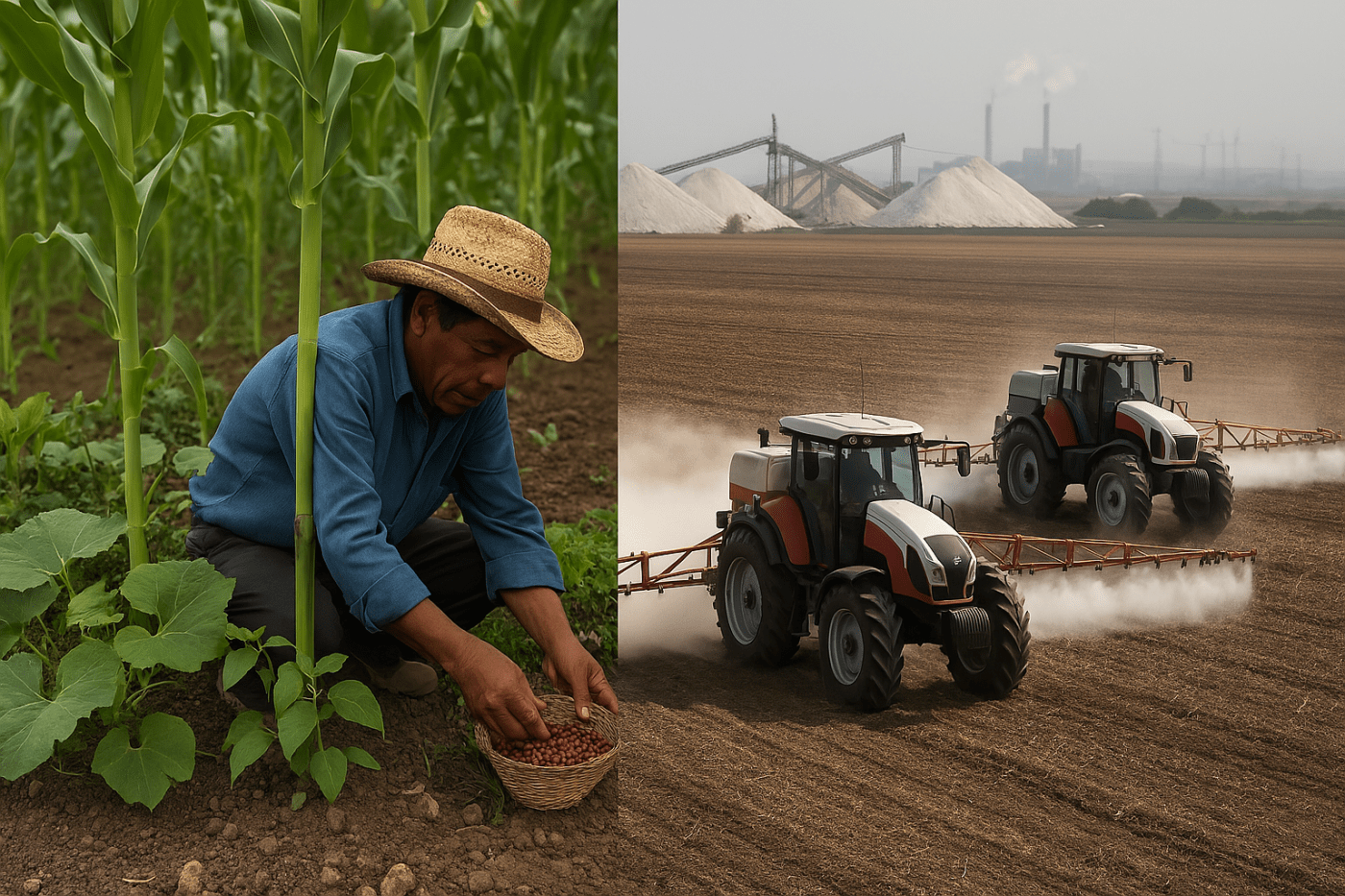
In capitalist agriculture, the growing of food no longer begins with soil or community. It begins with debt, chemical inputs, proprietary software, and fossil-fueled supply chains. The process of life reproduction—what Indigenous societies organized around ecological reciprocity—is today fractured and rerouted through a global supply system governed by monopoly finance capital, fossil energy, and imperial logistics.
The agricultural input supply chain is not a neutral tool. It is a mechanism of domination. From fertilizer and pesticides to hybrid seeds, irrigation infrastructure, and diesel fuel, modern agriculture is hooked on an extractive, fragmented input regime that alienates farmers from the land, undermines ecological knowledge, and reproduces dependency at every level.
Capitalist Inputs and the Law of Dependency
The basic building blocks of agricultural production—what are now called “inputs”—include:
- Nitrogen- and phosphate-based fertilizers
- Chemical herbicides and pesticides
- Genetically modified and hybrid seeds
- Diesel and energy-intensive machinery
- Drip irrigation and water pumping systems
In theory, these inputs increase yields. In reality, they create structural dependency: each season, farmers must re-enter the market to purchase new rounds of inputs, on terms dictated by transnational corporations and local credit systems. The very act of growing food becomes a commercial transaction—conditional, speculative, and debt-bound.
A Global Chain, Not a Local Cycle
Under capitalism, the input system is global, chaotic, and ecologically incoherent. Consider:
- Fertilizers are manufactured using natural gas and mined phosphate—often extracted in politically unstable or colonized regions like Western Sahara or Russia.
- Pesticides are synthesized in corporate labs, patented, and exported to the Global South, where environmental regulations are weak and health impacts severe.
- Hybrid and GMO seeds are developed in industrial gene labs, produced offshore, and locked behind intellectual property regimes (TRIPS, UPOV).
- Diesel and tractors are manufactured in the imperial core, sold at inflated prices, and subject to fuel market volatility and software licensing (see John Deere’s repair bans).
This system is not sustainable—and it’s not supposed to be. It is built to extract: wealth from the land, labor from the peasant, and surplus from the South. It is a logistics system designed by capital to undermine local control and ecological knowledge.
Indigenous Ecologies: Inputs Without Commodities
Before the rise of imperial input regimes, Indigenous agricultural societies developed systems rooted in local ecology, cultural stewardship, and cyclical regeneration. They did not treat inputs as marketable items. They understood them as embedded elements of a relational cosmos. Examples include:
- Milpa systems in Mesoamerica: Corn, beans, and squash grown together created a self-sustaining cycle of nitrogen fixing, soil coverage, and dietary balance—no fertilizer or pesticide needed.
- Andean terrace agriculture: Sophisticated hydrology and crop rotation managed water, nutrients, and temperature without artificial inputs—using gravity and geology as guides.
- Sub-Saharan agroforestry: Baobabs, shea, and legumes provided shade, nutrients, and organic matter through leaf litter, without breaking the soil or extracting external energy.
- North American Indigenous composting: Fish waste, shell, and charcoal were used to regenerate soil and retain moisture—far superior to commercial synthetic fertilizers in sustainability and biodiversity.
These systems were metabolically closed, socially embedded, and culturally transmitted. They didn’t rely on imports. They relied on memory, ceremony, and relationship. And they worked.
Private Ownership, Public Dependence
Today’s farmers, especially in the Global South, are often trapped in input-credit chains. Corporations and banks partner to provide loans for chemical inputs—on the condition that the farmer buys seed from a specific company, sells through a specific intermediary, and repays at harvest. This is the economic logic of indenture—updated for the neoliberal era.
Even where inputs are subsidized by the state (as in India or Ghana), they are typically sourced from private monopolies like Bayer, Syngenta, or Yara. Governments play middleman, not sovereign actor.
The result: farmers bear the ecological risk, the financial burden, and the debt. The corporation bears only the profit.
Technofascist Management of Inputs
Today’s input systems are increasingly managed not by the farmer but by algorithm. This is the next phase of technofascism in agriculture:
- Satellite surveillance tracks soil conditions and water use
- AI-driven apps “recommend” fertilizer quantities and pesticide timing
- Credit scores and blockchain titling systems determine who gets access to seed or insurance
- Private digital platforms enforce compliance with contracts, creating smart supply chains that criminalize autonomy
Farmers are no longer growers. They are data points—managed, monitored, and monetized. Even the decision to plant becomes a function of a digital recommendation engine run by corporations like Corteva or Cargill.
Ecological Crisis Built Into the Input System
The ecological cost of this regime is staggering:
- 80% of global nitrogen runoff comes from synthetic fertilizer overuse—killing rivers and oceans.
- Pesticide drift poisons pollinators and causes birth defects and cancers in rural communities.
- Seed dependency eliminates biodiversity, making food systems vulnerable to disease and climate shocks.
- Diesel-based mechanization fuels emissions and displaces millions of landless laborers.
This is not agriculture. It is industrial death masquerading as food production.
Revolutionary Alternatives: Input Sovereignty
The alternative is not to localize the same toxic model—it is to abolish the private input system entirely. This means:
- Reclaiming organic soil fertility through composting, crop rotation, cover crops, and agroforestry
- Restoring Indigenous knowledge systems of pest management, water cycling, and seed selection
- Creating cooperative, publicly owned production of compost, tools, and seed through community land trusts and agroecological hubs
- Ending reliance on global supply chains and reconnecting inputs to bioregional ecological cycles
This is input sovereignty. It is not backward—it is revolutionary. It is not pre-modern—it is post-imperialist.
You Can’t Farm Liberation on Borrowed Inputs
Until farmers control the means of fertility, pest resistance, and hydration, they will remain dependent. Until soil nutrients are restored through collective labor, not corporate supply chains, agriculture will remain extractive. Until input sovereignty is reclaimed, food sovereignty will remain a dream.
To abolish capitalist agriculture, we must abolish the input regime. To restore food and land to the people, we must start with the materials that make life grow—and take them out of the hands of empire.
 Weaponized Information
Leave a comment