By Prince Kapone, Weaponized Information
Capitalism Makes Space
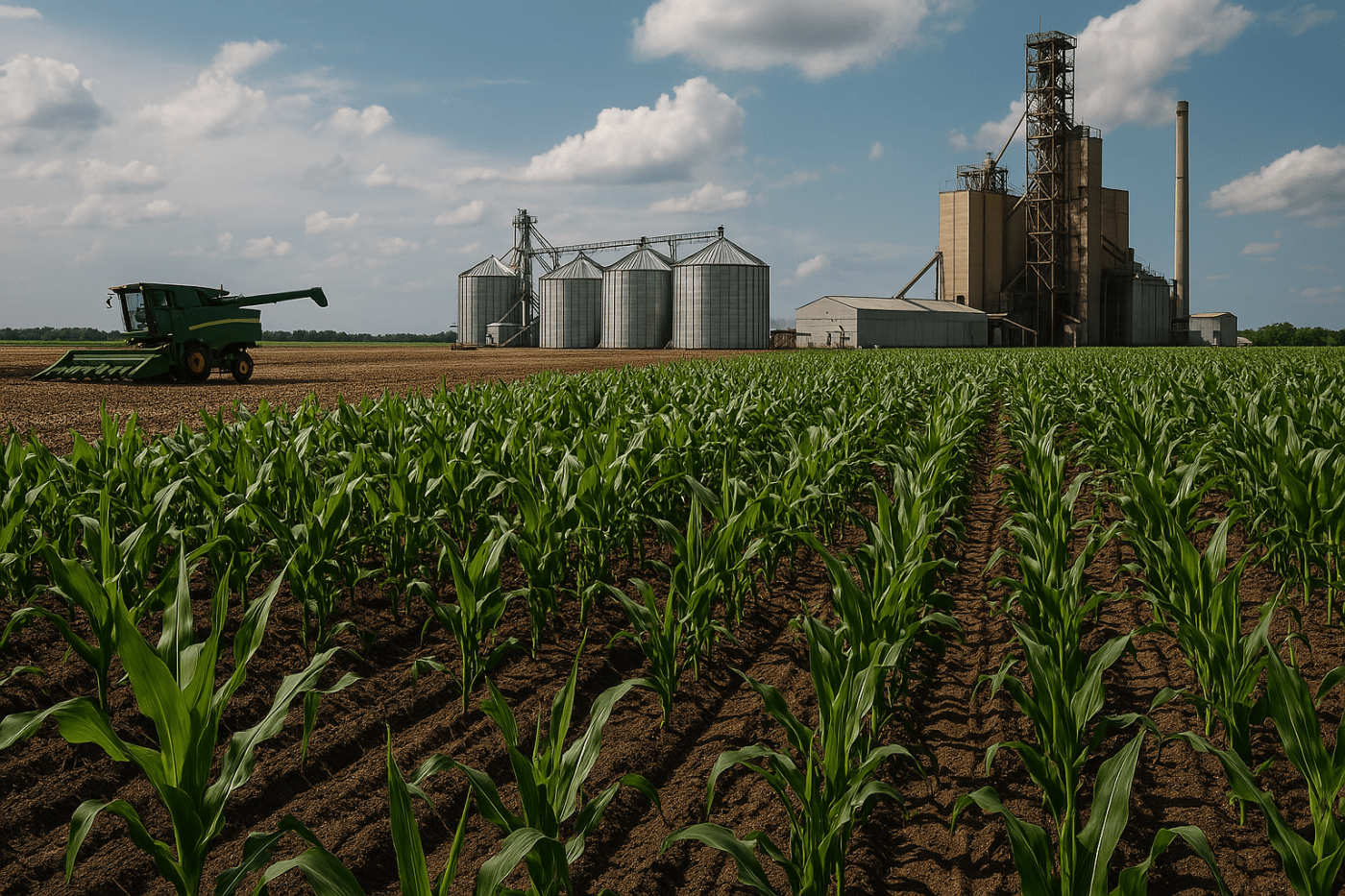
Capitalism is not only a mode of production—it is a mode of spatial organization. Just as the seed is commodified to control life at its origin, the farm is restructured to extract surplus at industrial scale. What was once a diverse, relational space of stewardship becomes a standardized, mechanized apparatus for profit: the industrial farm.
This installment examines the industrial farm as a historically produced landscape—shaped not by necessity, but by capital. It is a site where land, labor, seed, water, and machinery are violently integrated into the metabolic logic of accumulation. And it is where the contradictions of imperial agriculture are most visible: in soil collapse, rural dispossession, food waste, and the alienation of producers from their own survival.
The Rise of the Industrial Farm: Historical Genesis
The industrial farm did not arise organically. It was forged through state violence, colonial land theft, racialized labor regimes, and technocratic reform. Its evolution tracks with the development of capitalist agriculture itself:
- 16th–19th century: Plantation agriculture under European empire—monoculture and slave labor as the global norm.
- Late 19th century: Mechanization and land concentration accelerate under settler colonialism (e.g., U.S. Homestead Acts, South African Boers, Argentina’s pampas).
- 20th century: Green Revolution exports industrial farming model to the Global South—combining hybrid seeds, chemical inputs, and World Bank-backed land reforms.
- 21st century: Digital integration through precision agriculture, AI-managed irrigation, drone surveillance, and carbon-offset farming—dominated by finance capital and agribusiness.
The Logic of the Industrial Farm
Every feature of the industrial farm reflects the imperatives of capital:
- Scale: Bigger is better. Efficiency means expansion—through consolidation, mechanization, and debt-fueled growth.
- Uniformity: Monocultures eliminate complexity to simplify input-output cycles. Diversity becomes inefficiency.
- Surveillance: Data replaces ecological knowledge. Farmers are tracked, ranked, and nudged through algorithms, credit scores, and compliance protocols.
- Labor alienation: Human labor is minimized, deskilled, or replaced entirely. Those who remain are marginalized, criminalized, or precarized.
The farm becomes a factory in the field—or more accurately, a speculative asset controlled by hedge funds, vertically integrated into commodity markets, and governed by remote capital in New York, Zurich, or Beijing.
Finance Capital and the Land Commodity
As capital over-accumulates and real profits stagnate, finance turns to land—especially farmland—as a “safe asset.” Over the past two decades, land has become a central site of financial speculation:
- In the U.S., over 40% of farmland is rented—much of it owned by institutional investors like BlackRock, Hancock, and UBS.
- In Africa, more than 80 million hectares have been seized through “land grabs” by states, corporations, and private equity since 2000.
- Food, labor, and land are bundled into investment portfolios—hedged with crop insurance, securitized through farmland REITs, and indexed on global futures exchanges.
This is the financialization of the farm—where soil becomes spreadsheet, and hunger becomes a market opportunity.
The Ecological Consequences of Spatialized Capital
Wherever the industrial farm model spreads, it leaves ecological devastation in its wake:
- Soil degradation: One-third of the world’s soil is already severely eroded due to intensive tillage, fertilizers, and chemical inputs.
- Water exhaustion: Industrial irrigation systems, designed for export crops, drain aquifers and rivers (see: Punjab, California’s Central Valley).
- Dead zones: Fertilizer runoff from large-scale corn and soy farms in the U.S. Midwest creates massive oxygen-depleted areas in coastal waters.
- Biodiversity loss: Global pollinator decline is directly linked to pesticides and habitat fragmentation driven by industrial farming.
The capitalist farm is ecologically suicidal—not because of ignorance, but because it is structurally incapable of producing life without destroying it.
Spatial Counterinsurgency and the Militarized Farm
As peasant, Indigenous, and ecological movements challenge the industrial model, the state responds not with reform but repression:
- Drone surveillance of land defenders (e.g., Brazil, Palestine, India)
- Militarized eviction of small farmers in favor of agri-export plantations
- Data harvesting through satellite imagery and blockchain titling to facilitate digital enclosures
The farm becomes a battlefield—not just of production, but of sovereignty, memory, and survival.
Conclusion: Beyond the Factory-Farm Complex
To challenge capitalist agriculture, we must confront not only who owns the land, but how the land is spatially configured. The industrial farm is not an accident—it is a territorial strategy of capital in crisis, fused with finance, logistics, surveillance, and empire.
The antidote is not a smaller farm—but a different logic: the agroecological commune, the Indigenous territory, the peasant cooperative federation. These are not nostalgic forms. They are insurgent spaces of reproduction, resistance, and renewal.
In the next chapter, we will explore the return of the peasant—not as a vanishing relic, but as a revolutionary subject—rooted in land, organized in collectives, and fighting to reclaim the future.
 Weaponized Information
Leave a comment